Company Relocation in the Eastern Province: Running an Organisation Move Across Departments, Assets and Archives
When a company moves, rather than a small office, the scale of decision changes. There are several departments, each head wanting to keep working without a stop, assets recorded in the accounts that must not go missing, a confidential archive, information systems, a lease ending on a fixed date and senior management wanting to know the schedule, the risks and the cost. In the Eastern Province, where businesses operate in Khobar, Dammam, Dhahran and Jubail and across business parks and industrial areas, the move becomes a project that needs managing. This page offers a practical method for a corporate relocation: how to split it into phases, what an asset register is, how to handle systems and archives, who coordinates with whom, how to manage risk and what to send us so we can estimate our part.
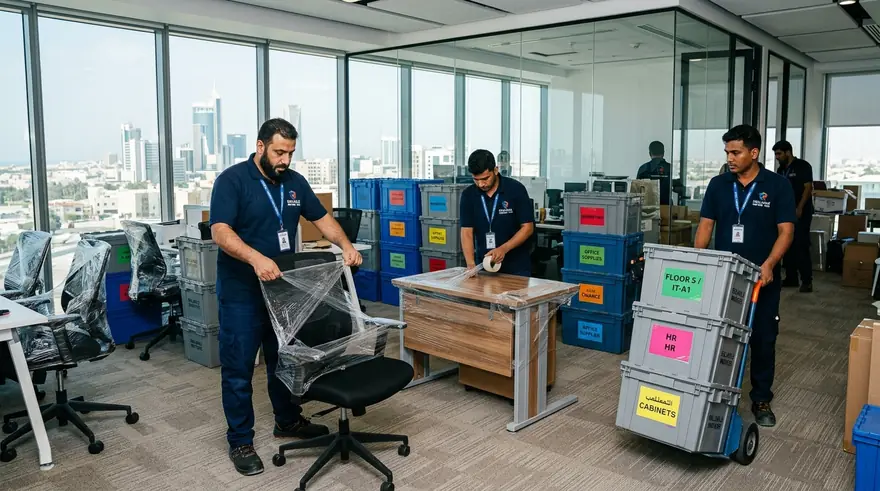
What is different between moving an office and moving a company?
A small office can move over one weekend with a simple plan. A company move spans several teams, departments and floors, and involves elements that are not the movers business alone: systems and telecoms, HR, legal, finance and facilities management. That is why a relocation does not succeed by hiring more labourers but by being clear about who decides what and when.
We focus here on what matters to those searching for company moving: splitting the project into phases, organising assets, protecting the archive and coordinating the parties. If you are moving a small office, our office moving page is the better fit.
Who takes part in a company relocation?
Many parties are the source of complexity, and clear roles are the cure.
| Party | Role | What it needs from others |
|---|---|---|
| Project management | Decisions, schedule and budget | Task lists and dates from every department |
| Department heads | Preparing their departments and setting priorities | The new floor plan and their move date |
| IT | Network, servers and devices | Early access to the new building |
| Finance and assets | Asset register and insurance | Lists of what will move and what will be disposed of |
| Building management | Lifts, permits and parking | Dates and crew details |
| The moving company | Wrapping, dismantling, moving and assembly | The plan, numbers and asset lists |
Keep the weekly meeting between these parties short and specific; it is the cheapest way to prevent surprises.
Six phases of an organisation move
What is done in the early phases decides how smooth the last ones are.
Assessment and planning
Count departments, assets, archive and systems, identify risks and draft a schedule and a budget estimate.
Design the new premises
A plan of departments, workstations, meeting rooms and stores with a number for each location, agreed with the building.
Asset register and sorting
A list of every asset with a number, current and new location and a decision to move, sell or dispose.
Preparation and wrapping
Each department prepares its desks and archive by written instruction, with non-critical teams first.
Phased moves
One department or floor per wave, arranged so no essential department is down longer than necessary.
Post-move review
An inspection and handover walk, handling of notes, closing the asset register and returning the old premises.
The asset register: a document that protects the company and the mover
The most important paper in a company move is the asset list: every desk, chair, device, safe, printer and monitor, each with a number, a photo, a current location and a new location. This list prevents items from going missing, protects the company at audit and makes it easy at delivery to confirm everything that left arrived. It also reveals already-damaged items before the move so the move is not blamed.
Each asset should carry its internal number and be checked at loading and at unloading. One copy of the list stays with the asset officer and another with the crew coordinator. If an item goes missing, the moment it went missing is known rather than remaining a mystery.
Systems and communications: who handles what?
The technical side is not the movers business alone, yet it controls when work resumes.
Network and internet
The IT team or provider prepares the new premises before furniture arrives and tests connectivity.
Servers and technical rooms
Moved only under specialist supervision, with a backup plan, testing and a clear schedule; not left to ordinary moving labour.
Phones and the switchboard
Lines are diverted and tested before the move, and number transfers coordinated with the provider.
Computers and printers
Moved numbered, wrapped and tied to user names so they work the moment they are connected.
Security and access
Gates, cards and cameras need coordination with the building and their suppliers.
Licences and official addresses
Update the address with authorities, registers and websites before and after the move.
Archive and confidentiality: what to do with sensitive papers
A company archive holds contracts, financial records and employee files that must not reach unauthorised hands. So it is decided who supervises each box, contents are logged, boxes are closed with seals or tape that reveal any opening, and the critical ones travel in a separate vehicle or with an escort. Boxes are not left in open corridors or public areas of the building.
Do not decide the fate of old archive on your own. Some documents must be kept for set periods depending on their nature and the rules of the bodies your company deals with, so consult your legal department before destroying anything. If you need a place to keep archive temporarily, ask us to confirm availability of a storage arrangement for your request.
Moving in waves: how to decide which department goes first
Moving an entire company in one weekend is possible for small firms, but larger organisations usually move in waves. The order of waves is a management decision: begin with support departments least tied to customers and leave the ones that cannot stop, such as customer service, sales and finance at month end, until later. Related departments should go in the same wave so teams that work together are not split.
One simple rule helps in every wave: a department does not leave its old premises until its new place is ready and the network verified. That makes a week of moving less risky than one rushed day.
Managing risk: what could slip and what do we do?
A good project lists what might go wrong before it does: a delay in fitting out the new premises, internet activation delays, the building refusing a move date, pieces that will not pass a door, staff who have not prepared their desks or a minor accident that damages an item. Each risk gets a fallback: a backup date, a support team, temporary remote working.
On liability for damage or loss, ask that the written quote states what it covers and what it does not; we make no promises here that we cannot prove. Most important is to document the condition of assets before and after with photos and lists.
An illustrative schedule for a mid-sized company
This is illustrative to show the sequence; it does not mean any set duration suits every company.
| Phase | What happens | Who is responsible |
|---|---|---|
| Weeks before | Asset count, floor plan, approvals, building booking | Project manager and facilities |
| Days before | Archive wrapped and desks prepared, new network ready | Departments and IT |
| Move day | Dismantling, loading, transport and assembly | Moving crew and coordinator |
| Immediately after | Testing network and devices, support on hand | IT and coordinator |
| Days after | Handling notes and returning the old premises | Project manager |
Fix the real schedule with your parties and adjust it for premises size, number of departments and the nature of the work.
Before the move: what is not worth moving?
A relocation is an opportunity to clean up assets: damaged furniture, broken devices, files no longer needed and storerooms full of forgotten items. Every piece moved costs wrapping, carrying and assembly and takes space in the new premises. It is best for a small committee to run sorting by written criteria: condition, value and need.
What is sold, donated or scrapped needs approvals under company policy, so obtain them before the date. Record every decision in the asset register so the count does not disagree later.
What about heavy equipment and warehouses?
Some companies have warehouses, workshops and heavy equipment. This page covers moving administrative premises, offices and related assets; moving heavy industrial machinery, large racking and systems that need cranes or special permits requires a separate assessment, and we promise nothing here that we have not confirmed.
If your project includes such equipment, tell us its type, weight and dimensions so we can confirm whether it is within what we arrange, instead of finding out on the day. Hazardous or restricted materials have their own rules.
What factors decide the cost of a company move?
We publish no figures because every company differs, but the factors are clear: the number of offices, workstations and assets, the archive volume, the number of floors and lifts, the distance between sites, the number of waves, the crew time, whether wrapping, dismantling and reassembly are wanted, work outside office hours and any coordination with technicians.
The more clearly phases and numbers are laid out in the request, the more accurate the quote. Ask for a written quote that itemises each element, compare quotes on the same line items and watch for what may be charged outside the quote such as storage and extra wrapping.
After the move: handover, review and lessons
After departments are working in the new premises two tasks remain: handing the old premises back to the owner with a photographed report as the lease requires, and reviewing the asset register to close it after checking every item. In this review, notes are recorded: missing or damaged items, assembly problems and obstacles found.
Then hold a short meeting to draw lessons: what worked, and what should have started sooner? This summary helps if the company moves again or opens a branch, and feeds into improving continuity and contingency plans.
What should you send us so we can estimate our role in your move?
Send the city and rough addresses of both buildings, the number of floors, departments and workstations, the archive volume, the nature of any special assets, the end date of the old lease, building management conditions and whether you prefer waves or a single move. It is best to have a project manager who speaks for the company.
Then contact us on WhatsApp or by phone, and we will arrange a visit or a photo walkthrough and give you a written quote that sets out what it covers.
Frequently asked questions about company moves
Answers to what management teams ask most before relocating.
Do we move the whole company in one day?
Who moves the servers?
What is an asset register?
How do we protect a confidential archive?
Do you move heavy industrial equipment?
Can the move happen outside working hours?
Who decides what happens to old archive?
What helps you give an accurate quote?
Pages related to company moves
Guides and services that help you plan the relocation.
Office moving
Workstations, files and the lift
Office and company moving service
The general service page
Office moving in Dammam
Details for offices in Dammam
Large truck moving
For offices and long routes
Moving timeline
When each stage should start
The moving-day crew
Roles and safety
Furniture storage warehouses
For archive and surplus furniture
Compare moving quotes
How to compare line items
Request a written quote
Send your move details
Furniture crane lift
Furniture crane lift in the Eastern Province: how the lifting site is assessed first, with a checklist covering street, cables, ground and…
Door to door moving
Door to door furniture moving in the Eastern Province: the stages from inspecting your home to placing pieces in the rooms of your new one, what…
Office movers
How to plan an office move with little downtime.
Office Furniture Moving
Desks, chairs, cabinets and partitions with numbering and a map.
Warehouse Moving
Stock count, racking and phased relocation.
Is your company moving to new premises?
Send us the number of departments, floors and both addresses on WhatsApp or call us, and we will arrange a corporate relocation plan with a written quote in the Eastern Province.