Movers and Packers in the Eastern Province: Who Turns Up on Moving Day and What Each Person Does
Behind the phrase movers and packers is a crew with divided work: a supervisor who coordinates, packers, loaders, a carpenter who takes apart and rebuilds, and a closed truck waiting outside. Here we explain how those roles run on moving day, what each person does and what we expect from you.
What does a crew of movers actually do on moving day?
When you call movers and packers in the Eastern Province you usually hear a simple line: we will send a truck and workers. But the gap between a calm move and an exhausting one is often in details that are never mentioned on the first call. How many workers? Who supervises them? Who wraps, who carries and who takes the furniture apart? And in what order is the home loaded into the truck?
We wrote this page so you know before booking how the day is run from the inside, and so you can ask any company, including us, to explain the roles of its crew. We do not give fixed worker numbers here, because the number changes with the home, the floor and the pieces, but we explain the logic behind our estimate.
Who is in the crew and what do they do?
In small moves one person may combine several roles, but dividing the work is essential on larger moves.
Crew supervisor
Talks with you, reviews the plan on arrival, assigns rooms to workers, settles questions on site and reviews pieces with you before closing.
Packers
Wrap pieces in suitable layers, prepare cartons, number items and protect corners and surfaces before any lifting.
Loaders
Move pieces from rooms to the truck once wrapped and arrange them in the right sequence inside the closed body.
Carpenter
Takes apart bedrooms, wardrobes and sectional pieces, keeps screws in numbered bags, then rebuilds them at the new place. See furniture assembly.
Truck driver
Drives the closed truck with care, helps secure the load and agrees with the supervisor on the arrival route and parking spot.
The main tasks of the day and who handles them
This is a general table to explain the sequence of work. The split may differ with crew size.
| Task | Who does it | Materials or tools |
|---|---|---|
| Reviewing the plan and inventory | Supervisor with the customer | Inventory list and photos |
| Wrapping furniture and guarding corners | Packers | Thick blue stretch film, bubble wrap and ink-free paper |
| Packing small items | Packers | Numbered cartons, tape and marker pens |
| Taking apart wardrobes and bedrooms | Carpenter | Disassembly tools and numbered screw bags |
| Carrying pieces to the truck | Loaders | Protective covers and suitable gear for heavy pieces |
| Arranging and securing the load | Supervisor, driver and loaders | Closed truck, securing materials and protective dividers |
| Unloading and reassembly | Loaders and carpenter | Keys, screw bags and numbered lists |
The order of work from crew arrival to departure
Every stage has a time and a purpose, and keeping to the sequence prevents chaos.
Arrival and introductions
The crew arrives, the supervisor introduces himself and goes over the plan, the large and delicate pieces and the first rooms with you.
Preparing the carrying route
Floors and entrances are covered where needed, doors are opened and a collection point for cartons is chosen near the exit.
Packing and disassembly
The two tasks run in parallel: the packers wrap furniture while the carpenter takes apart what is needed.
Orderly loading
Heavy items go first, then lighter ones, with each piece firmly secured.
Room-by-room check
The supervisor walks through the empty rooms with you and opens wardrobes and drawers to make sure they are clear.
Departure and coordination
The truck sets off with the receiver told the arrival time, and contact stays direct with the supervisor.
Unloading and reassembly
Pieces go to their set places, taken-apart pieces are rebuilt and doors and runners are tested.
Review and departure
Pieces are matched against the inventory, any note is written down and the crew leaves once the truck is confirmed empty.
How a home is arranged inside a closed truck
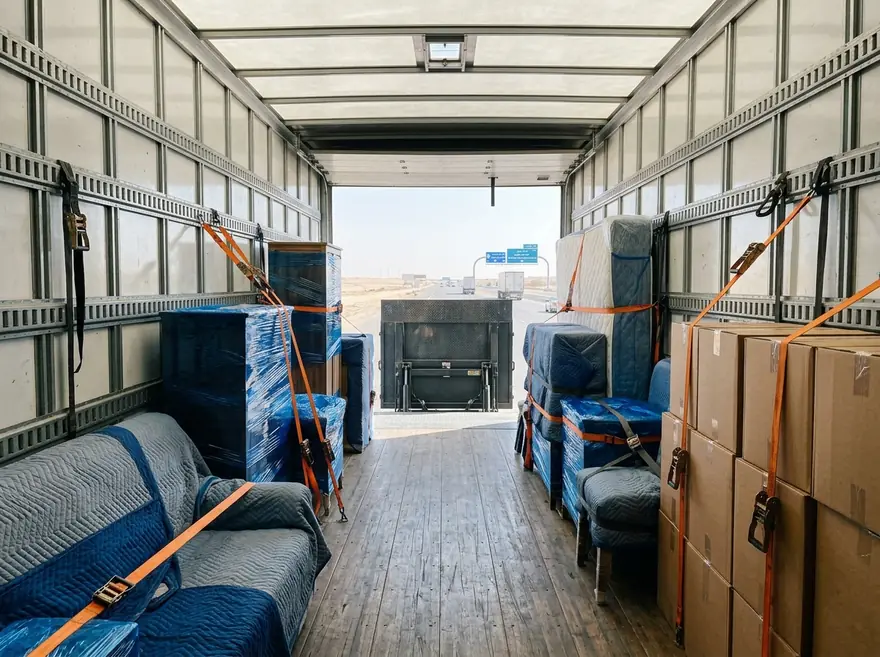
Arranging the load is like building a wall: it starts from a heavy base and rises toward the lighter. Fridges, washing machines, heavy cabinets and book boxes go in first beside the truck wall, then the taken-apart wardrobes and mattresses, and at the top the light cartons, pillows and covers that fill gaps.
Fragile pieces such as mirrors, paintings and glass are loaded after the heaviest items and put where nothing presses on them, standing upright and secured between two sturdy pieces. We also think about the unloading order before the loading order, so the essentials you need first are placed near the front.
- Heaviest at the bottom and near the truck wall.
- Mattresses and covers fill gaps and protect the sides.
- Glass and mirrors stand upright and secured between sturdy pieces.
- Light cartons on top and numbered for quick unloading.
- Whatever you need on the first night goes on last and comes off first.
Safety while lifting: what protects the crew and your furniture?
Correct lifting is not just strength but technique. A trained worker learns to bend the knees rather than the back, to hold the piece close to the body and to speak clearly with a partner on stairs and tight corners. Heavy pieces are shared between several people rather than one person trying to carry them.
On stairs and in lifts we decide in advance who leads, who follows and who guides from behind, and we stop at any stumble rather than gamble. This protects your floors, walls and furniture, and the safety of the crew, and lowers the chance of injury and damage.
- Sharing heavy pieces between more than one worker.
- Agreeing who guides at corners and stairs.
- No rushing at turns and narrow doors.
- Covering floors and walls where needed.
- Keeping children away from the carrying route.
What do we expect from you on moving day?
Cooperation saves the crew time and cuts mistakes.
A responsible person present
It is best to have someone at each location who can make a quick decision and direct where pieces go.
Clear entrances and the lift
Make access available, reserve the lift with management and prepare a place for the truck.
Set personal items apart
Keep valuables, documents and medicine somewhere you will carry them, not among the furniture.
Mark what is not moving
Put a clear label on it and tell the supervisor when he arrives.
Provide basics
Drinking water and access to a bathroom for the crew helps work continue without long breaks.
Settle questions quickly
The crew may ask where to put a piece, and a quick answer prevents stoppages.
What happens if conditions change on the day?
No moving day is free of surprises: a broken lift, a taken parking spot, wind and dust that make work harder, or extra items that appear at the last minute. A good crew is not surprised by the surprise; it tells you as soon as it happens and suggests a practical fix.
In most cases the fix is changing the sequence: we carry what can be carried from the ground floor first, or postpone big pieces until the lift is free, or use another route for the truck. The more you told us in advance about site limits, the fewer surprises you meet.
- Broken lift: re-plan the route and start with what can be carried by stairs.
- Parking taken: coordinate with management or change the stopping point.
- Extra items: tell the supervisor at once so load and time can be adjusted.
- Weather: postpone some stages or strengthen protection for pieces.
Signs of a good crew in the first half hour
You can learn a lot about a moving crew in the first few minutes. An organised crew arrives with visible tools and materials, introduces itself, asks about the rooms and delicate pieces before starting, and protects entrances and floors. A confused crew starts carrying without asking and moves between rooms with no plan.
If you notice something you do not like, speak calmly to the supervisor straight away. Correcting course in the first hour is far easier than discovering the problem at the back of the truck.
- A known supervisor who communicates clearly.
- Packing materials ready and sufficient.
- Protection for floors and entrances where needed.
- Questions about delicate pieces before loading starts.
- Numbering for cartons and for taken-apart pieces.
Frequently asked questions about the moving crew
Short answers to what customers ask before booking.
How many workers will come to move my home?
Is there a supervisor with the crew?
Who takes apart and rebuilds furniture?
Can I choose the workers?
What if I need extra workers on the day?
Does the crew handle appliances and screens?
What should I provide for the crew on the day?
How do I reach the supervisor on moving day?
Pages that complete the picture
Read more about how we work.
How moving works step by step
Stages from first contact to handover
Closed moving trucks
Truck types and how the load is arranged
Furniture assembly
Carpenters who take pieces apart and rebuild them
Multi-layer packing system
Protecting each material with suitable layers
Furniture protection during moving
How we prepare furniture before it moves
Moving company in the Eastern Province
Our services and coverage in detail
Pre-move home checklist
What to do before moving day
Request a moving quote
Ask for a written quote
Want to know the crew and timing for your move?
Send us your home details and we will arrange the crew size and date with you and give you a written quote.