Office Movers in the Eastern Province: How to Choose and Plan a Move With Minimal Downtime
If you manage an office in Dammam, Khobar, Dhahran, Jubail or Al-Ahsa, you already know that a move is not really about furniture. It is about whether your team can sit down on the first working day and carry on. Whether you are a small branch, a startup, a clinic or a regional office of an international company, the same questions decide how smooth the move goes: who coordinates, what the building allows, how the IT equipment travels, and what is written down before anyone lifts a desk. This guide walks through those questions in plain terms.
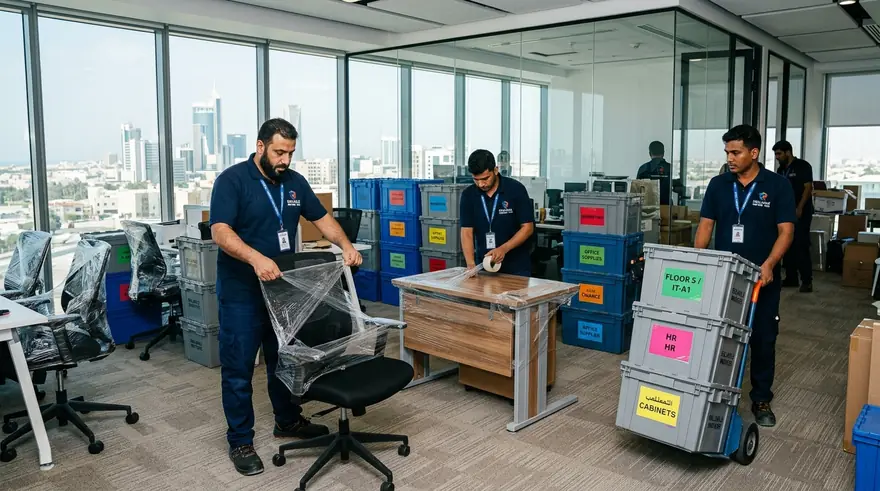
Why is an office move different from a home move?
A home move transfers belongings. An office move transfers a working system: computers, networks, printers, confidential files, safes and furniture laid out around how people work together. If one piece arrives in the wrong place, someone cannot work.
That is why a good office relocation needs more coordination than a household one. You will usually deal with management, the IT lead, the building administration at both addresses and sometimes your internet provider. A capable mover asks about these parties before talking about price.
What should you write down before requesting quotes?
A clear brief saves everyone time. Note roughly how many staff you have, how many rooms or departments, which floors you are moving from and to, and whether there is a service lift. Describe the furniture: modular desks, fixed partitions, meeting-room tables, safes, filing cabinets.
Add your preferred date, whether a weekend or after-hours move is possible, and any sensitive items such as servers or large printers. Photos of each area help more than long descriptions, and they let a provider avoid guessing.
When is the best time to move an office?
For most offices the least disruptive window is the end of the week or after closing time, when staff are away and building access is easier. In some buildings, though, lifts are restricted at certain hours or must be booked, so the building rules may decide the timing for you.
Ask whether the provider can stage the move: archive and storage items first, furniture next, daily-use equipment last. A phased plan lets the team return to work faster and reduces the pressure of a single long night.
From decision to first working day: six steps
Adjust this sequence to the size of your office.
Appoint one coordinator
Choose a single person to make daily decisions and speak to the mover, so the team does not receive conflicting instructions.
Draw a simple floor plan
Mark where each desk and department will sit in the new space and give every location a number. This lets the crew place items without asking.
Label everything
Put a label on each box and item showing the department and destination number. A colour for each department makes unloading faster.
Prepare IT with your IT lead
Back up data, photograph cable connections before unplugging, and plan servers and network gear as a separate, more careful movement.
Clear out what you do not need
Sort old files and damaged furniture beforehand. Moving items you will discard only adds volume and cost.
Move, then verify
Check items against the inventory as they are unloaded, then confirm computers, internet and phones work before staff return.
How do you move computers and networks without losing data?
Disconnecting and reconnecting equipment is the most sensitive stage. Ask your IT lead to take backups of important data before any move rather than assuming the transport will go well. Photograph the back of each workstation before unplugging and label each cable.
Servers and network devices should travel wrapped, secured and ideally with someone from IT present. Monitors and large printers need dedicated protection. Ask the mover about its real experience with such equipment instead of assuming it.
What about confidential files and paper archives?
Many offices keep contracts or client records on paper. For these, set up a security routine: closed numbered boxes, a content list for each box, and a named person who receives them on arrival. Never leave them unattended during loading or unloading.
Ask how the crew handles confidential material and whether they commit not to open boxes. For truly sensitive documents, the safest approach is often to carry them yourself or with a trusted employee.
Questions to ask any office relocation company
Use this as a checklist and write down the answers before you decide.
| Topic | Question |
|---|---|
| Experience | Have you handled office moves before, how large was the biggest, and how do you treat IT equipment and safes? |
| Packing | What do you pack, are materials included, and how do you protect monitors and glass furniture? |
| Dismantling | Does your crew dismantle and reassemble desks and meeting-room tables on site? |
| Timing | Do you work after hours and on weekends, and how many movers will the job need? |
| Building rules | What permits or lift bookings are needed, and who arranges them? |
| Liability | What happens if an item is damaged, and is any coverage confirmed in writing? |
| Inventory | Do you record items before and after the move, and how are shortages or damage logged? |
Ask for the key answers in writing. A phrase such as "do not worry" is not a commitment, and a serious provider is comfortable listing what is and is not included.
Why contact building administration early?
Many commercial buildings set conditions for moving: fixed hours, lift bookings, a separate service entrance, floor and wall protection and sometimes a fee or permit. Missing these can delay you on the day itself.
Contact the administration at both addresses before agreeing a date, ask for the conditions in writing and pass them to your mover so the plan is built around them. This is one of the most forgotten steps and often the source of the biggest surprises.
How are modular and heavy office furniture items handled?
Modular desks, attached cabinets, meeting chairs and boardroom tables need orderly dismantling and edge protection. Keep screws and small parts in numbered bags fixed to the matching piece; lost hardware is the usual cause of delays at reassembly.
Safes and heavy cabinets need enough crew, proper handling equipment and a prepared route. Do not assume everything passes through the same door; measure entrances, corridors and lifts before the day.
How do needs differ between a small office and a large site?
The basics are the same, but planning depth changes.
Small office
Often done in a day with a small crew. A simple inventory and basic floor plan are usually enough, plus careful IT preparation.
Mid-size office
Needs a written schedule, zones, coordination with building management and sometimes more than one work period.
Multi-floor site
Needs a move coordinator, a crew per floor, a phased approach and a clear IT and archive plan.
Clinic or lab
Sensitive equipment may not tolerate vibration or heat, so agree handling with the equipment specialist before you book.
How do you keep staff informed during the move?
Announce the date early and ask each employee to pack personal belongings and clear their desk before the day. Staff who know what is expected save the crew a lot of time.
Send a short note with the new address, directions, start time and who will greet the crew on arrival. This simple step reduces crowding and confusion on the first day.
What changes between Dammam, Khobar, Jubail and Al-Ahsa?
Buildings and distances differ. Dammam and Khobar have many commercial towers with limited lifts and strict entry rules; Jubail has business complexes that may follow larger operator policies; Al-Ahsa tends to have more spread-out buildings with easier parking. State your exact location when you ask.
A move between two cities inside the region needs travel time and return time included, and the crew should arrive before your staff. Tell the provider both addresses and any access limits at the new site.
What drives the cost of an office move?
We do not list fixed figures here because every office is different. The main factors are furniture and equipment volume, floors and lift access, distance between locations, the need for packing and dismantling, timing and crew size.
Compare quotes by what they include, not only the number. A cheaper quote may leave out packing, assembly or a time window. Ask for clearly itemised scope so you compare like with like.
Common mistakes in office relocations
The most common are fixing a date before checking building rules, skipping data backups, leaving sorting of old files for moving day, and having no floor plan for the new space, so items are placed at random.
Another is relying on a verbal agreement. Get the scope, timing and what happens in case of delay or damage in writing before confirming any booking.
What should you do on arrival?
Before the crew brings furniture in, check the space: cleanliness, power, network readiness and the positions on your plan. Then bring items in the agreed order and tick them off the inventory.
Once unloaded, switch on equipment, test internet, printers and phones, and photograph any damage or shortage the same day, informing the provider immediately. Quick documentation makes any issue easier to resolve.
What this page does not claim
We make no promises about specific dates or outcomes and do not quote figures we cannot confirm. This is a practical guide; the real details are confirmed once we know your location and the size of your office.
If you want to know what can be arranged for your case, send the information listed in the brief section and we will confirm what is available and under what terms.
How to choose with confidence
Prefer the provider who asks more than it promises, writes down what is agreed and shows care for building rules, IT and archives. Those are signs it treats an office as a working system, not just furniture.
If you are unsure about the scale of the move, start with clear photos or a short visit. That is a far better basis for an accurate estimate than a general description.
Frequently asked questions about office movers
Short answers to what people ask before moving an office.
Do you move offices within the Eastern Province?
Can the move take place after hours or on weekends?
Do you dismantle and reassemble desks and meeting-room tables?
How do I protect my IT data?
What about confidential files?
What determines the cost?
How long does an office move take?
Do I need building permission?
Related reading
Topics close to office relocation.
Office moving in the Eastern Province
An overview of the service.
Company relocation
Moves for larger companies.
Office moving service
Service details and scope.
Office moving in Dammam
What is specific to Dammam.
Furniture packing company
How furniture is packed before a move.
Furniture assembly company
How furniture is dismantled and reassembled.
Office Furniture Moving
Desks, chairs, cabinets and partitions with numbering and a map.
Planning an office move?
Send a short description of your office and both addresses on WhatsApp or call 0566300558, and we will confirm what we can do for your case and under what terms in the Eastern Province.