Furniture Assembly Company in the Eastern Province: How to Choose the Right Provider and What Belongs in the Scope of Work
Dismantling and assembly is the stage that separates furniture that arrives complete and works as before from furniture that arrives missing screws with crooked doors. This page explains how to choose a furniture assembly company in the Eastern Province, how a crew works step by step, what should be written into the scope of work before you begin and how to verify the result afterwards.
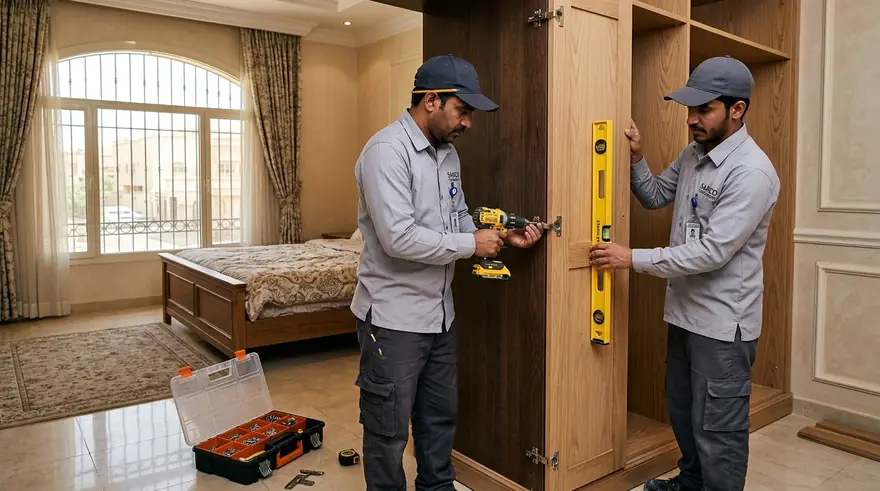
What do we mean by a furniture assembly company?
It is a provider that takes apart assembled pieces such as bedroom sets, wardrobes, desks, modular kitchens and beds, keeps their parts and fittings safe, and then rebuilds them in the new place in the same arrangement or a new one. It normally works with carpenters or technicians who know the fixing methods and how to dismantle without damaging the piece.
The service may be tied to a full move, or stand alone, such as for someone who bought flat-pack furniture or is rearranging a room. The difference between the two lies in the inventory, the responsibility and the time, and all of them need a clear agreement.
For field detail read the dismantling and reassembly guide and the carpenter's role in assembly. Here we focus on choosing the provider and writing the scope of work.
Assembly as part of a move, or as a standalone service?
If you are moving, dismantling and assembly are part of the journey: pieces are taken apart at the old home, wrapped, moved and rebuilt at the new one. The benefit is that one crew carries responsibility from start to finish, so assembly does not become a separate file held by a team that does not know how the pieces were taken apart.
The standalone service suits someone who bought furniture in parts from a showroom or shop, or who wants to move a piece within the house or rebuild a room. Then the technician needs the instructions and the full set of parts, plus agreement on scope and time. See moving with assembly for the first case.
Assembling flat-pack furniture: what is different?
Someone who bought a flat-pack bedroom set or desk usually needs a technician to build it quickly and firmly. What matters most is that the parts are complete, the instructions are available and the technician knows where the piece will stand, because some furniture needs fixing to the wall for safety, especially tall pieces or those used by children.
Send photos of the boxes or labels and the number of parts, and tell us if any part is missing or damaged before the appointment. Assembly cannot make up for missing parts, and agreeing in advance who contacts the shop or supplier in case of a shortage saves a wasted day.
Types of pieces and what each needs when dismantled and rebuilt
A general table showing where the sensitive points lie in each piece.
| Piece | What needs attention | What is asked of you |
|---|---|---|
| A full bedroom set | Headboard, frame, hinges and drawers | Tell the crew of any piece repaired before |
| A wardrobe with hinges or sliding doors | Hinges, tracks and mirrors | Empty the contents and mention any mirrors |
| A desk or bookcase | Shelves, drawers and electrical wiring | Disconnect devices and mark delicate shelves |
| A bunk or children's bed | Safety parts and the ladder | Tell the crew if children use it |
| Flat-pack furniture | Boards and tiny screws | Keep the instructions if you have them |
| Wall shelves | Wall fixing and weights | Say where it will be fixed and the wall type |
| Glass or stone tables | Heavy and fragile tops | Do not leave them without suitable wrapping |
| Modular kitchens | Units and connections | Contact us to confirm your case can be done |
Note that some types of furniture, such as pressed boards, are affected by repeated dismantling more than natural wood is, so if you own one, tell the crew so they handle it with care.
How a dismantling and assembly crew works
A sequence that repeats across different pieces.
Inspect and photograph
Photograph pieces outside and inside before dismantling to record their condition and how they were assembled.
Inventory the fittings
Count hinges, screws, bolts and keys and note anything missing or worn.
Dismantle with numbering
Take apart in order, number the parts and gather screws in labelled bags for each piece.
Wrap and transport
Protect parts and place them so they do not rub or break, loading in an order that eases reassembly.
Reassemble
Rebuild pieces in their positions according to the agreed layout and align doors and drawers.
Final check
Test stability, open doors and drawers, review mirrors and keys and note any concern.
Why pieces are photographed before dismantling
A photo taken before dismantling answers many questions after arrival: how were the drawers fitted, did the wardrobe have an extra shelf, where did the legs go. It also records the condition of the piece before the work, so if a scratch or crack appears you can tell whether it was there already or happened during the job.
Photograph each piece from the front, the sides and inside, plus any earlier mark, and keep the pictures. If you work with a company, ask the crew to photograph as well, because shared records are clearer and easier to use in any later discussion.
Numbering and screw bags: a small detail with a big effect
One of the biggest time losses after a move is screws and hinges getting mixed up between pieces. A good crew puts each piece's screws in a bag marked with the name of the piece and the room, tapes it to the piece itself or beside it, and numbers the boards so each one has its place on reassembly.
Ask the company how it numbers and sorts, and if you have complex pieces suggest a simple sketch. This habit lowers the chance of a spare or missing screw after the job, which is one of the main worries during assembly.
Inventory of fittings and what happens to losses
Every piece has small fittings: hinges, bolts, special screws, lock keys and corner brackets. Some may wear out or get lost during dismantling, so it is wise to count them before and after, and to agree how a missing part will be handled: whether it is replaced with an equivalent and how that is charged.
If the piece needs special screws from a particular brand, tell the crew, because getting them may be harder. A frank note at the start of the agreement is better than a surprise at assembly.
What tools does the crew bring?
Tools vary with the pieces, but they commonly include different screwdrivers and spanners, a rubber mallet, a drill, levels and carrying straps, plus floor covers. The right tools mean faster dismantling and less damage to the piece, the walls and the floors.
Ask whether tools are included in the service and whether the crew needs electricity or particular space to work. If you own pieces that need special tools, mention them before the appointment.
Pieces fixed to the wall
High shelves and wall cabinets may be fixed to the wall with special screws. Removing them leaves holes and refitting needs knowledge of the wall type and what it can bear. A concrete wall differs from plasterboard, and wrong fixing can damage the wall or let the furniture fall.
State in your request any wall-mounted piece and where it will hang in the new place, and tell us if you want a screen fixed to a wall, since to confirm availability for your request you should contact us. Remember that wall repairs, such as filling old holes, are not normally part of dismantling.
Natural wood and pressed boards: sensitivity to repeated dismantling
Natural wood generally tolerates dismantling and reassembly better, whereas pressed boards used in much ready-made furniture can suffer in their screw holes when taken apart repeatedly, which weakens their grip. That does not make dismantling impossible, it means the technician needs care and sometimes extra fixing aids.
Tell the crew the type of piece and its age if you know them, since this helps choose the dismantling method. If a piece is old or was repaired before, say so openly so that faults that predate the job are not blamed on the crew.
What sets dismantling and assembly apart for each type
A quick look at the most requested pieces.
The bedroom
The most common request: bed, headboard, wardrobes and dresser, needing frame protection and organised screws. See bedroom moving.
The large wardrobe
Doors, mirrors, hinges and tracks need particular attention so doors line up after assembly.
The desk and bookcase
Shelves, drawers and sometimes wiring, and it helps to disconnect devices first.
The modular kitchen
Needs coordination with other technicians, and to confirm your case can be done please contact us. See kitchen moving.
What to prepare before the crew arrives
- Empty wardrobes and drawers of their contents.
- Decide which pieces will be dismantled and which stay as they are.
- Photograph the pieces and note any existing defect.
- Prepare working space around the pieces and clean the floor.
- Provide electricity if the work needs it.
- Bring the furniture instructions if you have them.
- Mark the place of each piece in the new home on a simple sketch.
What you prepare saves real time, because a crew that finds clean space and empty contents works faster and more precisely.
How long does dismantling and assembly take?
No single figure applies, because time changes with the number of pieces, their type and condition, the floor and lift and the complexity of assembly. A simple bedroom differs from a full set with large wardrobes and mirrors, and both differ from a dismantled kitchen.
The best approach is to estimate time after seeing photos of the pieces and to state it roughly in the quote, together with what could change it. If your flat handover date is tight, say so clearly. See the moving timeline.
A checklist for after assembly
- Shake the piece gently to check it is stable.
- Open and close doors and check they line up.
- Pull drawers out and make sure they run smoothly.
- Inspect mirrors, glass and handles.
- Make sure locks and keys work.
- Check there are no unexplained spare or missing screws.
- Inspect the wall or floor for new damage.
- Ask for packaging and waste to be removed if that was agreed.
Record any concern immediately with photos, then tell the crew while they are still on site, because fixing it on the spot is easier.
Who is responsible for a defect that existed before the work?
It is important to document earlier defects before any dismantling: scratches, cracks, broken legs, sticking drawers. These details protect both sides, since the crew is not blamed for what it did not do and your rights are not lost for anything that happens during the work.
It is best if this is written in a message, a signed note or dated photos. If damage does occur during dismantling or assembly, deal with it by the mechanism agreed, and a general explanation of protection appears on the protection and guarantee page.
Questions that define scope and responsibility
- Which exact pieces does dismantling and assembly cover?
- Is assembly at the new place included, or only dismantling?
- How are pieces numbered and fittings kept?
- Are tools and small materials included?
- What happens if a screw or hinge goes missing?
- How is the condition of pieces documented before the work?
- How many technicians and roughly how long?
- Do I need to prepare anything before the appointment?
Write the answers in a message and compare offers using comparing moving quotes.
Signs that call for caution
- A promise to dismantle and assemble anything without seeing it or asking about it.
- No mention of how fittings are kept.
- Refusal to document the condition of pieces.
- Vagueness about scope: does it include assembly or not.
- Pressure to start before details are agreed.
A sign invites further questions before you commit. See the guide to choosing a moving company for broader criteria.
Mistakes that keep recurring in dismantling and assembly
- Dismantling without photos or numbering.
- Mixing the screws of different pieces in one bag.
- Forgetting to empty drawers and wardrobes.
- Not agreeing who assembles at the new place.
- Ignoring earlier defects until after the work.
- Leaving the agreement on dismantling until moving day.
Avoiding these mistakes shortens the work, reduces surprises and protects your furniture.
Frequently asked questions about a furniture assembly company
Short answers to what people ask before agreeing.
What does a furniture assembly company do?
Is assembly included with moving?
How do you keep screws and hinges?
Can you assemble new flat-pack furniture?
What about dismantled kitchens?
How do I handle a defect that was already there?
How long does the work take?
How do I request the service?
Pages related to dismantling and assembly
Topics that complete what you read.
Dismantling and reassembly guide
Steps for taking apart and rebuilding.
The carpenter in assembly
The carpenter's role and what to ask.
Moving with assembly
Moving and dismantling together.
Bedroom moving
Dismantling and wrapping beds and wardrobes.
Kitchen moving
Handling units and connections.
Moving with assembly and packing
A complete service.
Furniture assembly service
The main service page.
Requesting a quote
How to ask for an accurate quote.
IKEA furniture moving
Dismantling, moving and rebuilding flat-pack pieces.
Bedroom furniture assembly
Bed, wardrobe and dresser step by step.
Wardrobe assembly
Sliding, hinged and mirrored wardrobes and wall anchoring.
Kitchen assembly
Cabinets, worktops and connections that need a specialist.
Custom kitchen moving
Is a made-to-measure kitchen worth moving?
Need a dismantling and assembly crew?
Send photos of your pieces and both addresses on WhatsApp or call 0566300558, and we will write the scope of work clearly for the Eastern Province.