Moving With Dismantling and Assembly in the Eastern Province: Getting Your Pieces Back As They Were
The hardest moment of a move is not lifting furniture, it is returning it to its original shape: a wardrobe door that closes smoothly again, a bed that does not creak, a bedroom set missing no screw. This page covers moving with dismantling and assembly in the Eastern Province from the craft side: what is taken apart and what travels whole, how pieces are numbered and their fittings kept, how rebuilding and adjusting is done, and what you can do before the carpenter arrives to make the work easier.
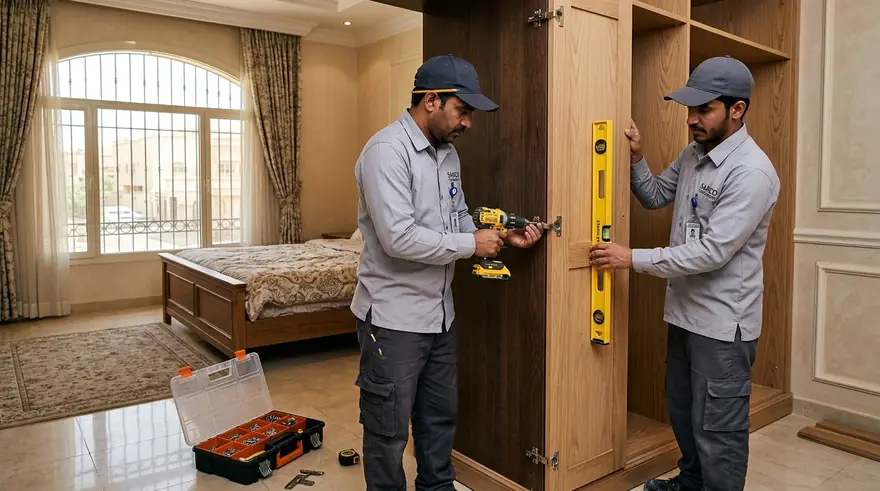
Why do we take furniture apart before moving it at all?
Dismantling is neither an old habit nor exaggeration. It does two things: a large piece can pass doors, corridors and lifts without hitting them, and it can then be loaded compact and protected, taking less space and suffering less rubbing. A wardrobe that will not pass a flat door at an angle must either be taken apart or scratched, along with the wall.
But wrong dismantling is worse than none, because too much force ruins screw holes and widens them so they no longer hold. That is why a carpenter does it, someone who knows how each model is joined, uses suitable tools and gathers fittings as he goes, so the piece returns close to its original firmness after the move.
Pieces that are mostly dismantled before the move
The final decision is the carpenter's after seeing the piece and the route.
Full bedroom sets
Beds, large wardrobes and dressers usually need their panels and doors removed to pass safely and be wrapped well.
Sliding-door wardrobes
The doors are lifted off and the tracks protected, then adjusted again after assembly.
Beds with mechanisms
Beds with hinges or lift mechanisms need special care for pistons and joints.
Desks and bookcases
Loose shelves and glass parts are separated and carried on their own.
Wall-fixed items
Hanging cabinets, wall shelves and screen brackets come off and go back with fresh, precise fixing.
Six stages from the first screw to the last adjustment
A sequence the carpenter repeats in every room.
Inspection before dismantling
He examines the piece, notes earlier flaws, tells you about them and decides how to take it apart.
Numbering
Panels are numbered and parts sorted so each returns to its place with no guesswork.
Gathering fittings
Screws, hinges and keys go into numbered bags taped to the piece itself.
Wrapping and moving
Panels are wrapped in protective layers and loaded secured so they do not warp.
Reassembly
He rebuilds to the same numbering and reinforces loose joints where needed.
Final adjustment
He balances doors, drawers and runners and reviews them with you.
Tools that separate careful dismantling from rough handling
Some tools look simple but decide the outcome: screwdrivers in several sizes that do not chew screw heads, special keys for some models, cordless drivers with torque control that do not crush chipboard, rules and levels for balance, and rubber mallets that do not hurt panels.
In the field, clear bags of different sizes, labelling tape and a permanent marker also help, because they are the tidiness tools that guard against loss. A good carpenter is measured not by strength but by organisation, and someone organised hands the furniture back with nothing missing.
Comparison: pieces that travel whole and pieces that are taken apart
A general rule that changes with size and route.
| Piece | Travels whole when | Taken apart when |
|---|---|---|
| Small cabinet | It passes doors easily | It cannot take turning on the stairs |
| Single bed | The frame is sturdy and passes at an angle | It has protruding parts or a lift mechanism |
| Master bedroom set | Rarely moved whole | It needs protection and safe passage |
| Large sliding wardrobe | Seldom | Its doors and tracks need protection |
| Dining table | The base is sturdy and passes | The base is heavy or the top is glass |
| Desk with drawers | Drawers are emptied and fixed | Legs or panels block the route |
Modern bedroom sets: why they need double care
Modern bedrooms, especially those made of laminated board, depend on concealed fittings and precise hinges, and any mistake in dismantling ruins a hole so that it no longer grips. So they are taken apart according to how they were made, not to the carpenter's habit, and their fittings are kept in numbered bags for each panel.
When rebuilding, the carpenter may treat earlier gaps with matching screws and reinforce joints, so furniture sometimes comes out firmer than before. If you have an older set that has loosened, tell us before the date so we can allow for it.
Sliding doors and soft-close hinges: adjustment takes time
Sliding doors rely on top and bottom tracks that need precise straightness; if they lean slightly the door gets heavy and jumps its path. Refitting them calls for measuring and adjusting after assembly, which is time that should be counted from the start.
Soft-close hinges likewise need their force and direction adjusted after fixing. Without that, the door springs back or does not shut, and the customer thinks the furniture was damaged in the move when it simply needs calibrating.
Hanging cabinets and screens: fixing again with precision
Wall-fixed items need a new position measured and the wall type identified, since a concrete wall is different from plasterboard. A drill, a level and fixings suited to the weight make sure the piece neither moves nor falls. If the item is heavy, ask about the right fixings before drilling.
A photo of the piece in its old place helps you set the right height again. And decide the position of the screen and sockets before fixing to avoid drilling twice, small details that spare your wall some marks.
What about fitted kitchens?
Fitted or custom wall kitchens call for inspection before any promise. Some can be taken apart and refitted, and some are tied to electrical, water and gas connections and fixed stone that need specialist technicians and planning. So we look at the case first and then tell you what can be done and what needs a specialist.
Send photos and details of the kitchen and say what you want: only doors and drawers removed, or whole units. We do not promise to refit what its condition does not allow, because candour is more useful to you than a promise that may not come true.
Five things that make the carpenter's job easier and save time
A little preparation before the date saves hours.
Empty wardrobes and drawers
A lighter piece is easier to dismantle and less likely to be damaged.
Tell us about complex pieces
Imported sets or special systems are something the carpenter needs to know beforehand.
Provide special keys
If your pieces came with keys or tools, hand them to the crew.
Clear the work space
Room around the piece lets the carpenter move safely.
Decide where beds and wardrobes go
It saves reassembly time and stops them being moved twice.
Where do the screws and small keys go?
Loss is the best-known problem after dismantling. To avoid it, each piece's fittings go into a separate bag labelled with the piece and room and taped firmly to the piece itself. Screws from different rooms are never put into one big bag, because mixing delays assembly.
If at handover you notice a bag was not delivered, say so at once. Better still, you or someone you name can watch the bags being placed with the pieces before loading and photograph them if you wish.
How much time does dismantling and assembly add to a move?
It adds time in proportion to the number and complexity of pieces: one ordinary bedroom differs from two imported rooms with a wall cabinet. No single figure suits every home, so we ask for photos and propose a suitable number of carpenters working in parallel with the wrapping team.
In ordinary flats and houses the stages of dismantling, wrapping, loading, moving and assembly are usually completed the same day, and large villas may be split. The more precise the details you send, the closer the estimate.
How we handle a move that includes dismantling and assembly
We start with photos of your rooms and questions about models and complex pieces, then propose the number of carpenters and explain what the estimate covers. On the day we inspect pieces, take them apart according to each model, number, wrap, rebuild, adjust and review with you.
We do not promise to rebuild what its condition does not allow, and we tell you frankly about any earlier flaw before we start. If you want more on the carpentry service, see our furniture assembly page.
Frequently asked questions about moving with dismantling and assembly
Clear answers on the craft and the procedure.
Do you dismantle every piece before moving?
How do you stop screws getting lost?
Do you adjust doors and drawers after assembly?
Do you move fitted kitchens?
Does assembly add to the length of the move?
Do I need to prepare anything before the carpenter arrives?
What if a piece already has a flaw?
How do I order this service?
Pages connected with dismantling and assembly
Services and guides that complete the move.
Furniture assembly
Carpenters and careful dismantling skills
Bedroom moving
A specialist service for master rooms
Moving with packing
The packing cycle inside a move
Moving with assembly and packing
A complete one-day service
Packing system
Levels and materials
How the move works
Moving day stages
House moving
House moving in the Eastern Province: a practical family guide from deciding what moves and what stays to switching on utilities, handing back the old
Bedroom moving
Bedroom moving in the Eastern Province: how to dismantle beds and wardrobes, protect mattresses and mirrors and move clothing and bedding so you sleep
Furniture assembly company
How to choose a dismantling and assembly provider.
Moving with labor
What the crew covers and what counts as extra.
IKEA furniture moving
Dismantling, moving and rebuilding flat-pack pieces.
Kitchen assembly
Cabinets, worktops and connections that need a specialist.
Want a carpenter to dismantle and rebuild your rooms?
Send photos of your rooms on WhatsApp or call us, and we will propose the crew and steps that suit you.