Bedroom Moving in the Eastern Province: How Beds, Wardrobes and Mattresses Arrive Ready to Sleep In
The bedroom is the room most tied to comfort, and one of the most complicated to move: a bed with a frame, base and headboard, a big wardrobe with sliding doors and mirrors, a dresser with glass, heavy and delicate mattresses, lots of clothing and personal items you do not want lost. If it is not organised well, the least that happens is that the family sleeps one night on the floor because the bed was not assembled. This page explains how a whole bedroom is moved in the Eastern Province: what is dismantled and what moves whole, how mattresses, upholstered headboards and mirrors are protected, how clothes travel without needing new ironing and how to rebuild the room in the right sequence so it is ready before the day ends.
Why a bedroom is moved with its own plan
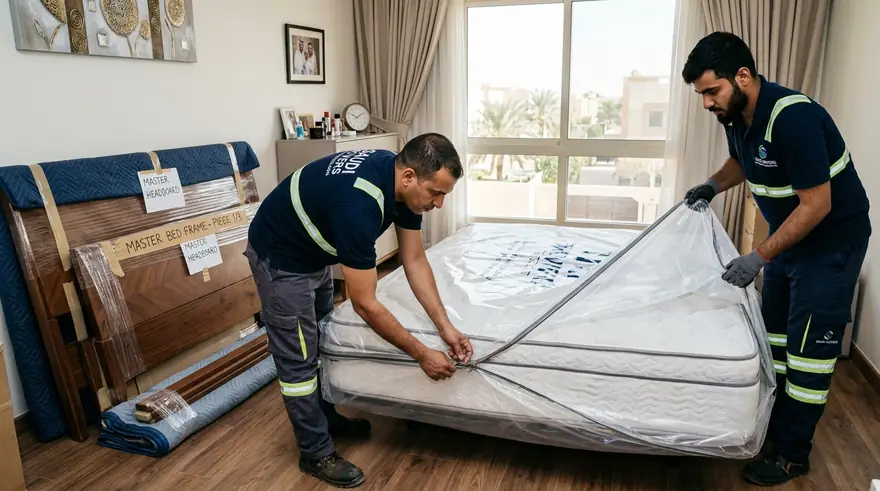
In most Eastern Province homes the bedrooms hold large pieces designed to stay put for years: wardrobes with heavy doors, beds with wooden or metal bases, thick mattresses and dressers with mirrors. These pieces entered the house in parts the first time, and in the room they were assembled; they only come apart again when you move. So they must be dismantled the right way and reassembled in the right order, or screws go missing and joints are damaged.
And sleep requires the room to work on the first night even if the rest of the house is still in cartons. So we start from the end: what must be assembled and made up before the day is over? From that we set the loading and unloading order.
Parts of a bedroom and how each is handled
Each piece has its method, and the sequence between them is the solution.
| Piece | How it travels | What to watch |
|---|---|---|
| Bed frame and base | Dismantled and numbered | Screws and fixings in a bag taped to the part |
| Upholstered headboard | Covered with cloth and a thick wrap | Fabric soils and scratches easily |
| Mattress | In a full cover, flat or upright | Nothing heavy on top |
| Wardrobe with doors | Doors and shelves removed | Mirrors and sliding doors are fragile |
| Dresser and mirror | Mirror detached and wrapped separately | Glass and handles |
| Bedside tables and side units | Moved whole after emptying drawers | Sliding drawers are secured |
Agree what will be dismantled and what moves whole before the date so the decision is not left to the moment of loading.
From six days before to six hours on moving day: preparing the room
A simple order that protects pieces and speeds assembly.
Empty wardrobes and drawers
Move clothes into cartons or numbered bags and empty drawers of small items; a lighter piece is easier to carry and safer for the wood.
Photograph the room and the joints
A photo of the whole room and of the wardrobe and bed joints helps at reassembly.
Number the parts
Stick a number and room code on each panel and note it on an attached sheet.
Bag screws by piece
One bag per piece, taped to it, not one bag for the whole room.
Wrap mattresses and mirrors
A full cover for the mattress and bubble film and cardboard for mirrors and glass surfaces.
Prepare the first-night bag
Bedding, pillows, a day or two of clothes and chargers, carried with the family, not in the truck.
Mattresses: the costliest item in the room and the easiest to damage
A good mattress is expensive, but it does not tolerate sharp bending, rubbing or damp. Spring mattresses suffer from tight folds, foam and medical mattresses soak up odours and moisture, and light-coloured fabric picks up marks from any friction. So they need a clean, complete cover closed at the ends, and are moved flat or upright depending on thickness, never squeezed by ropes.
Nothing heavy goes on top of a mattress in the truck, it should not sit on a wet floor or in direct sun, and it should never be carried bent in the middle. Once at the new home, let it breathe for a while before making the bed, especially if it was in plastic for some time.
Upholstered headboards and premium beds: care that differs from ordinary beds
Beds with headboards covered in fabric, leather or velvet are common in newer Eastern Province bedrooms, and they suffer from friction, dust and hand marks more than wood does. They are carried with a full clean cotton cover and then a thick wrap, kept away from sharp objects and not leant directly against the truck wall.
Metal beds, those with built-in lighting or large drawers underneath need coordination before dismantling: do they have electrical connections, and do they come apart easily or risk damage? In complex cases it is wise for a carpenter from the crew to supervise and photograph the joints.
Wardrobes, sliding doors and mirrors
Wardrobes are the heaviest pieces in the room and need the most precision.
Sliding doors
Lifted off their track and wrapped separately, with wheels and tracks kept in a numbered bag so nothing is lost.
Mirror doors
Wrapped in bubble film between cardboard sheets and carried upright, never flat where they might crack.
Inner shelves
Removed and grouped by their numbers, with support positions photographed.
Top units
Taken down first and wrapped at the edge, numbered to return to their place.
Base and back panels
Checked before lifting; some older wardrobes need extra support.
Handles and locks
Removed if protruding or covered, and kept with the piece.
Clothes and bedding: moving them without needing new ironing
Clothes are what fill a bedroom the most, and moving them the wrong way means hours of ironing on arrival. The best answer for hanging items is a wardrobe carton with a metal rail: clothes travel on hangers and go straight into the new wardrobe. For folded items use medium cartons that are not heavier than one hand can lift, with clean paper between layers of delicate pieces.
Bedding, pillows and bedroom curtains go in large closed bags to protect them from dust, labelled with the room. Do not put perfumes or open liquids in a clothes carton, to avoid spills, and keep the first days clothes in a separate bag.
Drawers, personal and valuable items: what to carry yourself
A bedside drawer or dresser often holds medicine, papers, jewellery, watches, chargers, perfumes and sentimental things. These do not travel with the furniture; carry them yourself in a separate bag or wrap them carefully and hand them over personally. Perfumes and flammable or spillable liquids should go in your own car, not in the truck with the furniture.
Mind what under-bed drawers and storage hide: old cartons, covers and tools, which add weight to a bed and get damaged in carrying if left in. Empty them before dismantling.
Childrens rooms and bunk beds
Childrens beds have their own challenge: many small parts, ladders, safety rails and sometimes mattresses of special sizes. They must be dismantled in an order that can be reversed, and screws and keys kept in a bag taped to the main part, because a lost small piece can stop the bed being used for a night. Bunk beds need their joints checked after assembly before a child climbs up.
Mind the toys and books: sorting before the move saves space, and wrapping favourite things in a distinct carton helps reassure children. It is best to set up their room first in the new home since it makes the move less hard on them.
Reassembly: in the right order a room is done in hours
Assembly starts with the pieces that carry others: bases and legs for beds, then frames, then the headboard, then the mattress. For the wardrobe: back frame, then sides, then shelves, then doors. Check the floor is level and where the room sits relative to windows, air conditioner and sockets before fixing big pieces in place, because some wardrobes cannot be pulled out after assembly.
If the furniture is the kind bought flat-packed and assembled with a special key, keep the manufacturers instructions if you have them. After assembly check the stability of pieces, the soundness of doors and drawers and that handles work before making the bed.
The bedroom in different scenarios
Choose what fits your case.
| Case | What changes | What to watch |
|---|---|---|
| One room in a flat with a lift | Short time and fewer pieces | Lift size and the room door |
| Several rooms in a villa | Organisation by number for each room | One team dismantling and one loading |
| A bedroom for a family with children | Beds with many parts | Sorting toys and preparing a first night |
| A move to another city in the province | A longer trip and more road | Secure mirrors and mattresses well |
If your move is between cities in the province, check the trip schedule and the expected arrival time so assembly can be done in daylight.
Protecting walls, doors and floors from bedroom pieces
Bedroom pieces are long and heavy and rub walls at turns. So corner guards go on sharp wardrobe edges, door edges are covered, boards are laid on the floor along the carrying route and curtains or chandeliers are removed if they obstruct. Door and corridor widths are checked before lifting, as a wardrobe may need more dismantling.
In flats with narrow corridors, long panels and doors are moved before the heaviest items so they do not block the way. In villas with polished floors a floor covering is needed along the whole route.
How much time does a bedroom need?
We give no fixed duration because rooms differ, but the factors are clear: the number of pieces, the complexity of the wardrobe, the number of beds, how much is prepared before the crew arrives, the floor and lift, and the distance. A single room usually takes less time than a full living area, but reassembly takes the largest share.
So it is advised that the crew begin with the bedroom at the new home if possible, so it is ready as soon as that stage is done while the other rooms are unloaded. That way the family sleeps in their own room however late the rest of the house is arranged.
What should you send us for an accurate bedroom quote?
Send the city and district, the number of bedrooms, the types of beds and wardrobes and whether they are dismantled or fixed, the mattresses and their types, mirrors and fragile pieces, the floor and lift, whether you want dismantling, assembly and wrapping, and a preferred date. Photos of large pieces and of the room give a more accurate estimate.
Then contact us on WhatsApp or by phone, and we will explain the plan and what the quote covers before you decide.
Frequently asked questions about bedroom moves
Answers to what people ask most before moving a bedroom.
Do the bed and wardrobe need dismantling?
How is a mattress moved without damage?
How do I move clothes without needing re-ironing?
What do I do with perfumes and medicine?
Is the room assembled at the new home?
How do I keep small bed parts safe?
Can a single bedroom be moved on its own?
What helps you give an accurate quote?
Pages related to bedroom moves
Guides and services that help you plan.
Bedroom moving and wrapping service
The general service page
Furniture disassembly and reassembly guide
Numbering and documenting parts
Carpenter for furniture assembly
When you need a carpenter
Furniture packing by material
Which wrap for which piece
Room-by-room packing
Packing each room in order
House moving
A family guide to moving a whole house
Apartment moving
Lifts and parking
Moving with assembly
When you need the service
Request a written quote
Send your move details
Heavy furniture moving
Heavy furniture moving in the Eastern Province: how large wardrobes, marble tables and corner sofas are carried, protected and planned around…
Furniture packing materials
Furniture packing materials in the Eastern Province: thick blue stretch wrap, bubble wrap, ink-free paper, corner guards and cartons, what each…
Bedroom furniture assembly
Bed, wardrobe and dresser step by step.
Wardrobe assembly
Sliding, hinged and mirrored wardrobes and wall anchoring.
Moving a bedroom and want it ready from the first night?
Send us photos of the room and the number of pieces on WhatsApp or call us, and we will arrange organised dismantling and assembly with a written quote in the Eastern Province.