Furniture Packing Materials in the Eastern Province: What Each One Does and Why a Single Material Cannot Protect a Piece
Many people assume packing furniture means wrapping a piece in plastic and finishing there, but real protection comes from several layers, each doing a different job: one prevents scratches, another absorbs shocks, a third holds moving parts shut and a fourth keeps off dust and humidity. This page deals with the materials themselves: what they are, what they protect, where they are used and where they are not, and how they behave in the heat and humidity of the Eastern Province. It differs from our pages on packing by furniture type because its subject is the material, not the piece. Read it to understand why multi-layer packing uses several materials and when a piece needs a particular one.
Why one material is never enough
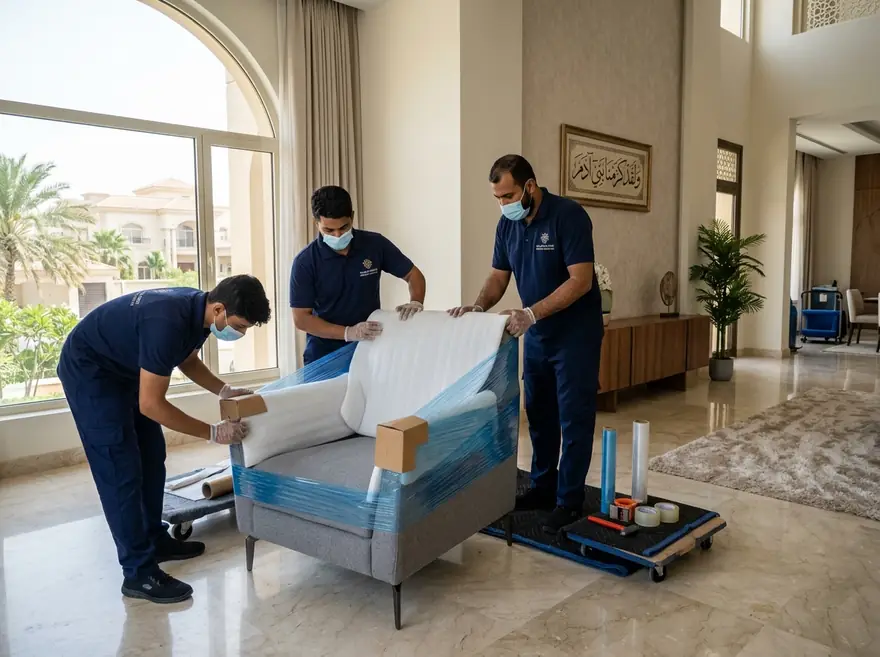
Every packing material does one job well and another badly. Stretch film pulls tight and holds things together but does not absorb shock; bubble wrap absorbs shock but does not hold doors shut; ink-free paper protects smooth surfaces from rubbing but does not stop dust. That is why professional packing relies on an order of layers: a soft layer touching the surface, then a shock-absorbing layer, then a layer that holds and gathers everything.
Once you know what each material does you understand why a crew suggests different wrapping for a wooden wardrobe, a glass table and a fabric sofa, and why coloured paper cannot replace ink-free paper on pale pieces.
The main packing materials and what they do
A brief table of the most used materials.
| Material | Its job | Where it is used |
|---|---|---|
| Thick blue stretch film | Holds layers together and keeps off dust | Wardrobes, sofas and beds after the first layer |
| Bubble wrap | Absorbs shock and protects surfaces and edges | Glass, mirrors, appliances and delicate surfaces |
| Ink-free paper | Prevents scratches and ink transfer | Pale surfaces, tableware and fine fabrics |
| Corner and edge guards | Stop breakage on impact | Sharp edges of tables and wardrobes |
| Cartons and cardboard sheets | Protect flat surfaces and support small items | Mirrors, pictures and household goods |
| Strong tape | Seals and holds doors and drawers | Moving parts and boxes |
The order of layers on a large wooden piece
This order is general and changes with the piece.
Clear what is on it
Remove dust and anything resting on the piece.
A soft layer
Ink-free paper or cloth over glossy surfaces.
Fix moving parts
Tie doors and drawers with a tape that leaves no mark.
A shock-absorbing layer
Bubble wrap or foam on edges and corners.
Outer wrap
Thick stretch that wraps the piece and gathers the layers.
A clear mark
Write the room name and which side is up.
Thick blue stretch film: its strength and its limits
Thick blue stretch film is what people usually see on moved furniture. Its main job is to pull the piece tight, gather the layers around it, keep out dust and surface humidity and make the piece visible and protected from light rubbing. It is easy to remove and leaves no trace if applied correctly.
It has limits, however. It should not be wrapped directly onto leather or painted wood in intense heat for long periods, because trapped heat and humidity can leave marks, and it cannot be relied on alone against shocks. A soft layer goes beneath it, and it is pulled without pressing hard on delicate surfaces.
Bubble wrap: absorbing shocks
Bubble wrap is the first defence against impact and vibration, and it is used on glass, mirrors, appliances, delicate surfaces and edges. Bubble sizes differ: small bubbles suit delicate surfaces, large ones suit heavier pieces and edges.
The bubble side generally faces the piece, corners get several turns, and it is fixed with tape that does not stick to the surface itself. With the long roads between Eastern Province cities, this layer is worth more, because vibration harms delicate pieces more than the moment of lifting.
Ink-free paper: the layer that protects appearance
Ordinary printed paper may transfer ink to pale surfaces, fabrics and white tableware, leaving marks that are hard to remove. Ink-free paper is therefore used as a first layer on pieces whose appearance matters, and for wrapping dishes, ornaments and plates.
It also stops polished surfaces rubbing against each other and absorbs slight humidity. If you have fine dinner sets or coloured paintings, ask for this paper and avoid wrapping them in newspaper.
Mistakes in choosing packing materials
Six common mistakes we see when furniture is wrapped unsuitably.
Printed paper on pale surfaces
The ink transfers and leaves stains.
Wrapping leather tightly in plastic in heat
Trapped heat and humidity may affect the surface.
Relying on one wrap
It neither absorbs shocks nor protects corners.
Tape on painted wood
It may lift the paint when removed.
Very thin bubble wrap for heavy pieces
It cannot bear the weight of large items.
Leaving corners uncovered
Most damage occurs at corners and edges.
Corner and edge guards: small and decisive
What gets damaged most on furniture is corners and edges, because they hit doors, walls and other pieces first. Guards made of hard cardboard, foam or plastic absorb the blow before it reaches the piece, and they are fixed before the outer wrap.
They are especially important on glass and marble tables and wardrobes with sharp corners. The more valuable the piece, the cheaper corner protection is compared with repairing a break that cannot be mended.
Cartons and cardboard sheets
Besides ordinary cartons for small items, stiff cardboard sheets protect flat surfaces such as mirrors, pictures and glass cabinet doors; they sit between the piece and the outer wrap and spread pressure. They are cut to size and secured safely.
It also helps to separate mirrors and glass surfaces with a cardboard sheet so they do not rub against each other. For carton types and numbers see our page on moving boxes.
Tape: the most underrated material
Good tape seals cartons and holds drawers and doors, but using it on polished or painted surfaces needs care: some strong types leave adhesive or lift a layer of paint. So it is usually stuck onto the wrap or onto parts that are not affected, not directly onto polished wood.
It is better to fix doors with the wrap itself or a gentle tape made for the purpose, and keep strong tape for cartons. In hot weather some cheap tapes lose their grip and release under load, so choose suitable quality.
Materials in hot, humid weather
Heat and high humidity in the Eastern Province affect materials: stretch film grows softer and sometimes sticks to hot surfaces, cheap tape loses its grip and damp cardboard weakens. So the time between wrapping and loading is kept short, and pieces are not wrapped in direct sun.
In humid seasons care is taken not to trap moisture inside wraps on wooden or leather pieces for long. These precautions are set according to the moving date and duration.
Are thick fabric covers used?
Besides disposable packing materials, thick fabric covers are sometimes used to protect large pieces from scratches and can be reused. They help with sofas and large wooden furniture and reduce the need for heavy use of plastic wraps.
We do not claim here that every type of cover is available, but if your job needs something specific, mention it so we confirm what can be provided. Details are settled when you contact us according to the size of the move and the type of pieces.
Materials for appliances and screens
Appliances and screens need different materials from furniture: bubble wrap, soft cardboard sheets, dust-proof covers and padding that holds the device in its carton. The key is not to wrap a screen in material that presses on its surface, and not to leave ventilation openings blocked during storage.
There are screen details on our page about TV and screen moving and for other appliances on our page about appliance moving.
Reuse or dispose after arrival?
After arrival wraps and padding are removed, and some can be reused, such as sound cartons, fabric covers and corner guards, while damaged stretch and bubble wrap are disposed of in an orderly way. It helps to gather wraps in bags instead of leaving them in corridors.
If you care about reducing waste, tell us so we arrange what can be reused and cut consumption without touching protection. The safety of the piece always comes first.
How we choose materials for your piece
The choice depends on the type and sensitivity of the piece, the length and nature of the trip, the weather on moving day, and whether the piece will be stored after the move. A large mirror needs a cardboard sheet and bubble wrap, a sofa needs a fabric cover and a dust-proof wrap, and a glass table needs corner guards and a cardboard sheet.
We do not use one template for everything, because packing is designed around the piece. You can see an example on our page about packing by furniture material.
How to tell good quality from poor quality
Not all materials are equal: thin stretch film tears when pulled, low-grade bubble wrap pops quickly and weak tape peels. To tell them apart, stretch the wrap slightly and it should extend without tearing easily, press the bubbles and they should not burst readily, and check that the tape sticks well and takes a pull.
For heavy furniture or long trips quality matters more because pressure and vibration are greater. So we prefer not to economise on material that protects an expensive piece, while avoiding waste on materials simple furniture does not need.
Handling materials safely
Some packing materials need care: sharp tape and cut cardboard can cut a hand, tight stretch can pinch fingers while wrapping, and popping bubble wrap can disturb children and pets. Gloves are used when needed and materials are kept away from small children.
Wrap offcuts should not be left on the floor in corridors because they cause slips. Tidy working spaces reduce accidents and speed up the job.
Pieces that wait before reassembly
Sometimes pieces are not assembled as soon as they arrive, for example when wardrobes sit for days in a room before the wall or floor is ready. In that case a piece should not stay tightly wrapped in a hot or humid room for a long time, and the wrap is best opened partly for ventilation once the piece has settled.
If storage is longer, ask about furniture storage in the Eastern Province to see how pieces are prepared to stay longer.
Should I prepare materials myself?
You can bring some materials yourself, such as cartons and tape, but specialised protection like thick wrap and bubble wrap needs quantities, sizes and knowledge of how to use them. If you want complete packing it is better that we do it and supply the materials within the service as agreed.
Details of the full service are on our page about moving with packing, and to confirm which materials are available for your job, contact us.
What affects the cost of packing materials?
We quote no prices here. Factors include the number and size of pieces, the number of layers each piece needs, whether there are fragile or valuable pieces needing extra material, the length and nature of the trip, whether pieces are stored after the move, and the date of execution.
Send us photos of the pieces for a written quote, and see how to compare moving quotes to check that offers include the same materials.
A practical scenario: a glass table, a sofa and a wardrobe
In one home three pieces can need three kinds of packing. The glass table: ink-free paper, then a cardboard sheet, then bubble wrap and corner guards, then an outer wrap. The fabric sofa: a protective cover and then thick stretch that keeps dust out. The wooden wardrobe: tie the doors, bubble wrap on the edges, then the stretch.
The scenario shows that good packing does not mean using the biggest quantity of materials but the right material in the right place, which is what an experienced crew does with its layer system.
What to send us so we can propose materials
Send by WhatsApp photos of large and delicate pieces, the number of rooms and the home type, what you wish to pack yourself, your moving date, whether storage follows the move, and both addresses.
We will reply with what we consider suitable in materials and layers plus a written quote, and confirm availability in the Eastern Province.
Frequently asked questions about furniture packing materials
Short answers to customer questions.
What is the most important packing material?
What is thick blue stretch film for?
Why ink-free paper?
Should bubble wrap go on everything?
Does tape harm wood?
Does heat affect the materials?
Should I prepare materials myself?
How do I get a quote?
Pages related to packing materials
Topics that complete protecting your furniture before a move.
Moving boxes
How many boxes you need and which sizes.
Packing by furniture material
Protecting wood, marble, glass and fabric.
Packing small items and boxes
How to pack delicate items.
Room-by-room packing
What to pack in each room.
Moving with packing
The full service with packing.
Furniture packing service
The general packing service page.
Packing system
The protection layers and how they work.
Request a quote
Send photos of pieces for a written quote.
Furniture packing company
How to choose a packing provider and what to ask.
Furniture storage company
How to choose and prepare furniture for storage.
Scratch-free moving
Where marks come from and how to limit them.
Antiques and Glass Moving
Assessing, wrapping and securing fragile pieces.
Want your furniture protected with the right materials?
Send us photos of large and delicate pieces by WhatsApp, or call us, and we will suggest the suitable layers and materials with a written quote in the Eastern Province.