Carpenter for Furniture Dismantling and Assembly in the Eastern Province: What Exactly Do They Do?
When you look for a carpenter to dismantle and reassemble furniture, you are not looking for someone with a screwdriver. You are looking for a person who understands how the piece in front of them holds together: is it solid wood or particle board, is it fixed with screws, glue or hidden cam locks, and where are the weak points that crack when someone rushes. This page explains the carpenter's role in a move: the tools, the stages of work, what they check afterwards and the warning signs that whoever is taking your furniture apart does not know what they are doing. The aim is to help you know what to expect when a carpenter works in your home in the Eastern Province.
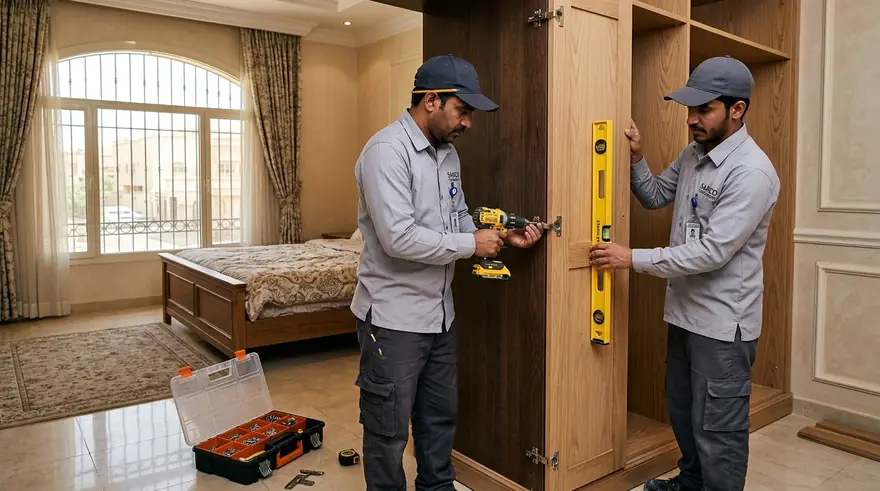
What separates a dismantling carpenter from anyone with a screwdriver?
A skilled carpenter reads a piece before touching it. They look at the material, the way it is fixed, its age and its condition, and decide an order of dismantling that keeps every part intact: which screws come out first, which panels need support, where trouble is waiting. An unskilled worker may force what should be understood, tearing screws from soft board or splitting a panel that will not survive being taken apart a second time.
This matters most when furniture is old, has no instruction sheet or was designed to be assembled only once. Experience then shows in knowing what can be dismantled and what should travel in one piece, and how to label every part so it returns to its place.
The tools and materials a carpenter really needs
These are not luxuries. Each one solves a particular problem.
| Tool or material | What it does | When it matters |
|---|---|---|
| Screwdrivers with several heads | Remove different screws without chewing the head | Old furniture with worn screws |
| Spanners and hex keys | Tighten and loosen bed bolts and frame fixings | Beds and large wardrobes |
| Variable-speed drill | Saves time while controlling torque | Large assembly jobs |
| Rubber mallet | Taps parts together without marks or breakage | Dowels and joints |
| Wood glue and adhesives | Re-fix a loosened joint | Older solid wood furniture |
| Labelled bags and stickers | Keep screws and fittings with their piece | Every dismantling job |
| Protective covers and brushes | Protect surfaces while working | Glossy or painted finishes |
| Spirit level | Check everything is straight after assembly | Wardrobes and shelving |
If your furniture has unusual locks or moving drawers, tell the carpenter beforehand. A special tool or technique may be needed.
The carpenter's job from arrival to departure
A sequence that repeats on most moves.
Inspect and read the pieces
Walk through the rooms, decide what is dismantled and what travels whole, and note and record existing damage before starting.
Photograph and number
Take photos of each piece, number panels and parts by room and item and put screws in labelled bags.
Dismantle in order
Start with what comes off easily such as shelves, drawers and doors, then the frame, protecting edges throughout.
Hand over to wrapping and loading
Dismantled parts go to the crew together with their bags so they can be wrapped and loaded in order.
Reassemble
Read the numbering, return each part to its place, adjust doors and drawers and tighten joints gradually, not all at once.
Final check
Shake the piece, open drawers, test doors and ask you to inspect the result before leaving.
How the approach changes with the type of furniture
The material decides the method.
Solid wood
Tolerates dismantling and reassembly but is affected by humidity. Old joints need care and suitable glue if they loosen.
Particle board and melamine
More fragile when dismantled repeatedly and screw holes can widen. It needs moderate torque and treatment of worn holes rather than over-tightening.
Flat-pack furniture
Comes with special fittings and dowels. The best approach is to follow the original assembly order, not to improvise.
Old veneered furniture
A thin veneer can lift on impact. Edges are protected and taped during dismantling.
Furniture with metal and glass parts
Glass and mirrors are removed from the frame and moved separately.
Bedrooms: beds and wardrobes in detail
Bedrooms are where people most often use a carpenter. A bed is dismantled by removing the head, foot and sides, then collecting and numbering the support slats and placing fittings in a bag fixed to the biggest panel. A sliding-door wardrobe needs its doors lifted off and the tracks kept, and a large built-in-style wardrobe comes apart by sections, with shelves emptied, drawers removed and corners protected.
On reassembly the carpenter brings the wardrobe back to true with a spirit level, checks that doors close without rubbing and, where suitable, anchors tall pieces to the wall to stop them tipping, especially in homes with children. Tell them beforehand because wall fixing means drilling and your tenancy may have rules.
Hinges and sliding doors: the adjustments that make the difference
What annoys people most after reassembly is a door that does not close properly or a drawer that rubs. Usually the hinge or runner has not been adjusted accurately. Modern hinges have screws that adjust depth, height and side position, and a careful carpenter uses them to make the door straight and flush with its neighbours. Sliding doors need their wheels set on the top and bottom tracks so the door neither rubs nor swings.
Some hinges include soft-close systems that need their own setting, and rushing the screws can split particle board. If the furniture is old, a hinge may need replacing, and a good carpenter will suggest a suitable part instead of fighting with a weak one.
Drawers and metal runners: why they stick after a move
Drawers stick after moves because their runners may have been bent during dismantling or because screws were not tightened evenly. The carpenter checks both runners, makes sure they sit at the same level and tests the drawer empty and then loaded. A heavy drawer is carried carefully and not dragged, so the front does not come away.
A simple tip is to empty drawers before the move and carry heavy ones separately from the wardrobe. That protects the runners from bending and reduces the weight of the main piece when lifted.
Pieces that should not be taken apart at all
Not everything that can be dismantled should be. Some small pieces, one-piece items or glued units do not tolerate being taken apart, and others lose strength if dismantled and rebuilt more than once. Some old furniture has worn joints that may break if forced, and in that case it is better to move it assembled if the doors and passages are wide enough. The carpenter makes that call after inspection.
Measuring doors and corridors and telling the carpenter helps. Sometimes the answer is to change the carrying angle or take the piece out through a window or balcony with a special set-up. If that is impossible, the piece is dismantled only as far as necessary.
Signs that the person dismantling your furniture does not know the job
There are early signs of poor work: dismantling starts without photos or numbering, screws go into one common bag, force is used when something sticks, floors and edges are not protected and the only promise is "we will put it back as it was". Small parts such as rubber feet or supports may be left behind because the worker does not know they matter.
If you see any of this, ask them to pause and explain the plan. It is much easier to stop a mistake than to repair a broken piece. Also feel free to send photos of tricky items in advance so the carpenter can judge whether they need special handling.
A checklist for after assembly, before the carpenter leaves
Do not settle for a glance. Open every door and drawer, make sure the wardrobe is straight and steady when you give it a gentle shake, look at corners and gaps between doors, confirm locks work, mirrors are firm and the bed does not creak when you move. If there are leftover parts, ask why before putting them aside.
With flat-pack furniture it is normal for some joints to loosen a little after the first days of use, so it makes sense to re-tighten the main screws after about a week, or ask the carpenter to show you how.
How long it takes and what changes the cost
No single time fits every home but the factors are well known: the number of pieces, their complexity and age, the tools available, the number of carpenters and whether some pieces need small repairs. A standard bedroom takes less time than one with huge built-in-style wardrobes, and a whole house can take a day or more.
We print no figures here because cost is set after seeing photos. Ask for a written quote that lists which pieces are included, whether wrapping is part of it and whether minor repairs are covered, so there are no surprises on the day.
Why it helps when the carpenter works with the same crew that moves you
When the carpenter and the moving crew are the same team, information flows better: packers know what has been dismantled, carriers know which bag belongs to which piece, and the driver loads large dismantled parts in an order that makes unloading simple. It also saves time because the carpenter works alongside wrapping instead of before it.
If you hire a carpenter separately you must coordinate the two yourself and make sure the carpenter arrives before the crew, not after. Our page on moving with assembly explains how that coordination works.
What to prepare before the carpenter comes
Empty wardrobes and drawers, remove fragile items from shelves, decide which pieces you want dismantled and which stay, send photos of anything you are unsure about and tell the carpenter about old, valuable or specially finished pieces. Keep any instruction sheets or original fitting bags you still have.
- Empty drawers and wardrobes
- Photos of complex pieces
- A list of pieces not to dismantle
- Instruction sheets, if you have them
- Free working space next to each room
Questions about carpenters for dismantling and assembly
Answers to what people usually ask before hiring one.
Does all furniture need dismantling before a move?
Can furniture be damaged by dismantling?
What if some screws go missing?
Will the carpenter reassemble the furniture at my new home?
Can wardrobes be fixed to the wall?
Can the carpenter handle old furniture?
How long does dismantling and assembly take?
Can I book a carpenter without the moving service?
Services and pages linked to dismantling and assembly
More on assembly, moving and packing.
Furniture assembly service
The core service and what it covers
Moving with assembly
How dismantling is coordinated with the move
Bedroom moving
Beds, wardrobes and mattresses
Moving with assembly and packing
Both services in a single plan
Loading furniture in a dyna
Placing dismantled parts in order
Moving workers and safe lifting
How the crew works safely
Packing system
Protecting pieces after dismantling
Request a written quote
Send your move details
Large Moving Truck in the Eastern Province: When Is Bigger the Right Call?
A large moving truck in the Eastern Province: when it beats a dyna, how villas and offices are loaded, and what access limits, timing and long roads m
Furniture Dismantling and Assembly in the Eastern Province: A Piece-by-Piece Guide That Loses Nothing
Furniture dismantling and assembly in the Eastern Province: a piece-by-piece guide to beds, wardrobes, tables and desks, plus a numbering and photo sy
Furniture Packing in the Eastern Province: The Right Wrap for Every Material
Furniture packing in the Eastern Province by material: how wood, leather, fabric, glass, marble, metal and electronics are wrapped and which layers ea
Furniture crane lift
Furniture crane lift in the Eastern Province: how the lifting site is assessed first, with a checklist covering street, cables, ground and…
Furniture assembly company
How to choose a dismantling and assembly provider.
IKEA furniture moving
Dismantling, moving and rebuilding flat-pack pieces.
Bedroom furniture assembly
Bed, wardrobe and dresser step by step.
Wardrobe assembly
Sliding, hinged and mirrored wardrobes and wall anchoring.
Kitchen assembly
Cabinets, worktops and connections that need a specialist.
Want a carpenter who understands your furniture?
Send photos of your furniture on WhatsApp or call us, and we will explain what is dismantled and what travels whole, and arrange a carpenter in the Eastern Province.