Furniture Moving by Dyna Truck: How the Load Is Arranged and Secured
Most furniture is not damaged by being lifted. It is damaged by the way it sits in the truck: a mirror laid flat, a wardrobe resting on a glass tabletop, a fridge that was never strapped and slid on the first roundabout. If you are planning to move furniture by dyna truck around Dammam, Khobar or any other Eastern Province city, understanding how a load is built from floor to ceiling helps you ask better questions and spot a careless job. This guide walks through the order of loading, where each common item belongs, how securing really works and what to check before the doors close.
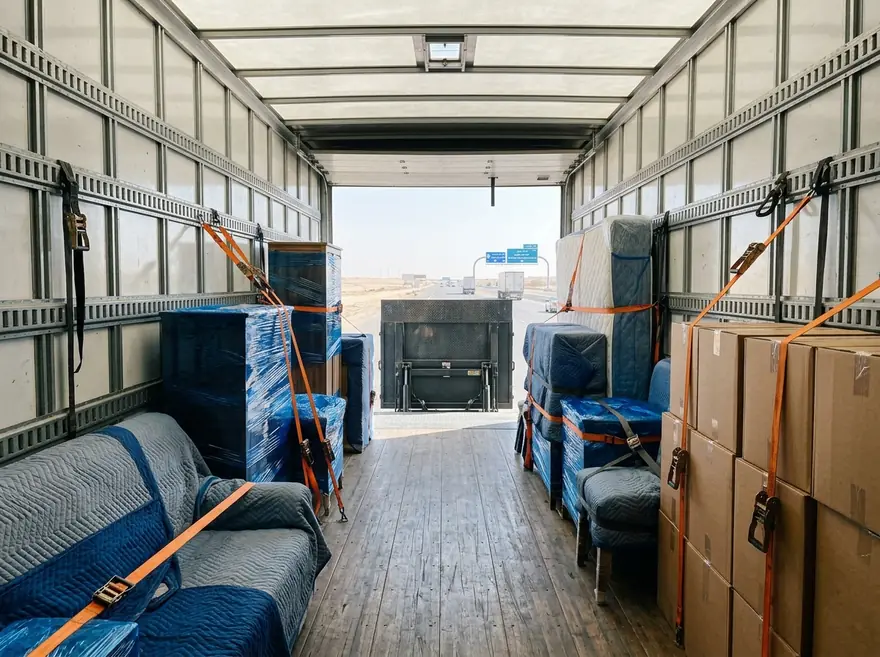
Loading is a plan that runs from the floor to the roof
An empty cargo box is only space. It becomes a test the moment the first piece goes in, because every later decision depends on what was placed before it. Wooden pieces packed tight without separators rub against each other with every vibration. Glass placed beside a sharp corner gets scratched. Appliances left loose behave like heavy projectiles. Good loading starts with three questions: what goes in first, where does it rest, and what supports it?
This page deals only with the inside of the truck. If you still need to decide on vehicle size and the number of trips, read our dyna sizing guide first. If you want to know about wrapping materials, the packing pages cover them. Here we focus on arrangement and securing.
The usual loading sequence for a household move
A stable order that applies to most apartment and villa moves.
Base: heavy, stable appliances and cabinets
Fridge, washing machine and big wardrobes go in first, on the floor and close to the cab end of the box. They are the heaviest and must never lean.
Walls: boards, mirrors and dismantled beds
Flat items stand upright against the side walls between blankets. Laying them flat under other items is how they crack.
Middle: sofas and chairs
Covered and supported against each other so a backrest never presses on the legs of another piece, with small gaps filled by padding.
Top: light boxes and cushions
Remaining cartons are stacked evenly, heavier ones below, and used to fill gaps so nothing can slide.
Lock-in: strapping and a shake test
Before the door closes, straps are tightened and the load is pushed by hand. If anything moves, it is re-secured.
Where common items sit and how they are held
A reference table for the pieces seen in most Eastern Province homes. Exact placement shifts with the shape of the box and the size of the load.
| Item | Position in the box | Securing notes |
|---|---|---|
| Refrigerator | Standing at the front | Strapped upright, door closed, emptied and defrosted beforehand |
| Washing machine | Next to the fridge on the floor | Drum locked, hoses drained and secured |
| Large wardrobe | On its strongest side against a wall | Blankets, corner guards and a strap |
| Dismantled bed frame | Boards upright along the wall | Panels bundled together with face-to-face padding |
| Mattress | On top of boards or along a wall | Fully covered, nothing heavy above it |
| Sofa | Middle layer | Thick plastic cover, never stacked on its legs |
| Glass table top | Upright between blankets | Edges protected, nothing resting on it |
| TV and screens | Upright, mid-load, away from walls | Original box if available, no leaning |
| Cartons | Top layer and gaps | Heavy below, light above, room name on each |
As a rule, heavy and regular shapes go low and forward, flat and fragile pieces stand along the walls, and soft items fill the remaining gaps.
Weight distribution: why a lopsided load is a risk to everything inside
An unevenly loaded truck leans in corners and behaves differently under braking. That matters for the driver, but it also matters for your furniture, because the lean presses items against the walls and against each other. The remedy is simple: spread weight evenly left and right, keep the centre of gravity low and slightly forward.
On longer roads in the region, such as the highways linking Dammam with Jubail or Al-Ahsa, constant vibration exposes any weak securing. Something that looks fixed in a quiet street can shift after half an hour at speed, which is why additional straps and soft separators are used on those routes.
Blankets, straps and separators: what each one actually does
A blanket protects a surface from scratches but does not hold anything in place. A strap holds, but may mark a surface if it touches bare wood. A foam or cardboard separator stops two pieces rubbing. A well-built load uses all three together: wrap the piece, add a separator at contact points, and tighten the strap over the wrap, never directly on the finish.
Friction alone is not securing. If the only thing holding a piece is its own weight, the first speed bump or hard stop will move it. Cross-strapping at several points turns the load into one block that moves with the truck instead of against it. Thin stretch film is also useful to keep drawers and doors shut while the furniture travels.
Items that should never be placed just anywhere
Loading mistakes tend to cluster around these categories.
Glass and mirrors
Stand them on their long edge between padding, with nothing on top. Load them as late as possible so they can come off first.
Electronics
Keep them mid-load, away from the hottest wall of the box, with no pressure on screens. Use the original carton when you still have it.
Liquids and cleaning products
Carry them in sealed, separate crates away from wood and fabric. One leaking bottle can ruin a whole sofa.
Living plants
They need shade and stability and suffer in summer heat. If possible, move them in your own car.
Small decorative pieces
Use padded cartons and place them in the top layer or in a dedicated container so nothing lands on them.
Loading beds and wardrobes that have been taken apart
Dismantling saves space, but it moves the responsibility to the small parts. Screws, cam bolts and brackets should go into numbered bags taped to the piece they belong to, not into one general bag that gets lost among the boxes. Panels belonging to the same bed are bundled together so they cannot be mixed with another set.
A quick photo of each piece before it is dismantled becomes your best reassembly guide. Tool and material details are described on our assembly pages. For loading, the point is simple: a well-organised load of dismantled pieces is half of a successful reassembly.
Last in, first out: unloading follows the loading plan
Unloading happens in reverse, so it is shaped by decisions made at the first address. If your most urgent items should reach the new home first, they need to sit near the door. If the lift or stairs force a certain sequence, the pieces that fit that sequence should be easy to pull out.
On arrival the door is opened slowly because something may have leaned against it. Items are carried in one by one, with the room name or number checked against a list. A final tally of what left against what arrived is the easiest way to catch anything missing before the crew drives away.
A short inspection that prevents surprises on the road
Before the truck leaves, a quick walk-around helps: is the door properly closed, are the straps tight, is there a large empty space where something might slide, and are valuables kept where you can see them? It is also sensible for the owner to photograph important pieces before the box is closed so any later discussion is based on a clear record.
For long routes, a stop halfway to check the straps is a sensible habit, particularly on hot days or after a rough stretch of road. Do not hesitate to ask about this when agreeing the job. Clear questions early set clear expectations.
Questions about loading furniture in a dyna
Answers to what people usually ask before moving day.
Can furniture be stacked on top of other furniture?
Why must a fridge travel upright?
Are blankets enough to protect furniture?
How do I know the load will not shift on the road?
Should I leave things in drawers?
Does the highway affect how the load is secured?
Who decides where each piece goes?
What if everything does not fit in one dyna?
Pages that complete the loading guide
Related services and guides on protecting furniture during a move.
Choosing the right dyna size
How to estimate your load and trips
Multi-layer packing system
Materials and layers that protect pieces
Heavy furniture moving
Large items needing special handling
Moving with assembly
Carpenters coordinated with loading
Bedroom moving
Protecting beds, wardrobes and mattresses
Appliance moving
Fridges, washers and screens done properly
Secure moving
Safety standards for load and road
Request a written quote
Send your move details
Moving Truck in the Eastern Province: What to Ask About Closed, Open and Padded Vehicles
Choosing a moving truck in the Eastern Province: closed, open and padded trucks compared, how heat, dust and distance change the choice, and what to a
Large Moving Truck in the Eastern Province: When Is Bigger the Right Call?
A large moving truck in the Eastern Province: when it beats a dyna, how villas and offices are loaded, and what access limits, timing and long roads m
Furniture Storage in the Eastern Province: How to Prepare, Choose and Plan the Trips
Furniture storage in the Eastern Province: when you need it, how to prepare pieces for heat and humidity, what to ask any storage provider and how to
Furniture winch lifting
Furniture winch lifting in the Eastern Province: when lifting through a window or balcony makes sense for upper floors, how furniture is prepared,…
Dyna moving company
How to choose a Dyna moving provider.
Want your furniture to arrive in one piece?
Send photos of your furniture on WhatsApp or call us, and we will explain how the load is arranged and secured for your move in the Eastern Province.