Moving Out of an Apartment Building in Dammam, Khobar and Beyond
Moving from a villa is simple. Moving from a building means a shared stairwell, a security guard with questions, neighbours who sleep early and a truck that may not find a space. We plan around those realities so your house shifting in the Eastern Province stays calm, clean and on schedule.
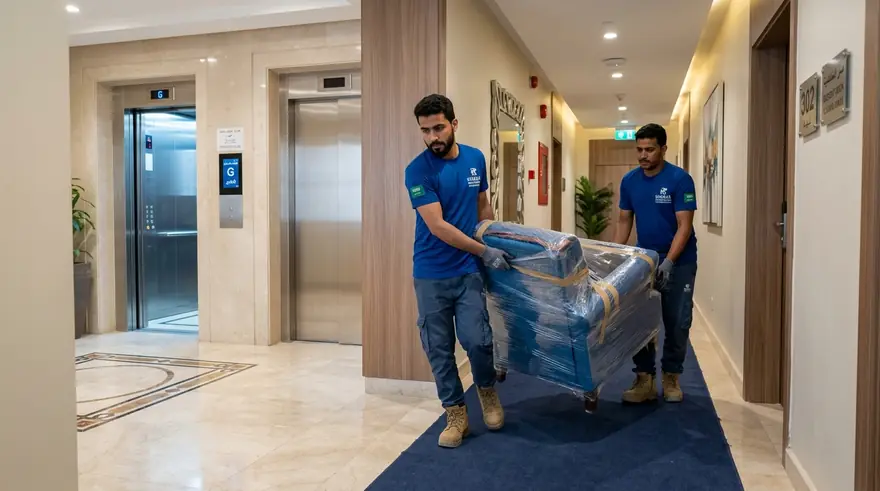
A building move is a group project, even when only you are moving
Expats often arrive expecting a quick job: carry the sofa down, drive away. Then the building guard asks who approved the move, the lift is booked by another tenant and the stairwell turns out to be narrower than the wardrobe. None of this is a problem if it is known in advance.
Our movers and packers handle buildings of every age across Dammam, Khobar, Dhahran, Jubail, Qatif and Al-Ahsa. We ask the dull questions early so that moving day is uneventful for you and for everyone who lives next door.
Who needs to say yes before the first box leaves
Tenants rarely own the building, so a move involves people you may never have met. The guard or doorman controls the gate. A building manager or a property management office may require notice. In buildings sold flat by flat, an owners association might publish rules about moving hours and damage deposits. Your landlord can also insist on a handover condition for the flat itself.
Send one short message to each of them at least a day ahead, naming the moving date, the company and the number of workers. Keep the reply, because a screenshot of approval settles most disputes at the gate in seconds.
- Ask the guard which entrance trucks may use
- Confirm whether the lift can be reserved
- Check allowed moving hours
- Ask if a damage deposit or floor covering is required
- Tell your landlord the vacate date
Keeping the neighbours on your side
Noise is the number one complaint in any apartment building. Dragging a heavy cabinet across a landing at an early hour can create more friction than a scratched wall ever would. Our crews lift rather than slide, speak quietly near doors and keep tools off the ground in shared corridors.
You can help by leaving a note on the neighbouring doors: date, rough hours, and an apology in advance. Families with newborns, shift workers and students during exams appreciate the warning. If someone nearby needs silence at a certain time, tell us and we will schedule the loud jobs, such as dismantling beds, for later in the day.
- Leave a friendly note on your landing
- Avoid prayer times and late nights where possible
- Keep your own door propped open for the crew
- Give the guard your phone number
Parking the truck outside a building: the small detail that sets the pace
On busy Khobar and Dammam streets, cars line both sides in front of residential towers. A closed moving truck needs more room than a family sedan, and the further it sits from the entrance, the more walking every single trip adds. Over a full flat, that distance can double the time spent.
Ask the guard to reserve a spot with a couple of chairs or cones. If the street is truly tight, we can use a smaller vehicle as a shuttle between the door and the main truck rather than blocking the road. Mention the street width and any parking permit rules when you book so we choose the right vehicle.
Old building or new tower: what changes for the move
Every building is different, but these patterns appear again and again.
| Building type | What to expect | How we prepare |
|---|---|---|
| Older block with narrow stairs | Tight turns and uneven steps | Dismantle large pieces and pad corners |
| Newer building with a lift | Small cabin and booked time slots | Pack boxes to fit the cabin |
| Tower with gate and security desk | Name lists and ID checks | Share crew details in advance |
| Shared entrance lobby | Congestion at the main door | Load in sequence, not all at once |
| Underground parking | Low clearance for trucks | Park outside and shuttle items |
| Closely packed flats | Echoing hallways | Cover floors and avoid dragging |
Treat the table as a guide only. A few photos of your stairwell and entrance let us advise on your actual building.
Corridors, lift walls and lobby floors
Damage to shared areas is the thing that follows a tenant out of the building. We lay floor runners from your door to the exit, wrap sharp corners near the stairs and hang protective pads inside the lift. Heavy appliances travel on rubber-wheeled dollies that do not mark marble or tile.
Eastern Province weather adds its own twist. Humid air on the coast and seasonal dust mean shoes and wheels carry grit and moisture inside, so we put extra mats at the door and wipe down before we leave. The lobby should look as clean as we found it, if not cleaner.
Shared lift or stairwell: choosing the right route
A shared lift suits boxes, lamps and light appliances. Booking it for a whole day irritates other residents, so most managers allow a fixed window. We send small items by lift in that window and carry long or awkward furniture by stairs when they fit.
If your building has no working lift, our guide to moving without an elevator explains the extra planning. If you live on a very high level, the page on high-floor moving goes further, so we will not repeat it here.
How we sequence trips between levels
A tidy order keeps the stairwell from becoming a traffic jam.
Walk the route
The team leader checks the gate, lobby, stairwell and lift, and notes the tightest point.
Zone the flat
Rooms are labelled and boxes grouped so small teams work in parallel without colliding.
Big items first
Wardrobes, beds and sofas go while the stairs are empty; boxes follow.
Separate up and down
Where possible one side of the stairs is for descending and the other for returning.
Load for unloading
The truck is packed in reverse order of the new flat, so the first items off are the first needed.
Final sweep
We walk the stairwell and lift with you or the guard to confirm nothing is left or damaged.
What moving day looks like in a five-storey building
The crew arrives, the guard opens the side gate and you have already cleared the landing. The supervisor walks through the flat with you, asking about fragile pieces, then floor runners go down from your door to the street. This takes a few minutes and prevents long arguments later.
Then the rhythm begins: two people wrap inside, two carry down, one stays at the truck to stack. If a neighbour needs to pass, the carry pauses and the way is cleared. Small gestures of respect like this are what make a building remember a move kindly.
What to prepare before loading starts
A little preparation does more than extra workers.
Message to management
State the date, company and number of workers, and ask for lift booking and gate access.
Clear the landing
Remove shoes, bikes and clutter near your door so nobody trips with a wardrobe on their shoulder.
Pack early
Have boxes sealed before we come; see packing materials for what suits each item.
Keep essentials aside
Passports, documents, keys and chargers travel with you, not with the truck.
Utilities and meters
Arrange final readings or disconnection according to your building rules.
Mistakes people make when leaving a building
All of these are avoidable with a quick conversation beforehand.
Loading without approval
The guard stops the crew halfway and hours are lost.
Holding the lift all day
Neighbours complain and management restricts you further.
Ignoring stair width
A new wardrobe is bought that cannot round the landing. Measure the route first.
Truck parked far away
Each extra step is repeated hundreds of times.
Moving at rush hour
Parking disappears when residents return. Plan the day with the moving timeline in mind.
Local questions from tenants in Dammam, Khobar and Dhahran
Many newcomers ask about summer. Heat and humidity on the coast tire any crew, so an early start or a late-afternoon slot is kinder to workers and to electronics. Fridges and screens should not wait inside a hot truck, so we load them close to the end.
Streets and parking differ between cities. Older neighbourhoods in Qatif or Al-Ahsa can have tight lanes, while newer parts of Khobar have wider roads but busier kerbs. Moving between cities in the region is routine for us, and longer routes to Riyadh, Jeddah or other cities are arranged on request.
Unloading at the other end with the same manners
What we do when leaving we repeat on arrival: contact the new guard, request the lift, lay floor runners and protect the lobby. Beds and wardrobes we took apart can be reassembled through our carpenter assembly service, so you sleep in a proper bed on night one.
If your new flat is not ready, part of your belongings can wait in a warehouse by arrangement. Tell us early and we will plan the split between delivery and storage.
Other pages that might fit better
If you live in a gated community with villas and flats, see residential complex moving. If you rent a single flat in a small block, apartment moving in the Eastern Province gives the basics.
If you are moving several flats owned by the same family, or an office from a ground-floor unit, tell us and we will divide the days between units.
Questions tenants ask about building moves
Short answers before you book.
Do I need approval from building management before moving?
What if there is no place to park the truck?
Can the shared lift be reserved for my move?
Who is responsible for damage to common areas?
How should I deal with neighbours who dislike noise?
Can you move me out of an old building with narrow stairs?
Is a night or Friday move possible from a building?
Does the guard or manager have to be present during loading?
More pages related to building moves
Pick the one closest to your situation.
Moving without an elevator
A plan for buildings with no working lift
High-floor moving
Lifting furniture to upper levels
Residential complex moving
Gate and guard rules in complexes
Apartment moving
A guide for single-flat moves
Moving timeline
How to schedule the days before a move
Moving day crew
Who works with you on moving day
Packing materials
Choosing wraps and cartons
Request a quote
Send your building details for an estimate
Ready for a quiet move out of your building?
Send us your building location, floor and whether there is a lift. We will coordinate with the guard and plan the trips between levels.