Moving Within a Managed Residential Complex in Dammam, Khobar and Beyond
If you rent or own a unit in a managed apartment community, your move runs through the community office, a move-in or move-out booking, a service lift and a loading window. We plan around those rules, protect the shared corridors, and carry your belongings out and in without disturbing your new neighbours.
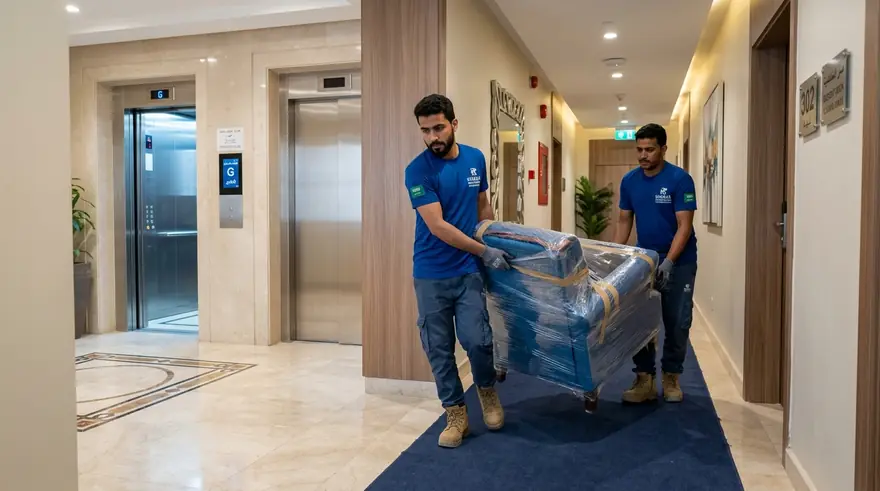
A move that works with the community, not around it
Many expatriates and families arriving in the Eastern Province land in a gated or managed apartment community: several buildings, a leasing or management office, shared parking and a lift that serves dozens of homes. The flat itself is rarely the hard part. The hard part is everything between your front door and the truck.
Our job is to learn the community rules before moving day, then shape the crew, the vehicle and the loading order around them. Everything we describe here is offered on request and subject to coordination with your management office.
What makes a managed complex different from a standalone flat
A managed community is run by a single office that looks after maintenance, cleaning, security at the main entrance and the flow of residents. You share car parks, lifts, stairwells and often leisure areas with neighbours you have not met yet. Every one of those shared spaces is something your furniture will pass through.
That means small questions become real decisions. Where can a truck wait? Is loading allowed at any hour? Is there a dedicated service lift, or must we use the one residents use to go to work? Because every community writes its own rules, we never assume. We ask, write the answers down, and plan from them.
- A management office that receives move requests
- A move-in or move-out form or notice, depending on the community
- Limited shared parking
- Service lifts and loading bays that vary by site
- Neighbours who notice noise and congestion
Complex, compound or single tower: the plan changes
People often use the words complex, compound and building interchangeably, yet the logistics differ. A walled villa compound with guarded gates and entry passes is covered in our guide to moving inside a villa compound. A single block with one stairwell is covered in moving in standalone buildings.
This page speaks to the middle ground: many apartments across several blocks, run by one management team, with shared amenities that must come out of the move undamaged. If you simply live in an unmanaged flat, start with our overview of apartment moving across the Eastern Province.
The management office and your move-out or move-in booking
The first practical step is a short conversation with the community office, ideally well before the moving date. Some communities ask for a written form. Others only need a note at reception. Some want the moving company details in advance. We do not pretend to know how a particular community works, but we know which questions settle it.
Ask about the date and time window, how many vehicles may enter, whether the lift needs to be reserved, and whether the office expects a deposit or an acknowledgement that shared areas will be protected. Once you know, we draft a short plan for you to approve before anything is confirmed.
Keep the office reply in writing or as a screenshot. If a security guard or a neighbour questions the move on the day, a prior agreement settles the matter calmly. If you are juggling a lease handover and an arrival date, build the booking into a clear moving timeline first.
From the first message to the last box
We follow the same sequence in every community so that you, the office and our crew all know what happens next.
Collect the community rules
We ask about the booking form, permitted hours, parking and lift before promising a time.
Walk the route
We map the path from your door to the truck: corridor, lift, ramp and distance, from photos or a visit.
Choose vehicles
We decide whether one vehicle is enough or the load should be divided to suit the parking.
Prepare the protection
Floors, corners and lift walls are covered, and furniture is wrapped before it leaves your unit.
Load inside the window
We work in a steady order that respects lift time and keeps the road open for residents.
Place and tidy
We leave corridors as we found them, then place furniture in the new home as you direct.
Permitted moving hours and the truck parking bay
Many communities restrict moves to certain hours so that residents are not disturbed during rest times or peak traffic. A short window changes how we work. We wrap, dismantle and stage heavy pieces beforehand, so the permitted hours are used purely for carrying and loading.
Truck parking might be a reserved bay by the entrance, a designated loading zone, or a space further away because visitor parking is full. We also need to know the entrance height and turning space, since some gates limit vehicle size. Our guide to moving vehicle types explains how we match a vehicle to the access.
We do not promise a slot that management has not confirmed. If your preferred date is unavailable, we propose the nearest workable alternative, because respecting the rules matters more than saving a day.
Service lifts, loading bays and what each means for loading
The type of lift or bay shapes the method more than the date does.
Dedicated service lift
Suitable for large pieces with padded walls and floor, and usually reserved for fixed hours.
Shared resident lift
Needs more protection and smaller batches so neighbours can still use it.
Loading bay
Shortens the walk to the truck and lets us stage items before lifting.
Block with no lift
May call for winch lifting or stair carrying with extra care.
Guarding corridors, stairwells and common areas
A scratched wall in a shared corridor is a problem for the whole community, and for your deposit. We lay protection over floors and corners at doorways, fit guards inside the lift, and wrap each item with heavy stretch film and bubble layers before it leaves the unit.
Long pieces are carried at planned angles around bends and never dragged. Wardrobes, sofas and big appliances each get their own handling, described in our page on heavy furniture moving. When we finish, we can walk the corridor with a management representative if you wish.
Long walks from block to bay and splitting the load
In larger communities the truck may be parked a good distance from your block. A longer walk adds handling time, tires the crew, and increases exposure to heat and dust. We allow for it with trolleys, extra covers and a crew spread along the route.
When the entrance cannot take a large vehicle, we split the load: a smaller truck that can come and go quickly, or two trips instead of one blocked gate. The split always follows what management allows, so we confirm it first.
Common situations in managed communities and our response
This table summarises what we often see and how we usually respond.
| Situation | What it affects | Our approach |
|---|---|---|
| One temporary parking space at the block | Tight time and resident traffic | Prepare early, load fast |
| Service lift booked by the hour | Staying within the slot | Load in priority order |
| Shared resident lift | Neighbours waiting | Small batches, full padding |
| Parking far from the block | Handling distance | Trolleys and a crew along the route |
| Low entrance height | Vehicle size | Smaller truck, more trips |
| Narrow corridors with bends | Long furniture | Planned angles, corner guards |
| Neighbouring units moving the same day | Bay congestion | Agreed sequence with the office |
These are general cases. Every community applies its own rules, so we confirm details with the management office rather than assuming one standard.
Coordinating a move-out from one community and move-in to another
Moving between communities means two sets of rules in a single day. The first office might allow a morning slot while the second asks for the afternoon, and the truck needs open roads between them. We arrange the schedule so a loaded truck does not wait long at a barrier.
At move-out we focus on handing the unit back empty and clean, since some offices inspect before closing a lease. At move-in we place furniture where you want it so the first evening is already livable. For shorter city hops, see moving within the Eastern Province.
Keeping noise down and neighbours on your side
In an apartment community, sound carries. A trolley rolling on a tiled corridor can interrupt someone working from home. Our crew speaks quietly, lifts rather than drags, and avoids booking the lift at its busiest hours when possible.
We suggest telling the neighbours next to your door that you are moving. A friendly word beforehand prevents a complaint on the day. If someone objects, we pause and speak with the office instead of arguing in the hallway, because you will live there long after we are gone.
What to prepare before moving day
A little preparation from you saves hours and avoids friction with management.
Written approval
Keep the office reply showing date, window, parking and lift.
Clear the path
Remove bikes, shoes and boxes from the corridor near your door.
Prepare the furniture
Empty drawers and shelves and dismantle large pieces ahead of time so they pass lifts and corners easily.
Pack by room
Label boxes with the destination room so placement is quick.
Entry details
Have vehicle plates and crew names ready if the gate asks.
Typical mistakes in managed-community moves
We see the same errors repeatedly, and all of them are avoidable.
Arriving without notice
Security may refuse entry and the reserved window is lost.
Using the wrong lift
A resident lift without padding invites damage and a complaint.
Misjudging the entrance
Assuming a large truck fits, then discovering a height limit.
Packing at the last minute
It eats the limited window and delays loading.
Ignoring the neighbours
One irritated neighbour can stall the whole move.
Eastern Province specifics: climate, cities and distances
The coast is hot and humid for much of the year, with seasonal dust. A long walk from a distant bay in midday heat is tough on a crew and on delicate items, so we cover furniture and prefer milder hours inside what the community permits. You will find managed communities across Dammam, Khobar, Dhahran, Jubail, Qatif and Al-Ahsa, with mixes of apartments, towers and villas.
If you are relocating from a complex in Dammam to one in Khobar, we plan two separate windows, one for each office. Our city pages for Dammam and Khobar show how we cover each area.
Packing, dismantling and short-term storage when needed
Moves in shared buildings call for firmer packing because items brush past lift walls and tight corners. We use thick stretch film, bubble layers, ink-free paper and cartons, and our carpenters dismantle beds and wardrobes and rebuild them on request.
If your new unit is not ready or your old lease ends early, we can hold furniture in a warehouse for a while, arranged on request. None of these add-ons is compulsory; you choose what fits, and we confirm each one with you before moving day.
Questions residents ask before moving in a managed complex
Short answers to common questions from people moving in or out of apartment communities.
Do I need to tell the community office before my move?
What happens if my permitted moving window is short?
How is a managed complex different from a villa compound?
Will you protect the lift and corridors?
Can you use more than one vehicle for my move?
Can you move me between complexes in different cities?
Do you dismantle and rebuild furniture inside the unit?
How do I get a quote for a complex move?
Related moving guides
More pages that match your type of home and the way you plan to move.
Villa compound moving
For walled compounds with gated access
Moving in standalone buildings
For single blocks and stairwells
High-floor moving
For towers and upper levels
Apartment moving
General flat moves in the region
Moving timeline
Plan the days around your handover
Furniture packing
Layers, materials and cartons
Request a quote
Share your complex details
Furniture storage
Warehouse space when plans slip
Ready to move within your community?
Tell us the city, the type of complex and whether management has approved your date, and we will plan a loading routine that fits its rules.