Moving Into or Out of a Gated Compound in the Eastern Province
If you are relocating to a gated compound in Dammam, Khobar or Dhahran, the move starts at the security gate, not at your front door. We help you line up the visitor list, the gate pass, the allowed hours and the right truck size, so the crew is waved through instead of waiting outside.
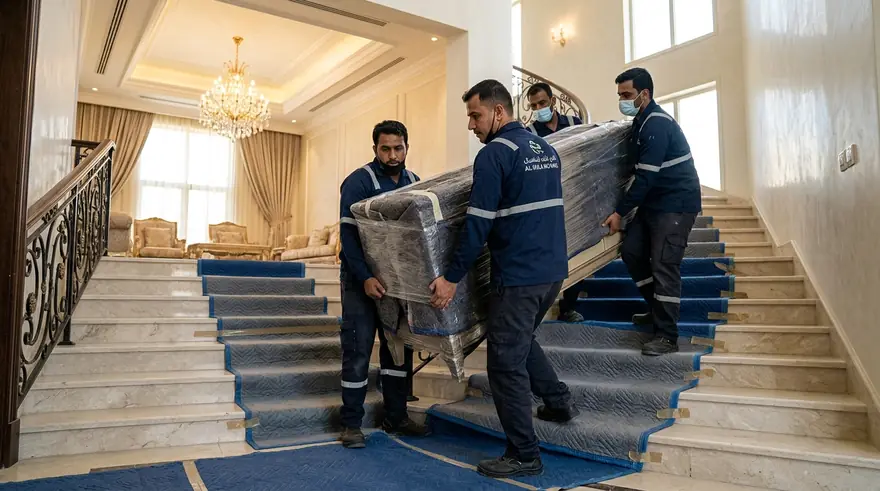
Why a compound move is a paperwork job before it is a lifting job
A compound is a group of villas or townhouses behind a perimeter wall, with a guarded entrance and a management office. Residents enjoy the privacy, but anyone arriving with a truck is treated as a visitor who must be expected, named and logged.
Newcomers often learn this the hard way. The truck arrives at eight, the guard has no name on the list, and the crew idles in the heat while someone phones the landlord. We would rather you spent ten minutes on the phone the week before, and we will tell you exactly what to ask.
Open street versus guarded entrance
On an ordinary street, a truck pulls up and loading begins. Inside a compound there are layers: the gate, the security office, the internal road with its own speed limit, and the parking spot that may be a short or long walk from your door. Each layer adds a question that needs an answer in advance.
Rules differ from one compound to the next, so we never assume. One may only need a phone call from the resident, another a signed form from the management office. We build the plan around what your own compound confirms.
This page is about gates, permits and internal roads. If you live in a managed apartment complex instead, read our guide on moving within managed residential complexes. For the packing and handling of the villa itself, see villa moving in the Eastern Province.
The visitor list, crew details and vehicle registration
Most compounds want names before arrival. Expect to supply the full name of each crew member as shown on their ID, the truck type and plate, the villa number, and the time you expect them. Some offices take this by app, some by message, some by a paper form handed to the guard.
Send the list early. Management offices can close for weekends or reduce hours, and a request made on the evening before may not be read until after the move should have started. If the crew changes or a second vehicle is needed, tell the guard as soon as you know.
You remain the contact the guard will call. Keep your phone on, and give us the number of anyone who can answer for you if you are travelling or already at the new address.
- Full names of crew as printed on ID
- Truck type, color and plate
- Villa or house number and resident name
- Expected arrival and departure windows
- One reachable phone number at the gate
Gate pass, landlord approval and management office sign-off
Tenants usually do not control the gate themselves. Your landlord or the compound management may need to approve the move, and some compounds ask for a move-in or move-out request form. Ask for the process in writing, even if it is only a message, so you can show it if the guard questions it.
If you are leaving, the office may inspect the villa or collect keys and access cards. If you are arriving, they may issue cards or stickers for your own car after the move. None of this is difficult, but it does set the order of the day, which is why we ask about it at booking.
Keep a copy of the approval on your phone. Guards change shifts, and the person at the gate may not be the one who logged your name earlier.
What to ask the compound management before you book
Six short questions that remove most surprises.
Is a written pass needed?
Ask whether a phone confirmation is enough or whether a form is required, and who receives it.
What hours are trucks allowed?
Many compounds set quiet hours. Get the window in writing, then compare it with evening moving options if daytime is limited.
Is there a truck size limit?
Ask about the tightest turn or lowest branch on the route, then read about vehicle types for moving to choose a fit.
Where may the truck park?
Some villas have a drive, others rely on a shared bay. Ask if the street may be blocked briefly.
Is a deposit or booking needed?
A few offices reserve loading time or ask for a refundable deposit. Better to know than to guess.
Who is the contact on moving day?
Name one person to speak with the guard and one for the crew, so calls do not pile up.
Inner roads, tight bends and what truck fits
A big truck is not always the smart choice. Compound roads can be narrow with speed bumps, parked cars along the kerb, low palm fronds and sharp turns around green areas. Before we commit to a vehicle we ask for photos or a short video from the gate to your door.
Often a smaller closed truck makes two trips more easily than one large truck makes a hard one. Our notes on Dyna truck moving explain where a compact vehicle helps, and the page on large truck moving explains when the bigger option is worth it.
If you prefer a large truck on the main road, some compounds permit a transfer point near the entrance, where goods are shuttled in smaller vehicles. That depends on management consent, so ask before it becomes the plan.
The carry from the parking spot to your door
Distance matters more than people expect. A truck parked at a visitor bay a few villas away means every box and cabinet takes a longer walk, and the crew needs more hands or more rests. Paved paths help trolleys, while gravel, grass or steps make heavy items slower.
At booking we ask where the truck is likely to stop and what the path looks like. Wardrobes, fridges and sofas are the pieces that decide the plan. Our guide to heavy furniture handling shows how we protect floors and doorframes when the route is awkward.
On the coast the humid heat and seasonal dust make long outdoor carries tiring. We schedule rests, wrap upholstery well and keep drinking water available for the crew.
Entry hours, exit times and internal speed limits
Compounds often allow trucks only in a set window, and some forbid moves during midday prayer time, school pickup periods or late evening. Plan the biggest work early in your window, and leave a margin so the last trip clears the gate on time.
Internal speed limits are low because children and cyclists use the roads. Our drivers stay under the posted limit, and slow down further near play areas. Guards notice, and so do residents, and a calm arrival makes the management office more helpful next time.
If you need a different window, ask whether weekend or off-hour entry is possible. We can plan around it, as long as the compound agrees first.
Living with neighbors on moving day
A compound is a small community, so noise and obstruction are noticed. We ask the crew to speak quietly, keep walkways clear, remove packing waste as they go and never block a neighbor driveway.
It helps if you tell the closest neighbors the date. A short note on their door or a message in the residents group is enough. It costs nothing and avoids complaints that could reach the management.
If there is a newborn, someone unwell or a family studying for exams next door, move the noisy jobs such as dismantling beds to a different part of the day. Our page on the moving day crew describes how the team behaves on site.
How different compound situations change the plan
This table shows general patterns, not rules of any named compound.
| Situation | How the plan adapts | What we need from you |
|---|---|---|
| Guard keeps a pre-approved list | Crew names and plate sent ahead | ID names and truck details |
| Narrow inner roads | Smaller truck or extra trips | Photos of the route |
| Parking far from the villa | More hands and trolleys | Where the truck may stop |
| Strict entry window | Heavy work first, margin at the end | Written hours from the office |
| Landlord lives abroad | Approval routed through an agent | Landlord or agent contact |
| Two villas on one day | Separate crews, staged timing | Details of both addresses |
Find the row nearest your case and tell us. We adjust the plan from there.
Our step-by-step approach to a compound move
A sequence that works for most compounds, adjusted to the office requirements.
Share the basics
Tell us the city, villa type, compound entry method and whether anyone stays at the gate.
Confirm office rules
You or your landlord ask for hours, pass requirements and truck limits.
Choose the vehicle
We pick a truck and crew size to match the road width and carry distance.
Register the crew
The visitor list and vehicle details reach the security office before the day.
Load and protect
The crew enters, parks where agreed, wraps items and guards doorways and floors.
Exit and hand over
We leave within the window and deliver at the new gate with the same checks.
Leaving one compound and entering another the same day
Many expats finish a lease in one compound and begin another the same day. The challenge is timing. The first office may want the truck out by early afternoon, while the second may not open its gate until later.
When the windows clash, a short overnight stay in a warehouse can ease the pressure. Read about furniture storage if you expect a gap. If both addresses are in the same compound, one crew and a simple sequence are usually enough.
Assign one person to each address: one to release and check out, one to receive and direct. That avoids a crew standing between two doors, each waiting for a decision.
Handover at the old gate and the new gate
At the old compound the guard may ask to see the items leaving, or ask for the pass. Keep documents handy. Anything that leaves should match the list you were approved for, and the office may hold your deposit until they confirm the villa is clear.
At the new compound the guard checks the truck against the list, directs it to the parking spot and may issue a temporary pass. Someone who represents you should be there, since a truck waiting at the gate with nobody to answer is a common delay.
Inside, decide which rooms get which boxes before the crew arrives. If beds and wardrobes need reassembly, our disassembly and reassembly guide explains what the carpenters handle.
What to prepare before moving day
Preparation saves more time than extra labor. This checklist is what we go through with you, and you can share it with a landlord or property agent.
- Approval or pass saved on your phone
- Visitor list confirmed with the guard
- Walkways cleared and your own car moved
- Loading bay reserved if the office allows
- Boxes labeled by room using a room by room packing plan
- Close neighbors informed of the date
- Fridge emptied and defrosted ahead of time
- New villa keys and access cards ready
Common mistakes when moving into a compound
The same errors appear again and again, and nearly all disappear with an early question.
- Arriving unannounced at the gate
- Assuming the last compound rules apply to the new one
- Booking a large truck without checking the bends
- Forgetting the distance from parking to the villa
- Starting so late that the entry window closes
- Leaving boxes and wrap in shared walkways
- Skipping the exit formalities with the office
If you make one of these, a call to the security office usually fixes it, but a calm day with no emergency calls is better, and that is what planning is for.
Eastern Province questions for newcomers
Gated communities are common across Dammam, Khobar, Dhahran, Jubail, Qatif and Al-Ahsa, ranging from rows of attached villas to detached houses inside a wall. What they share is a gate and a management office, though the details change from place to place.
Hot humid weather on the coast and seasonal dust shape the schedule: we favor cooler hours for outdoor work and wrap furniture to protect it. Our guide to packing by material explains how.
We work on request and by coordination across the region and between its cities. Tell us your city, villa type and how the gate works, and we will confirm what is practical.
Frequently asked questions about compound moves
General answers, with each compound own rules as the final word.
Do I need a gate pass for the moving truck?
What details does the security office normally ask for?
Can I move at any hour I like?
What if the roads inside the compound are too narrow?
Do I have to be at the gate myself?
How do you handle leaving one compound and entering another on the same day?
How do I keep neighbors happy during the move?
Do you cover compounds in all Eastern Province cities?
Related moving guides
More pages to help you plan the rest of your move.
Managed residential complex moves
For apartment complexes with building management.
Closed truck moving
Protection from dust and humidity on the road.
Professional moving service
How a moving day is organized from start to finish.
Villa moving
Packing and handling for whole villas.
Moving vehicle types
Choosing a truck for narrow roads.
Moving timeline
When to start each task before the move.
Request a moving quote
Send your villa details for review.
Moving checklist
Practical steps before moving day.
Plan your compound move before the truck reaches the gate
Send your city, villa type and how your compound handles entry. We will go through passes, hours and truck size with you, on request and by coordination.