Moving Up the Stairs: Walk-Up Apartment Movers in the Eastern Province
Living on the third floor of a building with no lift changes how a move works. We check the stairwell, the doors and the turns in advance, take apart what will not fit, carry heavy items with straps and a rotating crew, and protect rails, walls and tiles so your belongings and your deposit arrive intact.
What changes when your building has no elevator
If you have rented a flat in Dammam, Khobar or Al-Ahsa and discovered on viewing day that the building has stairs only, you are in good company. Plenty of low-rise blocks in the region were built without lifts, and tenants of every nationality end up carrying a sofa past a landlord who asks whether it will fit.
The short answer is that it usually does, provided somebody thinks about the route before the first box leaves the flat. We look at the stairwell, the landings and the doorframes first, then decide who carries what, what gets unscrewed, and what might be better lifted from outside. That planning is the whole difference between a calm morning and an argument on the second landing.
Why stairs change the effort, even for a modest apartment
People tend to judge a move by the number of rooms. On a staircase the number of rooms matters less than the number of landings, the width of the passage and how many awkward items you own. A one-bedroom flat with a deep sofa and a tall fridge can take more care than a larger flat full of flat-pack furniture.
Time stacks up in small stops: waiting for a neighbour to move a bicycle, adjusting a grip at every corner, letting the crew breathe on a landing. Each is minor, but together they decide the length of the day. That is why we ask for the floor number, the building type and a few photos before we talk about scheduling.
We do not quote from guesswork. Once we understand the stairs, the item list and the access, we explain the factors involved and give an estimate through our moving cost breakdown process, coordinated with you in advance.
The stairwell measurements that matter
None of these needs special tools. A tape measure and ten minutes with a phone camera are enough to start.
Clear width
Measure from the wall to the handrail, not wall to wall. Rails and wall lights eat into the space a two-person lift actually needs.
Step height and depth
Tall, shallow steps force the carriers to shorten their stride. We arrange the crew accordingly and choose between tilting and carrying level.
Turns and landings
A half-turn landing is where long furniture jams. We check the landing depth and the headroom before deciding how a sofa or mattress rotates through it.
Headroom
Staircases that pass under the next slab can have a low ceiling. We avoid raising tall items upright there unless we know they clear.
Surface and lighting
Polished tile, dust from outside, or a dark stairwell makes a fall far more likely. For crew safety we also follow our workers safety guidance.
Measuring doors and corridors, in both buildings
A wardrobe can climb three floors without trouble and then stop dead at the bedroom door. So we measure the door opening with the leaf fully open, allowing for hinges and handles, and compare it with the smallest dimension of the biggest item. Corridors with a sharp turn deserve the same attention.
Do the same at the destination if you can. A flat you are moving into may have narrower doors than the one you are leaving, and discovering it on the landing wastes everyone’s energy. A photo of the new entrance and a width measurement sent in advance takes a minute and can save an hour.
Large sofas need a diagonal check rather than a width check. Our guide to sofa moving explains how we judge whether a sofa passes whole, loses its legs, or needs another route.
Disassembly: a small job that saves a long climb
Wardrobes with sliding doors, solid wood beds and big dining tables are the first things we consider dismantling. Flat panels are easy to pass on a stair and much less likely to scrape the paint. We bag every screw, label it, and tape the bag to the piece it belongs to.
Our carpenters handle this as part of the service, arranged on request and coordinated beforehand. The process is covered in the disassembly and reassembly guide. Not everything should be taken apart: old chipboard can crumble when screws are removed a second time, and in that case we talk it through with you before deciding.
Our rule of thumb is simple. If an item travels safely in one piece, we leave it alone; if the staircase forces risky angles, we dismantle it and rebuild it upstairs.
Straps, spotters and a rotating crew
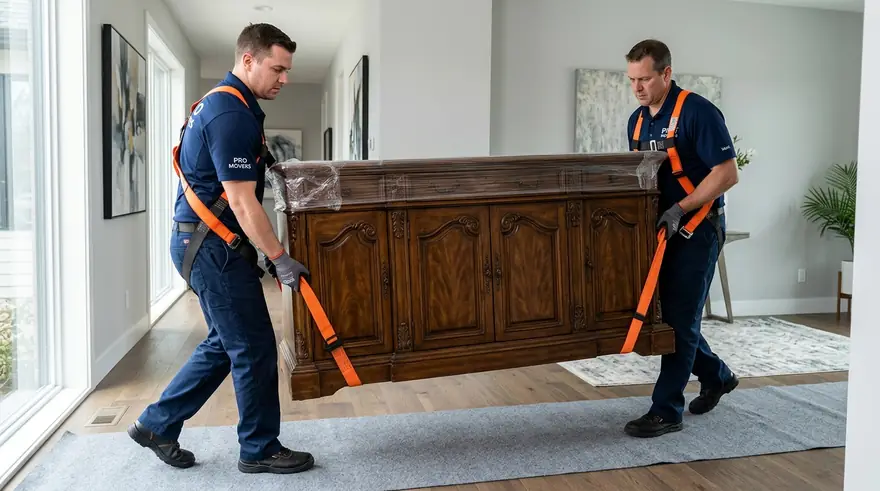
Lifting straps move some of the load from the hands to the shoulders and let two people carry a heavy cabinet with a straighter back. They are most useful for fridges, bookcases, desks and dressers where a bare-hands grip is poor. The person walking backwards always has a spotter, because the person below cannot see their own feet.
On the day the roles are usually split: someone at the bottom counting and sorting items, a pair or more on the stairs, and someone at the top who decides where each piece goes. Rotation matters on tall buildings, since fatigue builds with every flight and accidents tend to come late in the job.
The crew structure is explained further in our description of the moving day crew, and the exact numbers depend on the floors, the load and the layout.
Getting a washing machine and a fridge up a staircase
A fridge-freezer and a washer are the two things tenants worry about most. We empty them, secure doors with tape, cap or tie off hoses, and wrap corners before lifting. A fridge can be tilted only a little, then left upright for a while before switching on, as the manufacturer advises.
Appliances go on straps with a guide watching every step. If the stairwell is too tight or the appliance too bulky to be safe, we say so and discuss the outside-lift alternative rather than forcing it through.
For more on preparation see our appliance moving page. A note on scope: we move and place appliances, but disconnecting and reconnecting electrical or plumbing work is for a licensed technician you arrange yourself.
Rails, walls and floor tiles: avoiding damage and disputes
Tenants lose deposits over scuffed paint and chipped steps far more often than over broken furniture. So we pad the corners at each turn, cover the edges of the steps, and lay protection over slippery or polished entrance floors before the first load goes through.
Furniture itself is wrapped in layers of stretch film, bubble wrap and cartons depending on its surface. Our overview of packing materials explains which layer goes on which item.
Some buildings ask for notice or a set time window. A short message to the landlord, caretaker or neighbours the day before avoids awkward encounters on the landing, especially if the stairwell is shared with several families.
Working safely in the Eastern Province climate
Summers along the Gulf coast are hot and humid, and a closed stairwell can feel like an oven. Hands sweat, grip weakens, and tired carriers are more likely to slip. We prefer to start when the day is cooler where schedules allow, keep water for the crew, and schedule short pauses on landings.
Our basic rules are simple: one voice calls the steps, nobody walks backwards alone, and a load that blocks someone’s view always has a helper. If an item turns out to be unsafe to carry, we stop and choose another method rather than push on.
Seasonal dust can also make steps slippery and gets onto upholstery, so we cover soft furniture when crossing open stairwells and may postpone the job on a very dusty day if you prefer.
Which carrying method suits which item
A rough guide only. The final decision depends on your actual staircase and the item.
| Item | Usual approach | Note |
|---|---|---|
| Cartons and light items | Hand carry, in batches | Keep the stair clear while stacking |
| Sofas and armchairs | Tilt and rotate with edge padding | Legs or frame removed if needed |
| Wardrobes and beds | Dismantle, carry panels | Label parts and keep screws bagged |
| Fridge and washer | Straps, extra carrier, spotter | Door taped and hoses secured |
| TVs and mirrors | Upright carry in protective wrap | Never flat across a landing |
| Piano or very bulky pieces | Special assessment, maybe an outside lift | Arranged on request |
If something you own does not fit any row, show us a photo and we will suggest the safest method for your stairs.
When an outside lift beats the staircase
Some pieces simply do not belong on a narrow, twisting stair. If the stairwell is tight and the item is large, lifting through a window or balcony can be gentler on both the item and the building. That depends on a suitable opening, working space below and clear surroundings, as explained on our winch lifting page.
It is offered on request after we have seen the site, and you are not obliged to use it. Often the best plan is a mix: most items go up the stairs, and the single awkward piece goes over the balcony.
How many trips will it take?
We cannot promise a number without seeing your belongings, but we can show how we think about it. We sort items into light ones that go in batches, medium ones that need two people, and heavy ones that need a strapped crew. Each class has its own pace.
The cleanest way to reduce trips is uniform cartons. Boxes of the same size stack tightly, are easy to grip and do not tumble on the landing. Overloading one huge box is the classic mistake; several smaller boxes are kinder to backs and stairs alike.
Tell us your floor, the number of rooms and roughly how many big pieces you have, and we will plan the crew around it.
How a walk-up move runs from start to finish
A predictable order keeps the stairwell free and the day calm.
Walk the route
We go over the stairs, landings and doors with you and agree what will be dismantled.
Set up protection
Corners, rails and shiny floors are covered before heavy items move.
Take apart and wrap
Wardrobes and beds are dismantled, items are wrapped in layers, and screws are labelled.
Carry in rotation
The crew splits between bottom, stairs and top, swapping roles to share the effort.
Place and rebuild
Items are put in the right rooms and dismantled furniture is reassembled as agreed.
Final walkthrough
We check the route with you, remove the protection and sweep the stairwell.
What to prepare before the movers arrive
A little preparation on your side makes the day shorter and the stairwell safer. This is the checklist we give most tenants:
- Clear the landings and stairs of shoes, bikes and boxes
- Label cartons by room and keep heavy things in small boxes
- Empty drawers and remove fragile items from cabinets
- Tell the landlord, caretaker or neighbours the time of the move
- Measure the new flat’s door and send us the number
- Keep a loading space free; see our vehicle types guide
- Defrost and drain the fridge and washer early so they dry
- Keep ID, keys and valuables with you, not in the truck
If you want a printable version, our moving checklist covers the rest.
Common mistakes people make with stairs
We see the same errors again and again, and almost every one is avoidable:
- Assuming the sofa will fit without measuring the turn
- Leaving fridge and washer full or connected
- Trying to carry a whole wardrobe with two people and no plan
- Packing all the books into one giant box
- Skipping wall and rail protection to save a few minutes
- Moving at the hottest hour without water or breaks
- Telling the movers only on the day that the building has no lift
Tell us about the stairs when you book. It is the single most useful piece of information you can give.
Local questions from tenants and newcomers
Across Dammam, Khobar, Dhahran, Jubail, Qatif and Al-Ahsa you find a mix of villas, low-rise apartment blocks without lifts, towers and gated compounds. Stair width and design differ from one building to the next, so we never assume that two walk-ups behave alike, even on the same street.
Newly arrived expats often sign a lease before seeing the stairwell. If that is you, send us a photo of the entrance and stairs and we can tell you in advance whether anything will be a problem. If you are moving between towns, see our page on moving within the Eastern Province.
We can also arrange evening or weekend moves on request, which many working tenants prefer. For the broader picture on apartment blocks, read about moving out of apartment buildings.
Questions about moving without an elevator
Short answers to what tenants ask before a stairs move.
Can you move me out of a third-floor flat with no lift?
How do you check whether my sofa will fit up the stairs?
Do you take furniture apart before carrying it?
Is it safe to carry a fridge or washing machine up the stairs?
Will you protect the stairwell from damage?
When would you use an outside lift instead of the stairs?
What affects the estimate for a walk-up move?
How do I book movers for a building with no elevator?
More moving help in the Eastern Province
Pages that go well with a stairs move.
Moving out of apartment buildings
The wider view of apartment block moves.
Winch moving
An outside-lift option for items that will not take the stairs.
High-floor moving
Planning a move from upper floors of towers.
Heavy furniture moving
Handling bulky and weighty pieces.
Apartment moving
A full apartment move from packing to setup.
Furniture assembly
Carpenters to dismantle and rebuild furniture.
Appliance moving
Preparing fridges and washers for transport.
Request a quote
Send your details to get an estimate.
Tell us about your stairs before moving day
Send the floor, a few photos of the stairwell and your biggest items. We will plan the carry, the protection and any alternative with you in advance.