Moving with Packing in Dhahran: Layers, Materials and the Order of Work From Room to Truck
Packing is the first line of defence for your furniture. Between your door, the truck and the new door, pieces face rubbing, knocks, dust, damp and heat, and good packing is what lets them arrive as they left. But packing is not plastic wrap on everything. Each material has its own method: wood differs from glass, leather from marble, a screen from a mattress. This page explains how a move with packing works in Dhahran, the materials and layers, the correct order of work, what you can prepare yourself and what to ask whoever carries out the move.
What packing actually protects against
Packing guards against three risks: rubbing that scratches surfaces, knocks that break edges and glass, and the environment, meaning dust, damp and sun. Each risk has a material that suits it: blankets stop scraping, bubble wrap and cardboard absorb shocks, and protective covers keep dust out. Use the wrong material and its value disappears or it does harm.
In Dhahran, where pieces often pass between villas, compounds and apartment blocks, protection also covers the building that the pieces move through.
Layer one: the surface closest to the piece
The first layer is soft and clean so it will not scratch: ink-free paper, cloth or a thin blanket. Its job is to prevent direct rubbing and keep dust off the surface. Glossy and painted pieces get it before any firmer layer. Avoid plastic stuck directly to wood or paint because it can trap moisture and leave a mark.
The one essential is that this layer is clean; a grain of sand caught under the cover becomes a scratch with the first vibration.
Layer two: absorbing shocks
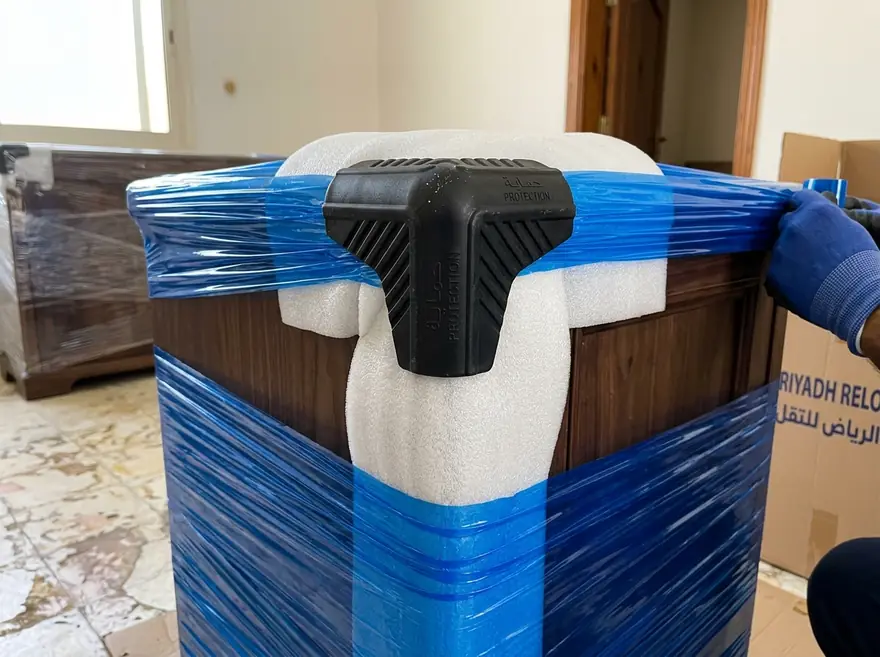
Over the first layer goes one that absorbs impact: bubble wrap for glass, screens and small items, foam or corrugated board for edges and corners, and thick blankets for large wooden pieces. It is held with straps or tape that do not touch the surface. The aim is that the wrap takes the knock, not the piece. See our packing system page for the detail.
The heavier the piece, the thicker the layer at points that may hit a wall or a stair.
Layer three: the outer cover
The outer layer holds the rest and shields it from dust and damp: stretch film or breathable protective covers for soft furnishings. Do not leave upholstered pieces sealed for days, because trapped moisture causes smells and stains. Remove these covers after arrival and let pieces breathe. Natural wood and leather suit covers that let air through.
In Dhahran, where humidity is high for much of the year, this matters more.
Suitable packing for each piece
A quick summary of what is normally used.
| Piece | First material | Extra protection | Note |
|---|---|---|---|
| Wooden cabinet | Clean blanket | Corner guards and tape | Empty the drawers |
| Leather or fabric sofa | Breathable cover | Outer dust layer | Never sealed for days |
| Marble table | Soft layer | Bubble wrap and foam edges | Carried upright |
| TV or screen | Bubble wrap | Rigid box | Carried upright |
| Mirrors and pictures | Clean paper | Cardboard boards and bubble wrap | Travel standing |
| Crockery and glass | Paper and bubble wrap | Strong corrugated boxes | Mark fragile boxes |
The table is general; exact materials are fixed after we see your pieces.
Packing crockery, glass and ornaments
Each fragile piece is wrapped separately in paper and then bubble wrap, packed in strong corrugated boxes, with gaps filled with crumpled paper so nothing shifts, and the box is marked fragile and which way up. Nothing heavy goes on top of glass boxes. Valuable sets travel in boxes with dividers between pieces.
It is wise to carry your most precious small items yourself.
Packing screens and electronics
A screen is covered with a soft layer, surrounded with bubble wrap and put in its original box if you still have it, or in a rigid one. It travels upright and secured. Cables are separated and bagged with the device name, and the rear connections are photographed before dismantling. Office equipment is wrapped with shock-absorbing material and protected from dust.
Do not put anything on top of wrapped screens and do not leave them in the sun waiting for the truck.
Packing soft furnishings, clothes and curtains
Soft furnishings and clothes need breathable bags or dedicated boxes, and must be completely dry beforehand. Hanging clothes travel in wardrobe boxes if available, and curtains are rolled with their rails kept together. Bedding goes into clean bags. Avoid stacking these light items under heavy ones to prevent creasing and soiling.
Emptying drawers early and boxing clothes lightens the load and protects wooden furniture.
What you pack and what you leave to the crew
You can prepare small boxes: books, ordinary kitchenware, clothes and household tools, packed in strong cartons and labelled with contents and room. Large and delicate pieces, such as marble, mirrors, screens and upholstered cabinets, are better left to the crew with their materials and experience. If you decide to wrap something yourself, ask about suitable materials and do not rely on ordinary plastic.
Agree beforehand what the crew supplies and what you must provide, such as boxes and paper.
Order of work from room to truck
Work usually begins with rooms that will be needed last, then large pieces, and the everyday rooms at the end. Furniture is wrapped room by room and boxes are placed at the room door, then carried according to the truck plan: heavy and stable items low and near the front, medium items next, light and fragile pieces in protected spots. Items that unload first go nearest the door.
This order saves unloading time and reduces carrying inside the new home.
Protecting floors, lifts and doors
Packing is not only about the furniture. Boards or covers are laid on marble and parquet floors in corridors, lift walls and doors are covered, and door frames and corners are protected. This protects the home and keeps good relations with management and neighbours. Ask the crew what materials they use and how.
In compounds that demand lift protection, it may be a condition of being allowed to move.
Dust and humidity in Dhahran
The eastern coast is humid in most months and dust travels with the wind. So furniture should travel in a closed clean truck, should not wait wrapped on the pavement, and covers should come off on arrival so the pieces can breathe. Wood and soft furnishings are especially sensitive to trapped moisture.
If you are moving in a humid season, tell the crew so they choose covers that let air through.
How long packing takes
Time depends on the amount of crockery, number of delicate pieces and number of rooms. A small flat may need a few hours, and a villa with a lot of furniture may need a day or more of preparation. Part of the packing can be done the day before for items you do not need daily, easing pressure on moving day. Agree this in advance.
Do not rush packing at the last minute; hurry causes more breakage than anything else.
Common packing mistakes
Mistakes include newsprint on glossy surfaces so the ink marks them, sealing wood tightly in plastic, putting books in large cartons that become too heavy, leaving gaps in crockery boxes without filling, not writing the room on boxes, wrapping damp items and stacking fragile boxes beneath heavy ones.
A skilled crew avoids them with simple steps and the right materials.
Labelling and organising boxes
Write on each box the room it belongs to and a brief note of the contents, with "fragile" where needed. Number boxes if there are many so you can check at unloading, and keep a list of important ones on your phone. Keep a first-night box with the basics you need.
This organisation makes settling into the new home much faster.
Moving to nearby cities with packing
If you are moving to Al Khobar or Dammam, the trip is short but vibration and stops at lights still move the load, so packing is secured and pieces strapped. On longer journeys extra securing and double wrapping are added to fragile items. A closed padded truck helps reduce vibration.
For priceless items you can ask to take them in your own car or in a separate load.
Packing together with dismantling
Pieces are dismantled first, then their panels are wrapped and their edges and hinges protected. We have combined both in the page on Dhahran moving with assembly and packing for people who want both, and for dismantling alone see moving with assembly in Dhahran.
If you do not want everything wrapped, point out which pieces need special protection and send their photos.
Judging the quality of packing
Look at whether glossy surfaces have a soft layer first, whether corners are protected, whether screens are upright and wrapped, whether crockery is separated, whether gaps are filled and whether covers trap moisture. Remember that excessive wrapping is not necessarily better if it does not suit the material.
Ask the crew to explain what they do for any piece you care about; skilled people explain easily.
Packing luxury furniture and ornaments
Luxury sets, decorated mirrors and metal or glass ornaments have both material and sentimental value. They are photographed before wrapping, decorative areas get a soft layer that will not stick to paint, cardboard dividers surround them and they sit where nothing presses on them. They do not travel with heavy loads, are listed separately and are reviewed with you at unloading.
If you can carry some of them in your own car, that is the safest option because they leave the load altogether.
Packing large appliances
Fridges, washers and ovens are emptied, cleaned and dried, their doors and moving parts are fixed with suitable tape, they are covered against scratches and stay upright. Check the manufacturer's advice on how long to wait before switching on. Do not carry them by protruding handles unless designed for it.
Gas and water connections are best handled by someone competent to avoid leaks.
Materials to avoid
Do not rely on thin bin bags to protect wooden surfaces, or coloured newsprint on pale surfaces, or strong tape directly on paint or varnish, which may lift it when removed. Do not use damp towels around soft furnishings.
Clean materials made for moving, suited to each surface, are the better choice.
From inventory to unwrapping
Six stages in sequence.
Inventory and photos
We identify delicate pieces and estimate materials.
Advance preparation
Small boxes packed and drawers emptied.
Packing
A soft layer, an impact-absorbing layer and an outer cover.
Loading
Truck planned and loads secured.
Unloading
Each box goes to its room and pieces are checked.
Unwrapping
Pieces breathe, are inspected and any comment is noted.
Questions about moving with packing in Dhahran
Short answers about materials and order.
What packing materials do you use?
Is packing included in the price?
Should I pack the boxes myself?
How do you move screens?
Does sealed wrapping harm wooden furniture?
Do you protect floors and lifts?
Do you move from Dhahran to Khobar and Dammam?
How do I get an estimate?
Related pages on packing
More about moving in Dhahran.
Movers in Dhahran
Our main page for moving inside Dhahran
Dhahran moving with assembly
How pieces are dismantled and rebuilt
Moving with assembly and packing in Dhahran
Both services together
Furniture moving in Dhahran
Protecting each type of furniture
Moving with packing in Al Khobar
Packing in Khobar
Moving with packing in Dammam
Packing in Dammam
Packing system
Layers and materials
Request a written quote
Send your details for a clear estimate
Furniture packing in Dhahran
Furniture packing in Dhahran: layers of protection, wrapping materials, labelling boxes, packin
Moving crew in Dhahran
Moving crew in Dhahran: what workers do and do not do, preparing hallways and compound access,
Moving with packing in Qatif
Packing materials and stages in Qatif.
Moving prices in Dhahran
Moving prices in Dhahran: how gated compounds, entry permits, short distances, housing handover dates and uni…
Want packing that really protects your furniture?
Send photos of the delicate and large pieces. We specify the packing for each one and give a written estimate, no obligation.