Furniture Assembly and Disassembly in Qatif: Done in the Right Order
Most furniture damage does not happen on the truck. It happens in a rushed teardown or a disorganised rebuild: a missing screw, a snapped hinge, a door that sits crooked afterwards. This page is about the assembly and disassembly work itself for homes in Qatif: what gets taken apart, in which order, how the small parts are tracked, what you should prepare before the crew arrives, and how to check the result at handover. If you are shifting an entire home, this is the part that is easy to overlook when comparing quotes. If you only need a bedroom or a fitted kitchen rebuilt, the same steps apply. For the full moving service with assembly included, see [[moving with furniture assembly in Qatif|/en/qatif/moving-with-assembly/]].
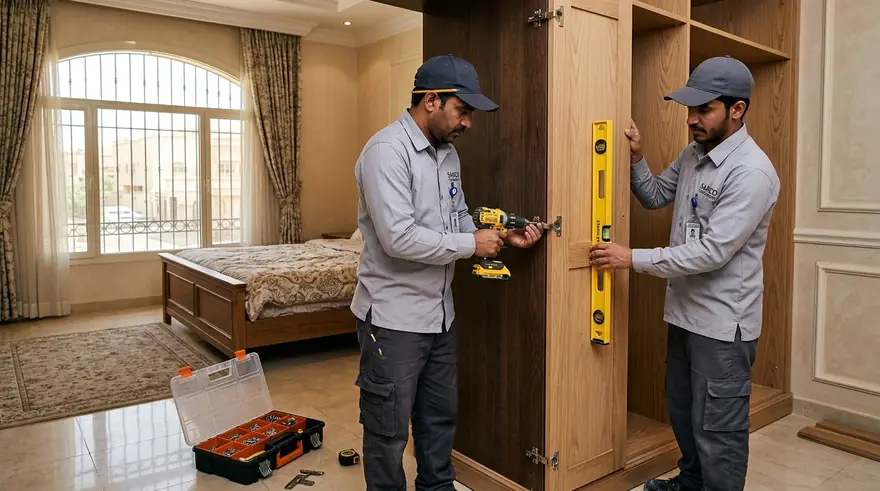
A job of its own, not a footnote to the move
When a resident of Qatif asks for furniture assembly and disassembly, three things are usually meant in sequence: taking apart whatever is meant to come apart without damaging panels or screw holes, wrapping and labelling the parts so pieces from different rooms do not get mixed up, and rebuilding everything at the destination so that doors, drawers and mirrors are adjusted and tall units are fixed in place. The service can come with a move, or on its own, for example when you rearrange a room inside the same home or bought flat-pack furniture and nobody to put it together.
The gap between a careful teardown and a quick one shows up two weeks later, not on the day: a door rubbing against the cabinet next to it, a bed that creaks because the bolts were tightened unevenly, a wardrobe that leans because its base was never levelled. That is why we treat assembly as small-scale carpentry that needs the right tools and some patience rather than a task squeezed in just before loading. Our page on how the work runs step by step shows the overall sequence.
Types of furniture covered by the request
Not every piece comes apart the same way. These are the items people in Qatif ask about most, and what each one needs.
Bedroom sets
Beds with frames and headboards, dressing tables with mirrors, wardrobes with sliding or hinged doors. The priorities are bolt order, mirror protection and polished edges.
Large wardrobes and cabinets
Dismantled into side panels, back, shelves and doors. The thin back panel is the weakest part, so it is stored flat and never leaned at a sharp angle.
Fitted kitchens
Wall and base units and worktops. Units are separated from the wall and from each other with positions recorded, then rebuilt to a level line. Plumbing or electrical changes need a separate specialist.
Desks
Desks with drawers, metal legs and dividing panels. Hole spacing is checked at reassembly so drawers keep sliding properly.
Kids beds and bunk beds
These carry weight and movement, so ladders, rails and bolts are checked twice before handover. Safe use matters more than appearance here.
Bookcases and shelving
Light but tall, and they tip if not anchored. We set out clear anchoring steps where the wall allows it.
TV units and media furniture
Often with glass doors and plenty of cables, so the cable layout is photographed before disassembly to make reconnection easy.
Newly bought flat-pack pieces
Items with manufacturer instructions. We follow the guide and check that all parts are present before starting, so a shortage is found early, not mid-job.
From first look to final check
The sequence repeats in every home, but the details change with the piece and its location.
Quick survey and piece list
We walk through the rooms and decide what is taken apart and what moves whole. Some older pieces, or those joined with glue, will not survive disassembly, and in that case moving them intact with extra protection is the better call.
Photograph the current layout
We photograph the inside of wardrobes, the cable layout behind media units and the kitchen before it is stripped. These images are the reference for rebuilding and settle most arguments about where things go.
Empty the pieces and prepare tools
Drawers and shelves are emptied so they carry no weight during disassembly, and the right hand and power tools are chosen for each type of fastener.
Disassemble in reverse build order
Doors, mirrors and drawers first, then shelves, then side panels, and the base last. This order lowers stress on joints and protects edges.
Number and pack
Screws and hinges go into numbered bags tied to each piece, panels are wrapped in layers that prevent scratches, and the bags travel with the owner or in one closed box.
Transport or wait
If the job is a move, the wrapped parts are loaded. If it is assembly only, the next stage starts right away.
Assemble and adjust
Bases and panels go together on level ground, doors are fixed and aligned, drawers are tested until they glide, and tall units are secured.
Handover check
We go through each piece with you: do the doors close without rubbing, are the mirrors firm, are there leftover screws, and are there scratches that need noting on the spot.
What you can prepare to make the job faster
A little preparation saves real time. A crew that walks into a cluttered room spends half its day moving things that are not its job. Start by taking everything out of drawers and shelves and packing it into boxes or bags. If you are short on time, it is better to hand packing to the packing service, described on our page about furniture packing in the Eastern Province. Keep valuables and documents with you.
Next, leave space around each piece that will be taken apart and decide where the dismantled parts can sit temporarily so they do not block movement. If the new furniture will be built in a room that is still waiting for paint or electrical work, finish that first, because shifting an assembled wardrobe after painting risks both the wall and the piece.
- Empty drawers and cabinets
- Point out fragile items, mirrors and glass
- Prepare and measure the space for the new furniture
- Make sure a power outlet is nearby
- Reserve a parking spot close to the entrance
The more of these answers you have ready when you contact us, the more accurate the quote and the shorter the work.
At a glance: what each type of furniture needs
The table summarises practical differences between the main pieces. It is general guidance, not a replacement for a survey.
| Piece | Usually taken apart | Needs care | Check at assembly |
|---|---|---|---|
| Full bedroom set | Bed, dressing table, wardrobe | Mirrors and polished edges | Sliding door alignment |
| Large wardrobe | Doors, shelves, panels | Thin back panel | Anchoring to the wall where possible |
| Fitted kitchen | Wall and base units | Worktops and sinks | Level line and consistent gaps |
| Desk | Drawers and legs | Wooden drawers | Smooth drawer movement |
| Kids bed | Rails and ladders | Safety parts | Bolts tightened before use |
| Bookcase and shelving | Shelves and sides | Long edges | Anti-tip fixing |
Every piece has a known weak point, and knowing it beforehand is what lets a crew work without surprises.
Humidity and dust in Qatif and what they do to wood and screws
Qatif is a coastal city in the Eastern Province and the air carries humidity. The effect shows most on pressed wood: panel edges can swell slightly and screws rust if left exposed for long. That is why we recommend drying panels before wrapping them, never wrapping damp boards, and keeping screws in sealed bags rather than loose on the truck bed.
Dust in certain seasons gets into everything, so surfaces are wiped before wrapping to stop grit scratching the board where it rubs against the wrap. At the new place the spot for each unit is cleaned and the floor is checked for slope, because older floors in some homes are not perfectly level and a tall wardrobe shows that immediately. These are small details, yet they separate an assembly that lasts from one that needs readjusting after a month.
From older neighbourhoods to newer apartment blocks
Qatif mixes traditional homes on narrow lanes with newer villas and apartments, and this changes how the work is done. On narrow lanes the truck may not reach the door, so dismantled parts are carried further, and a more careful teardown helps because smaller pieces are easier and safer to carry past walls. In apartment blocks the challenge is the lift and corridors, and some pieces have to come fully apart to fit. If your move reaches neighbouring areas, see the pages on moving furniture in Tarout and villa moving in Qatif.
Some families prefer to have the bedrooms built in the new apartment before the rest of the belongings arrive, so the rooms are usable from the first night. That approach works well and needs an agreed schedule. For apartments specifically, our page on apartment moving in Qatif covers typical scenarios.
Common mistakes that cost time and money
The most frequent mistake is relying on memory for where each screw goes, which fails after the first two rooms. The second is forcing a stuck screw until the panel cracks. The third is ignoring the back panel of a wardrobe, which then travels bent and snaps. The fourth is skipping wall anchoring because it takes a few minutes, turning a tall unit into a hazard for children. The fifth is accepting handover without testing doors and drawers, so a defect is found after the crew has left.
So keep a short condition note for each room: what was fine, what was already scratched, and what was completed. And if you are comparing quotes, check that each one really includes disassembly and reassembly and at what level. Our page on comparing moving quotes in the Eastern Province can help.
What to send us so the quote is clear
We do not list prices here, because cost depends on the number and type of pieces, their location, the floor, whether there is a lift and whether you need wrapping as well. The quickest route is to message or call us and send: the area within Qatif, the type of building and floor, a list of the main pieces needing assembly work, whether the furniture is old or new, whether it will be rebuilt in the same place or a new one, and any fragile or heavy items. Photos of the rooms help.
With that information we give an estimate based on your case rather than a general average, and tell you if a visit is needed before the work. To confirm that the date you want is available, contact us directly and we will reply with what is open. You can also use the quote request page.
Frequently asked questions about furniture assembly in Qatif
The questions that come up most often when people request this service.
Can I book assembly and disassembly without a move?
What if screws go missing during disassembly?
Are fitted kitchens taken apart too?
Can old furniture be damaged by disassembly?
How long does a full bedroom take to assemble?
Do you anchor tall wardrobes to the wall?
Do I need to be present during the work?
How do I request a quote for furniture assembly in Qatif?
Related pages
Pages that help if you are planning a move or an assembly job in Qatif.
Moving with assembly in Qatif
Full moving with assembly included
Moving with packing in Qatif
Protecting furniture before loading
Furniture moving in Qatif
General guide to moving furniture
Apartment moving in Qatif
Apartment and lift scenarios
Villa moving in Qatif
Planning multi-floor villa moves
Moving in Tarout island
The island in detail
Furniture assembly in the Eastern Province
The service across the region
Furniture assembly in Dammam
The neighbouring city
Ready to have your furniture assembled in Qatif
Send the piece list and location on WhatsApp or call us, and we will outline a clear plan.