Moving with Assembly in Qatif: How Pieces Are Dismantled, Numbered and Rebuilt as They Were in Your New Home
Assembled furniture does not always travel safely if it is carried as it is, and it does not come back as it was if it is taken apart without a system. Dismantling and assembly is a skill that joins knowing the structure of each piece with ordering the screws and fittings and adjusting doors and hinges when it is rebuilt. Here we explain the steps in Qatif homes, what you prepare, and the limits of the service, stated plainly so nothing surprises you.
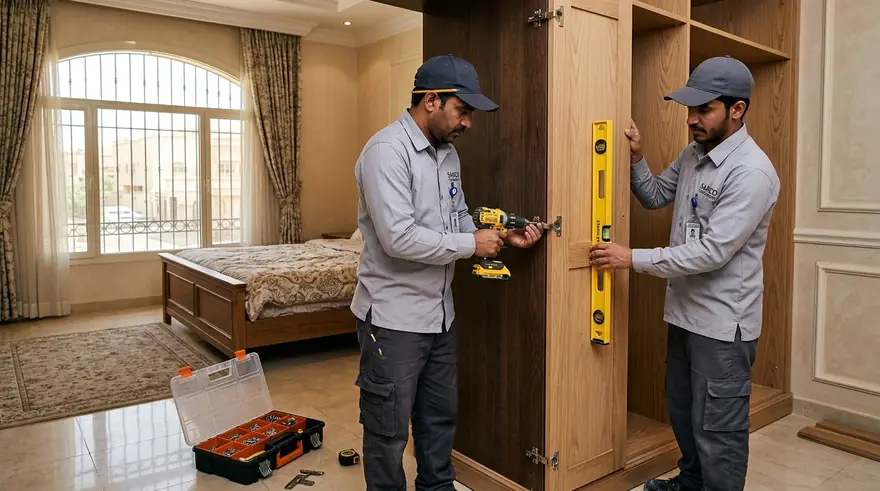
When dismantling is a necessity and when it is a choice
Dismantling is a necessity when a piece will not pass the door or stairs, or when its frame may be damaged by being carried whole. It is a choice when it eases the move, saves truck space and reduces the risk of knocks. In both cases the aim is that the piece returns as it was.
So we decide piece by piece after seeing photos, and we do not dismantle what does not need it, because every dismantling and rebuilding carries some chance of loosening joints. The rule: we take apart what helps and protects, and we move whole what can take being carried safely.
Pieces commonly dismantled and how each is handled
A practical summary of the pieces in homes that most often need to be taken apart.
Multi-door wardrobes
Doors lifted off, movable shelves and side sections removed when needed and numbered.
Beds of every kind
Frames separated into head, foot, sides and base and screws gathered.
Desks and large tables
Legs or drawers separated and surfaces protected.
Bookcases and wall units
Emptied and taken off the wall with fixing positions recorded.
Children's beds and small furniture
Dismantled, parts wrapped and small pieces bagged with labels.
Stages of dismantling and assembly from the first screw to the last adjustment
A sequence we follow for each piece.
Survey and photos
Photograph the piece before dismantling to record its position and condition.
Orderly dismantling
Take parts off in the reverse order of assembly and avoid forcing joints.
Numbering and bundling
Number the parts and place screws and fittings in labelled bags.
Wrapping and loading
Protect each part and place it in the truck in an order that does not press on it.
Assembly
Return the parts in place according to the numbering.
Adjusting and testing
Adjust doors and hinges, fix the piece and test its stability.
Dismantling large wardrobes with many doors
A wardrobe with six or eight doors is made of units joined together, each with its own doors, shelves and drawers. We begin by emptying it fully, then lift off the doors and put them in covers, then take out the shelves and movable parts.
If the units are joined with screws we undo them carefully and number each unit. On assembly we arrange them in the same order and adjust straightness and hinges so every door closes as it did. This step takes time, which is why we state an approximate time when estimating.
Dismantling beds and numbering their parts
Timber or metal beds are usually a head, foot, two sides, a base and perhaps legs. We take each part off and stick a number on it according to the piece, and gather the screws in a sealed bag stuck on the main part.
After the move we assemble according to the numbers, so parts neither go missing nor get mixed. We check that the base is steady and the sides level. If a bed has storage drawers or built-in lighting, we tell you the limit of what we handle.
The piece and what dismantling and assembly it needs
A short table for common choices.
| Piece | What comes apart | What you prepare |
|---|---|---|
| Large wardrobe | Doors, shelves and units | Empty it completely and decide where it will stand |
| Double bed | Head, foot and sides | Separate mattress and bedding |
| Desk with drawers | Drawers and legs | Empty the drawers and unplug devices |
| Wall bookcase | Shelves and fixings | Empty the books and mark positions |
| Children's furniture | Beds and cabinets | Set toys aside and gather small parts |
Kitchens and fixed units: the limits of the service
Tailored kitchens and wall-fixed units need specialist work beyond ordinary dismantling, and may involve water and electrical connections. So we say clearly that we may not handle everything about fixed installations, and we arrange an alternative with you if needed.
Freestanding kitchen cabinets and movable furniture can be handled within dismantling and assembly. Tell us exactly what you want in the kitchen, and it helps to send photos showing the type of fixing. Frankness at the start prevents misunderstanding.
Screws and small fittings: what gets lost most
The biggest problem with assembly after a move is a lost screw or small hinge. So we set aside a sealed bag for each piece marked with its name and room, and attach it to the piece itself or put it in a fittings box.
Fittings are never left loose in drawers. If a part is lost we try to find a suitable substitute where possible and tell you. Good organisation in dismantling saves hours of searching after arrival.
The tools we use and what you need to provide
We use hand and power tools suited to dismantling and assembly: various screwdrivers, hex keys, rubber mallets, drills, and lifting aids where required. That includes basic carpentry tools.
You need to provide a nearby power outlet and working space in the room. If you have manuals or assembly sheets for flat-pack pieces keep them and show us, because they help rebuild accurately.
Ready-made board-and-screw furniture
A lot of modern furniture comes flat in boxes and is assembled with screws and connectors. This type is sensitive to repeated dismantling because the holes widen and the connectors weaken. So we handle it more carefully and avoid excess force.
Sometimes it is better to move it assembled if it fits through the doors. Give us the piece type and a photo and we decide with you what suits best, since the right decision preserves the piece and saves time.
What is particular to Qatif homes in dismantling and assembly
In many Qatif homes there are large wardrobes and beds with heavy timber frames, and in older districts the doors and corridors are narrower than usual, so dismantling is more often a necessity. We measure the entrance before carrying to decide.
On upper floors, narrow stairs influence the decision to dismantle. Coastal humidity affects some timbers, so we are more careful when taking apart old pieces whose joints may be affected. Tell us the age and condition of the piece.
Old pieces that have not been taken apart for years
Some pieces have stood in place for years, so their screws are stiff and their wood dry, and taking them apart may risk breaking them. We handle them gently, test the joints before using force, and may suggest moving them as they are if possible.
If a piece is heritage or valuable we tell you the possible risks and write that down, then decide with you. Honesty in judging condition is better than a promise of a result we cannot guarantee, and we consider protecting the piece more important than completing the dismantling.
What you do before dismantling begins
Empty wardrobes, drawers and shelves completely, move the mattress and bedding, and clear space around the pieces. Photograph the pieces before dismantling and tell us about any weak piece or one that has been repaired before.
If some pieces are fixed to the wall decide what you want taken off and what you want left. The more ready the room, the faster the crew starts, the less time is counted and the fewer the errors from hurrying.
Rebuilding: how we make sure the piece is as it was
On arrival we place each piece in its assigned room, then assemble it according to the numbering. After assembly we test stability with a gentle shake, open and close the doors and drawers, and check the beds are straight and their parts level.
If an adjustment is off we correct it at once. If a piece needs extra fixing to the wall we tell you what we handle and what needs other equipment. We finish the job after you have reviewed the pieces with us.
What the service does not normally include
We do not promise to install anything that needs complex electrical wiring or plumbing, nor to mount a television on a wall or fit air conditioners, unless a special arrangement is agreed. We do not take responsibility for items that were faulty or missing parts before the move.
We state these limits so that no wrong expectations are built. If you need a service beyond our scope we tell you plainly, and may coordinate with a suitable provider for you. The written agreement fixes all this.
How long dismantling and assembly takes
Time depends on the number and size of pieces and their type, on ease of access and on how ready the room is. A big wardrobe or several beds may take longer than the carrying itself.
We do not quote fixed figures without a survey, because every home is different. When you send photos we estimate the crew and time and tell you if dismantling needs to start before moving day. An honest estimate is better than a promise that changes.
Common dismantling and assembly mistakes to avoid
Among the commonest: taking a piece apart without photos, not numbering parts, mixing screws, forcing a stiff joint, loading parts without protection so they scratch, and leaving dismantling to the last moment.
Another mistake is believing that every piece must be taken apart. Sometimes moving a piece whole is safer. An experienced crew knows when to dismantle and when not to, and explains why.
What goes into the agreement about dismantling and assembly
Specify which pieces will be dismantled and rebuilt, whether assembly in the new home is included, and what falls outside the service. Mention any old or valuable piece.
For more on documentation see our page on a furniture moving company in Qatif, for protection of each furniture type see our page on furniture moving in Qatif, and for general details see our page on movers in Qatif.
Common questions about moving with assembly in Qatif
What people ask about dismantling and assembly.
Must all furniture be dismantled?
How do you make sure pieces are rebuilt as they were?
Do you dismantle fixed kitchens?
Do you mount televisions on walls?
What if a screw is lost?
Does flat-pack furniture survive dismantling?
How long does dismantling and assembly take?
How do I request a quote with dismantling and assembly?
Related pages
More steps in planning dismantling, assembly and moving.
Movers in Qatif
Full service guide and the Qatif areas we cover.
Furniture moving in Qatif
How each type of furniture is protected.
Moving with packing in Qatif
Packing materials and stages.
Furniture assembly service
Assembly across the Eastern Province.
Furniture assembly in Dammam
Assembly in the city of Dammam.
Request a quote
Send your details and we prepare a breakdown.
Moving prices in Qatif
Moving prices in Qatif: cost factors specific to the governorate, such as narrow lanes in older districts, di…
Want organised dismantling and assembly for your furniture?
Send photos of your wardrobes and beds and we will decide with you what comes apart and what moves whole.