Moving Workers in Khobar: How the Crew Is Built and How Heavy Furniture Is Carried Safely in Your Home
The truck carries the furniture, but it is the workers who get it to the truck and out of it undamaged. So the size and organisation of the crew and its skill in lifting and securing matter more than any other description of a moving company. This page explains how a crew in Khobar is made up, what each person does, how heavy pieces are carried on stairs and in lifts, what conduct to expect inside your home and how to prepare the space for them.
What makes a crew good rather than just a number of hands
Many people think moving is only muscle, but the hardest part is coordination: who carries at the front and who at the back, who guides at a corner, who protects the wall and door, who controls the loading order. A good crew works as a unit that exchanges signals, which reduces effort, knocks and time.
So the question about moving workers is not only how many there are, but who supervises them, how roles are shared and whether they are used to the kinds of furniture in your home.
The parts of a crew and what each does
A typical crew has a supervisor who coordinates, speaks to you and makes decisions, carriers who move the pieces, one or more packers who prepare belongings, a carpenter when dismantling is needed and a driver in charge of the load. In small homes one person may combine roles. The size depends on the floor, the lift and the bulk of the furniture, and the aim is a crew that is right for the job: not too small and not excessive.
How many workers does your move need?
General guidance, settled from photos.
| Situation | What affects the number | General crew estimate | Note |
|---|---|---|---|
| One room or little furniture | Few pieces, lift available | Small crew | A small vehicle may do |
| Medium flat with a lift | Number of large pieces | Medium crew | Faster with pre-packing |
| Upper floor without a lift | Stairs and many pieces | Larger crew, sometimes two days | More dismantling may be needed |
| Villa with several floors | Floors, majlis and marble | Large crew split by floor | May run to two days |
We do not tie crew size to a fixed number. We estimate it from photos and knowledge of the floor, lift and corridors.
How heavy furniture is carried safely
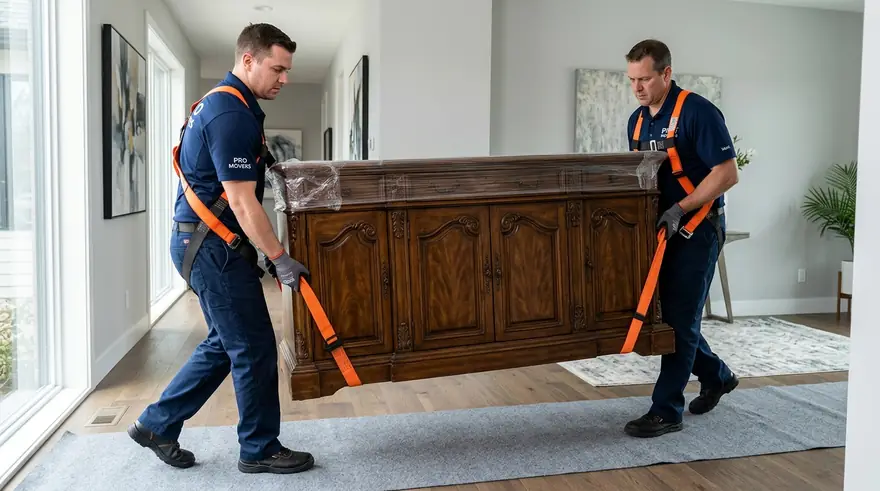
Safe lifting has simple but strict rules: the route is checked before the piece is raised, doors and turns are measured, the load is carried in turns by two or more people depending on weight, lifted with the legs rather than the back and rhythm is coordinated by signals between front and rear carriers. Straps and trolleys are used where needed, and furniture is lifted rather than dragged across floors. This protects the piece, the tiles and the worker.
Stairs and lifts: the hardest moments
On stairs the carriers keep the load slightly tilted and balanced, with someone guiding at each turn. In a lift, pieces are set at a steady height and furniture must not lean on the control panel or the walls without protection. Lift walls and corners are covered with blankets where management allows. If a piece will not fit the lift upright, we decide whether it is safer to dismantle it or take the stairs, and tell you before acting.
How the crew works on moving day
The order we usually follow.
Introductions and briefing
The supervisor introduces the crew, walks the rooms with you and asks about delicate items.
Protecting the home
Floors and corridors are covered and door frames and lifts are protected.
Wrapping and dismantling
The crew prepares furniture, takes apart what is needed and numbers parts.
Carrying and loading
Workers move pieces in turns and load them in order and securely.
Unloading and placing
Pieces go to their rooms by label and are put in place.
Review and handover
You walk through pieces and rooms with the supervisor and confirm the work is complete.
Conduct inside your home
You are entitled to expect courtesy, cleanliness and calm: clean shoes or shoe covers where you prefer, respectful dealings with neighbours, no use of household items without permission and no wandering into rooms where they are not working. If your family prefers a particular arrangement for when workers enter and where they are, tell us beforehand so the work is done in a way that is comfortable for you; this is agreed before the day.
Family privacy: how entry and work are arranged
In some homes families prefer to arrange the crew's work so women of the household avoid direct contact, so a room or part of the home is set aside that workers enter only after notice. We make a point of accommodating this through prior coordination with the supervisor, starting with rooms that are emptied first and leaving them before moving on. Tell us what you need before booking so we plan the schedule around your comfort.
Heat and humidity: keeping the crew safe
Working in Khobar's summer is tiring and heat stress is a real danger for workers and for the quality of the carry. We prefer morning loading where your circumstances allow, spread rest breaks, make sure workers can drink water and avoid piling the work into the hottest hours. A rested crew carries with focus and makes fewer mistakes, which gives you a safer load and quicker work.
Getting your home ready for the crew
Clear corridors of shoes, toys and small rugs, remove anything that obstructs doors, empty drawers and wardrobes of heavy and fragile items, tell the crew where cartons should go and keep a bottle of water if you wish. Arrange a place for children or elderly relatives to sit away from the carrying route. This small preparation shortens the day and protects everyone.
Safety for the workers and for you
Most accidents happen when someone rushes, lifts more than they can manage or neglects the stairs. We apply simple rules: shared carrying for heavy pieces, no lifting without seeing the path, warning markers in corridors and children kept out of the way. You help safety too by not standing in the carrying path, keeping little ones away and telling us beforehand about slippery floors or weak stairs.
The supervisor: your single point of contact
A responsible supervisor makes the difference between an organised day and a muddled one. He asks, decides and coordinates between packing, carpentry and carrying, keeps you updated and deals with surprises such as a broken lift or a piece that will not pass. That is why we do not encourage you to direct each worker; go back to the supervisor and he handles the rest. If the company you hire has no supervisor, ask who is accountable when something goes wrong.
Towers versus villas: a different crew each time
In towers the effort centres on corridors, lifts and protecting walls and entrances, so crews are smaller but better coordinated. In villas it centres on the number of floors and carrying heavy furniture down inner stairs, so crews are bigger and divided by floor. That is why we ask about the type of building before setting numbers, and why we do not propose a fixed number for every case.
Crew-related mistakes worth avoiding
Typical ones include booking a very small crew to save money so the carrying drags on and knocks multiply, leaving workers without a supervisor so each acts on his own view, allowing furniture to be dragged across floors, neglecting to cover floors and letting the stairs go unguided at turns. All of them are avoided with prior organisation and a supervisor present.
How we help you decide the crew
We start with photos of the home, the building and the floor, then suggest the crew size, roles and expected duration and explain why. If your initial estimate is smaller than needed to protect you from damage we say so plainly. We want our crew to be enough for safe work, no bigger than you need and no smaller.
Questions about moving workers in Khobar
Short answers before you book.
How many workers do I need to move my flat?
Does the crew work under supervision?
How is heavy furniture carried on stairs?
Can entry be arranged around my family's privacy?
Does the crew work in the heat?
What should I prepare before the crew arrives?
Do workers protect floors and the lift?
How do I get an estimate for the crew and cost?
Related pages on crews and safety
Guides to workers and the working process.
Movers in Khobar
The main service page for the city.
Moving truck in Khobar
Choosing the right vehicle.
Dyna moving in Khobar
When a dyna is enough.
Moving workers safety
Safety rules across the Eastern Province.
The crew on moving day
How the work is organised.
Moving with labour
A regional guide.
Apartment movers in Khobar
Moving from flats and towers.
Furniture assembly in Khobar
How dismantling and reassembly is handled.
Request a quote
Send your move details.
Moving workers in Jubail
Moving workers in Jubail: how a moving crew is formed, roles, safe handling of heavy pieces, ho.
Khobar movers phone number
Khobar movers phone number: ways to reach Al Bayt Al Hadith by call or WhatsApp, a ready message template, th…
Want the right crew for your home?
Send photos of the rooms, the building and the floor and we will suggest crew size and roles, without obligation.