Moving Workers in Jubail: How the Crew Works, How Roles Are Split and How Many Workers You Really Need
When people ask for moving workers they really want two things: strong hands that carry the furniture, and skilled hands that know how to carry it without damaging it. The difference between the two is large. Correct carrying is a craft with rules: distributing weight, how to grip, ordering of roles and communication within the team. On this page we explain how a moving crew is formed, what each member does, how many workers your load needs in Jubail, and what to ask before you agree.
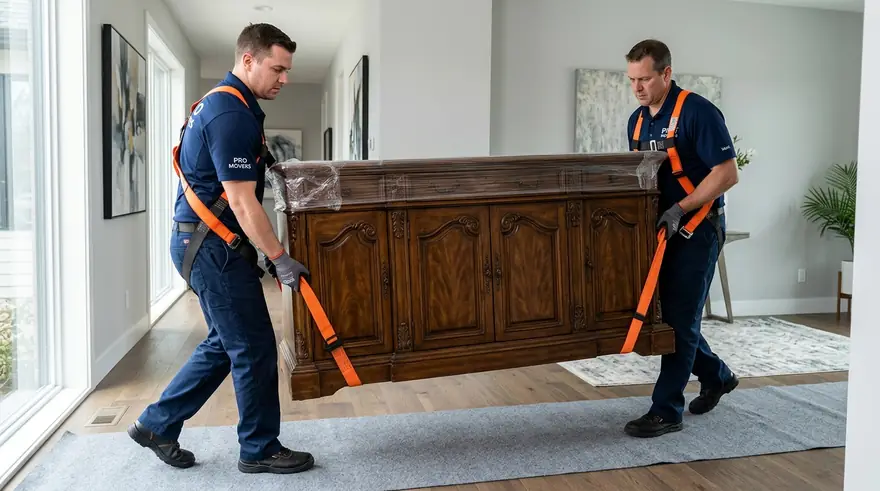
A good worker is not the strongest but the most knowledgeable about how to carry
Physical strength helps but is not enough to move furniture from upper floors without damage. An experienced worker knows how to share the weight of a cabinet between two, how to turn a long piece at a stair bend, how to hold glass and when to ask for help. That knowledge comes with practice and with working inside an organised team, not alone.
A good crew communicates: one word means stop, another means lift, a third means watch the edge. This simple communication prevents accidents and protects furniture. When you choose a crew for your move, ask about its way of working and not only its head count.
The roles of crew members on moving day
A general split that changes with load size.
| Role | What they do | When needed | Note |
|---|---|---|---|
| Crew supervisor | Plans, allocates and communicates with you | Every move | First point of contact |
| Packing worker | Wraps fragile and upholstered pieces | When packing is included | Works before carrying |
| Dismantling technician | Dismantles, numbers and reassembles | When furniture is dismantled | Works with suitable tools |
| Carrying workers | Carry pieces up and down | Every move | Number depends on the load |
| Truck lead | Arranges loading and secures the load | Every move | Prevents shifting on the road |
| Receiving worker | Places pieces in new rooms | On arrival | Following your plan |
In a small move one person may combine more than one role, and in a large move roles are spread across people.
How the crew behaves from arrival to departure
A sequence that recurs in most moves.
Arrival and introduction
The supervisor introduces the crew and reviews with you the list, sensitive pieces and carrying routes.
Securing corridors
The corridor is cleared and what needs protection is protected, with care for residents and children.
Packing and dismantling
Crew members work on pieces by their specialism and parts are numbered.
Coordinated carrying
Workers carry heavy pieces in pairs or threes by weight and warn each other at turns.
Loading and securing
Pieces are arranged in the truck by weight and fragility and tied down.
Unloading and review
Pieces are placed in the set rooms and condition is reviewed with you before leaving.
How heavy pieces are carried: wardrobes, fridges and marble
A large wardrobe is emptied first and then carried by at least two workers with its doors secured and corners protected, held by the base and not the doors. A fridge is usually carried upright with suitable straps and enough workers, with care for the door and handle. Marble tables are the heaviest and riskiest and are carried only by enough people from protected edges, upright if their thickness allows.
On narrow stairs the method relies on rotating workers and calling out any obstacle to each other, and on protecting walls and railings. In some cases straps or trolleys are used to ease effort and reduce damage. These tools are part of professionalism, not luxury.
- Wardrobes: empty, secure doors, carry by the base
- Fridges: upright with straps and enough people
- Marble: more people and protected edges
- Narrow stairs: rotate and call out obstacles
How many workers you need: factors that set the number
There is no fixed figure; these factors determine it.
Load size
The number of rooms and large pieces sets the basic count, since a two-room flat differs from a four-room villa.
Floor and lift
Upper floors with no lift need more people and rotation, and a good lift reduces effort.
Entrances and distance
The farther the truck is from the entrance, the more carriers are needed.
Timing
If time is tight, adding workers shortens the duration but raises the cost, so we balance the two for you.
Worker safety and your safety: what we take care of
Heavy furniture can cause injury if carried wrongly, so we make sure workers lift by bending the knees and not the back, that nobody is loaded beyond what is bearable, that corridors are clear of obstacles, and that children and residents are warned of the carrying route. We avoid improvised carrying of very heavy pieces without enough hands.
Hot summers have their own account: we spread effort, prefer cooler hours and make sure the crew has water and rest breaks, because exhaustion raises the chance of mistakes. A worker safety is part of furniture safety, since a tired worker may drop a piece.
Crew conduct in your home: what you can expect and what we expect from you
You are entitled to expect respect for the privacy of the home from a moving crew: entry with permission, avoiding private areas that are not needed, observing modesty and manners, keeping the place clean and not touching your belongings without permission. We keep to this in our work.
We expect simple cooperation from you: be present or have someone you trust stand in, point out sensitive pieces, carry your valuables yourself and clear the corridor. This mutual cooperation makes the day calm and orderly.
What is specific to moving crews in Jubail
In Jubail the work ranges across flats in blocks, villas, compounds and company housing in the industrial city. Some of these sites require entry permits for workers and vehicles, or ID details before entry, so if your site is like that tell us early so we prepare what is needed.
The hot, humid weather also makes midday work tiring, so we arrange the carrying schedule so the heaviest part falls in cooler hours. If your building has quiet hours or limits on noise, we keep to them.
Questions to ask anyone offering you workers
Ask: how many workers will actually come? Are they one team used to working together? How experienced are they with heavy pieces? Who is the supervisor I deal with? What happens if a piece is damaged? And does the offer include packing and dismantling or carrying only? Specific answers point to an organised party.
Beware of offers that promise a large number of workers at a very low price with no details, since fewer may arrive, or a crew that does not work well together. It is better that the number is written in the offer and the supervisor is known by name.
- How many workers will come and with what experience?
- Who is the supervisor and contact point?
- Does the offer include packing and dismantling?
- What is the procedure if a piece is damaged?
How to ask us for a crew
Send us the number of rooms, large pieces, the floor, whether there is a lift, photos of the furniture and the location of both homes, and we will explain the right crew size and what the offer includes. If you need workers for carrying only, with no truck or packing, say so and we will consider the request by availability.
Call or message us on WhatsApp at 0566300558. We do not state worker prices here since they depend on the load, the site and the services, and we explain that in the written offer.
Mistakes that recur when relying on moving labour
One is settling for fewer workers than needed to save cost, so the job drags, fatigue rises and the chance of damage grows. Another is choosing workers who do not belong to an organised team, so responsibility is missing. Another is not deciding who handles dismantling and assembly, so furniture is left in pieces. Another is neglecting the safety of residents and children during carrying.
Others are leaving valuable pieces unsupervised, or ending the carrying without a final walk-through to confirm every piece arrived. Avoid these mistakes by settling roles, number and the person responsible from the start.
Common questions about moving workers in Jubail
General answers that depend on your load.
How many workers will come?
Are the workers one team?
Do they handle packing and assembly?
Can I order workers for carrying only?
What about heavy items like marble and cabinets?
What if a piece is damaged?
Does the crew follow building rules?
Does the crew work in the hot summer?
How do I order?
Related pages
What connects to the moving crew.
How many workers does your load need?
Send photos of the furniture, the floor and whether there is a lift, and we will explain the right crew size and what the offer includes, with no obligation.