Marble Table Moving in the Eastern Province: Getting Stone Tops Across Without a Crack
Marble is heavy and brittle at once. It tolerates pressure from above but cracks at the first twist or hit on an edge. This page explains how a tabletop weight is estimated, why slabs are carried on their edge, and how the top is separated from the base, wrapped and secured inside the truck.
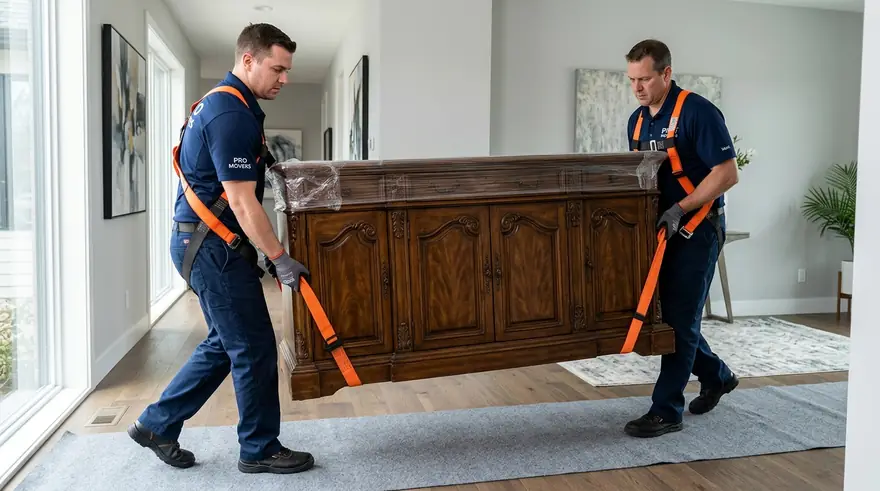
Why marble tables are among the hardest items to move
Marble is a natural stone and every slab contains veins and hidden weak lines. Hairline cracks may already exist before the move without being visible. If the slab bends slightly while being carried, or an edge takes a knock, those veins can open into a full crack.
The difficulty grows because a large table is too heavy for two people to lift safely in many cases, and metal or wooden legs need their own protection. So a marble table is moved as parts, a top, a base and legs, each with its own method, and its weight and the number of people needed are estimated before anyone lifts it.
How much does marble weigh? A rough calculation
Marble density is roughly 2.7 grams per cubic centimetre, so one square metre at 1 cm thickness weighs about 27 kg. These are estimates only and vary by stone type.
| Thickness | Approx. weight per m² | Example: 1.8 × 0.9 m top (1.62 m²) |
|---|---|---|
| 2 cm | about 54 kg | about 87 kg |
| 3 cm | about 81 kg | about 131 kg |
| 4 cm | about 108 kg | about 175 kg |
This is why we always ask for the table size and top thickness before deciding the crew size. The base and legs add weight on top of this, and the figures do not mean one person lifts any part alone; the load is shared across enough hands with proper straps.
Inspect and photograph the table before touching it
We inspect the top from above and from the sides, looking for hairline cracks or earlier repairs with adhesive, and we photograph these areas together with the owner. This is not paperwork for its own sake: some damage is noticed days after delivery and a dated photo settles any disagreement about when it appeared.
Then we measure the table, the doorway, the corridors and the lift, and compare the longest dimension of the top against the narrowest point on the route. If it will not pass flat we turn it onto its long edge, and if it can only pass through a balcony or window we discuss the options before moving day, not during the carry.
Separating the top from the base and legs
Most marble tables allow the top to be separated by removing screws or a flexible adhesive. We never pull the top off by force. If it is bonded firmly we handle it carefully or leave it attached and move the table as a unit once its weight is assessed. Screws go into a bag marked with the table name, and legs are wrapped in foam because metal-on-stone rubbing during the trip can scratch the polished surface.
We do not dismantle pieces that were not designed to come apart, such as some engineered stone tops bonded with industrial glue, because taking them apart can damage them more than carrying them whole. In that case we plan to wrap the piece fully and carry it with more hands.
Steps for carrying a marble slab safely
One rule governs every step: never let the slab bend under its own weight.
Estimate weight and crew
From size and thickness we estimate the weight, then decide the number of movers, the straps and whether a dedicated carrier is needed.
Pad edges and corners
Edges receive a thick foam wrap and corners are covered with rigid cardboard before any movement.
Turn the slab on its long edge
It is lifted upright from the sides and never held flat by its middle.
Synchronised team lift
Movers move together on a single signal so nobody takes more load than the others.
Rest it on padded supports
The slab is lowered onto a padded edge inside the truck and leaned against a fixed side.
Strap it in
Wide straps are used with foam between slab and strap to stop sliding without point pressure.
Wrapping marble in layers that protect without scratching
The first layer on marble is ink-free paper or clean soft cloth, because some inks and dyes transfer to light stone and leave stains that are hard to remove. Over that goes foam or bubble wrap, then rigid cardboard on both faces, and finally an outer stretch layer to hold the stack together. The polished face is kept away from any metal edge or screw.
A note reading "marble - nothing on top" is attached to the wrap so everyone handling it pays attention. If the table has ornamental or carved edges, they are covered with cut foam moulds so nothing moves inside the wrap.
How marble is placed inside the truck
Marble goes in after the heavy fixed items and never under anything. The best place is beside the truck wall near the floor, leaning on a wooden board or on stable furniture, in an upright position. We avoid leaning it on the rear door, because vibration or opening the door could shift it.
We leave a small gap between marble and any glass or mirrors, because rubbing or pressure over bumps can break either one. On longer roads, such as Dammam to Al-Ahsa, we add more securing points and check the straps at rest stops.
Dining table, coffee table or console?
Handling varies with the piece. A large marble dining table needs the biggest crew because both area and thickness are large, and it usually has a heavy base. A coffee or centre table is smaller but may combine a glass top with marble edges, requiring double protection. Consoles and side tables can be relatively light but have delicate edges that tolerate no knock.
Some tables mix marble with metal finished in gold or black, so a scratch on the metal shows easily and each metal part gets its own cover. If you own a rare or imported piece, tell us so we can prepare a dedicated carton and wrap.
Upper floors, lifts and stairwells
A ground floor is easiest. In apartment buildings and towers the calculations change: a large slab fits a lift only if its dimensions are smaller than the lift width and depth with a safe margin, and on stairs the corners and turns are the most dangerous points. We map the route in advance, place guards on edges in narrow corridors, and ask the building to clear and reserve the lift.
Options we cannot confirm as a standard service, such as lifting from the facade, must be discussed before the appointment. You can read our page on crane and winch lifting for furniture to understand the limits of this option and what it requires.
On arrival: placing the table where it belongs
The slab is unloaded before the other parts of the same table and set temporarily on a padded edge near the final position. The frame is assembled first and checked for level, and then the top is lowered by enough hands at once. We never leave the top on an uneven base, because uneven pressure can crack it weeks later.
We advise adding small pads under the legs if the floor is not level, and rubber supports to prevent sliding. If any crack appears, we stop and record it with you immediately against the inventory list.
Marble table moving FAQ
Short answers to what owners of marble tables ask most.
Do you guarantee a marble table will not break?
How many movers does a large marble dining table need?
Can the table move with its top still attached to the base?
How do you protect carved edges?
Do you move marble tables to Al-Ahsa or Jubail?
What if the table will not pass through the door or lift?
Should I wrap the table before you arrive?
How do I get a quote?
Pages related to marble and heavy furniture
Topics that help you prepare difficult pieces.
Heavy furniture moving
How we work with pieces needing more than two people.
Crane and winch lifting
When pieces must be lifted from the facade.
Packing by material
Wood, glass, marble and fabric.
Luxury furniture moving
Sensitive and high value pieces.
Majlis moving
A full sitting room with cushions, carpet and tables.
Villa moving
Loading several rooms of a villa.
Crew and safety
How crews are organised and protected.
Request a quote
What we need to estimate cost.
A marble piece deserves a planned lift
Send the dimensions, thickness and a photo of the table and we will explain the steps and price factors.