Villa Moving in Khobar: How to Move a Multi-Floor Home, Annex and Roof Included
A villa is not simply a large flat. It has floors, an internal staircase, a yard, usually an annex or a maid room, and a roof where odd things collect over the years. If you search for villa movers in Khobar, what you really need is a crew that walks the whole property with you before touching a single piece, then works in parallel teams rather than one long queue down the stairs. This page explains how a villa is surveyed, how floors and stairs are protected, how large majlis sets and wardrobes are handled, and what to ask the company before you book.
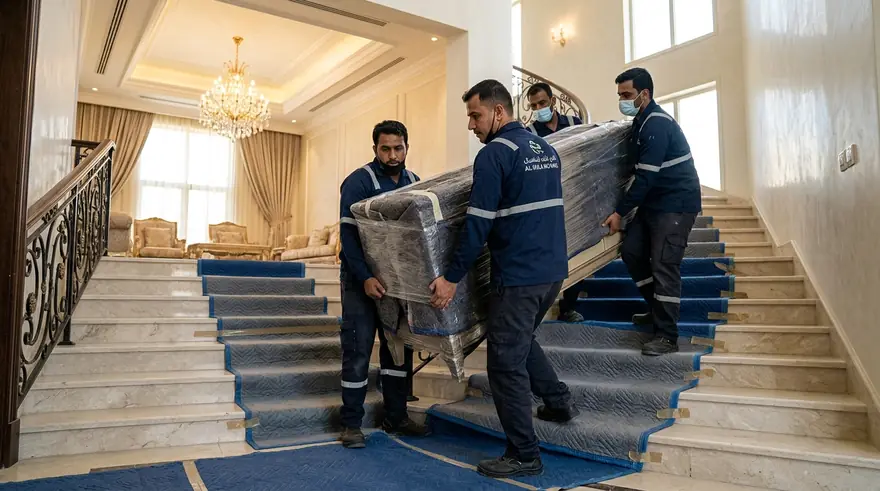
Why villas are moved differently from flats
In a flat, the lift and the corridor decide everything. In a villa, what decides is volume and spread: dozens of pieces on several floors, boxes in the annex and on the roof, and one staircase that everything from the upper floor has to pass through. The quality of a villa move therefore depends on organisation far more than on strength.
A villa moved with a clear plan finishes in a reasonable day. The same villa moved without a survey or a split of tasks turns into a long, tiring, expensive one.
The first walk-through
Ask for a visit, or send photos of every room and corner, not only the living room and majlis. A good supervisor asks about the upper floor, the bedrooms and attached bathrooms, the maid room, the storeroom, the roof, the yard and any covered parking, because these places reveal the real size of the job. Old furniture, boxes and garden tools often turn up on the roof or in the storeroom that nobody had counted.
Keep one list of what moves, what stays and what is given away. A villa move is a good moment to lighten the load, and every box you remove before the day saves part of a trip.
Floors, stairs and surfaces
The internal staircase is the artery through which everything from the upper floor travels. It is covered with protective sheets before any carrying starts, banisters and wall corners are padded at the turns, and polished marble or tile is covered along the main walking route. Dragging one heavy piece across marble leaves a mark that is hard to repair.
Large pieces that will not clear the turn of the staircase are looked at before the day: they are either dismantled or lowered from outside if the balcony allows it. That decision belongs in the survey, not in the middle of the afternoon.
Parts of a villa and what each one needs
General guidance, finalised by photos or a visit.
| Area | What is special | How it is handled | Note |
|---|---|---|---|
| Majlis and lounge | Large sets and heavy tables | Full wrapping, team lifting | Measure doors first |
| Bedrooms | Wardrobes and beds that come apart | Label, dismantle, bag the screws | Rebuilt first at the new place |
| Kitchen | Appliances and fragile items | Empty and wrap separately | Secure doors and hoses |
| Annex and roof | Mixed and often old items | Sort before the day | May add a trip |
| Yard and storeroom | Tools and outdoor furniture | Clean and light wrap | Usually moved last |
The table gives direction only. It does not replace a survey or real photos of your villa.
The majlis and large hosting furniture
Arabic majlis sets and big sofa suites are among the heaviest items in a villa, and also among the most sensitive to fabric damage and scuffed carved wood. They are covered against dust and rubbing and lifted by enough people that nothing is dragged. Each piece is measured against the front door and the staircase turn before lifting; if it will not pass, it is dismantled or another route is planned.
Marble and glass tables get their own wrapping and travel upright, supported away from edges. Their bases are checked for weight and fixing points at the new house.
Bedrooms and wardrobes
Most villas have several bedrooms with large wardrobes, built in or modular. Clothes come out before dismantling, panels are numbered, and screws and hinges go into small bags taped to the piece itself. Mattresses are bagged, and beds come apart into headboard, rails and base so the timber does not bend.
Big mirrors and glass doors are removed before the wardrobe moves and are carried separately with shock-absorbing wrap. Writing the destination room on every piece means everything lands in the right place the first time.
Kitchen and appliances
The kitchen looks small but holds many fragile and heavy items together. Crockery goes into strong boxes with paper and bubble wrap, and big appliances such as the fridge and washing machine are emptied, with doors and hoses secured before lifting. Anything that needs electrical or plumbing disconnection is handled by a specialist before the crew arrives.
If there are built-in cabinets, decide beforehand what comes out and what stays with the property, because some belong to the landlord rather than the tenant.
Yard, annex, roof and storeroom
These are the spaces forgotten in planning that surprise everyone on the day. The yard may hold garden seating, shades, children's toys and tools; the annex may hold extra rooms; the roof may hold tanks or old furniture. Outdoor furniture is cleaned and lightly wrapped, small tools are sorted into boxes, and what will not move is decided before the day.
If the roof is reached only by a narrow spiral stair, the supervisor needs to know so that a suitable lowering method and enough hands can be planned.
Street, gate and vehicle size
Some Khobar districts have quiet, fairly wide streets; others are narrower with cars parked in front of houses. Villas inside compounds have gates, entry rules and set hours for moving. Ask the compound office about the permit required and the gate height and width, and tell the company what kind of street it is so that the right vehicle is chosen.
Sometimes two smaller vehicles work better than one large vehicle that cannot enter the street, and the move is quicker and gentler on the furniture. See our pages on moving trucks in Khobar and dyna trucks for more.
Humidity and dust on the Gulf coast
Khobar is a coastal city, and humidity and fine dust reach furniture during loading and unloading. Wooden pieces and upholstery are covered with sheets that keep dust off, and large items are not left sealed in non-breathing plastic for days inside a closed space, because trapped moisture harms timber and leather.
If unloading is the same day there is no issue. If the plan needs a night of storage in between, ask where the pieces will wait and whether the place is dry and covered.
Splitting the work between crews
The real strength of a villa move is several teams working at once: one dismantling and labelling, one wrapping, one carrying down, one loading in order, and one receiving at the new villa. This overlap shortens the day and eases the crowd on the stairs. A supervisor holds the list and knows where each box is.
Ask the company how many workers will come, how roles are divided and who owns the list. The answer shows quickly whether the plan is thought through or improvised.
Handing over the old villa
Before you leave the old villa, walk every room once it is empty and check built-in cupboards, shelves, roof and yard. Photograph walls and floors if you are handing back to a landlord. Read the meters and keep the keys until everything is finished. Decide beforehand who will hand over and who stays with the crew.
If some furniture is staying behind, tell the crew so it is set aside and not loaded by mistake.
Receiving the new villa
Before the truck arrives, prepare the new villa: keys, power and lights on, a quick clean, and protective sheets laid over floors and stairs. Put a sheet of paper with the room name on each door, and agree with the supervisor where the load will stop and where boxes will gather. That way every piece goes straight to its room instead of piling up in the hall.
Start by rebuilding the beds and bedroom wardrobes, because they are what the family needs on the first night.
How to compare offers for villa moves
Do not compare on price alone. Ask how many workers and how they are divided, how many vehicles and what type, whether dismantling, assembly and wrapping are included or separate, how floors and stairs are protected and how any damage is dealt with. Ask for it in writing. Be wary of an offer that never asks how many floors you have or whether there is an annex and a roof.
A company that asks about details usually understands what will happen on the day better than one that gives a fast number before seeing anything.
Common mistakes in villa moves
Typical errors include leaving out the annex and roof when listing, leaving wrapping to the last night, not numbering dismantled wardrobes, not measuring doors and stairs in advance, forgetting compound permission, and putting valuables among general boxes. Another is leaving the crew without anyone from your side, so small decisions stall.
The fix is usually simple: an early walk-through, a written list, a supervisor who knows the new villa, and one person from your side present all day.
Valuables and documents
Official papers, jewellery, cash and small expensive devices do not go on the load. They stay with you in a bag you carry yourself, along with keys, gate cards and remote controls for both villas. Paintings and ornaments are wrapped separately, listed, and placed in a safe part of the vehicle.
After unloading, confirm these items are all accounted for before the crew leaves.
The villa moving process in Khobar
A general sequence, adapted to each villa.
Survey and walk-through
You go through floors, annex, roof and yard with the supervisor and list what moves.
Plan and crews
Worker numbers, vehicles, compound rules and stair protection are agreed.
Dismantle and wrap
Wardrobes and beds are labelled and dismantled; sofas, appliances and fragile items are wrapped.
Carry and load
Pieces go down the protected stairs and are loaded in the order they will come out.
Unload and rebuild
Each piece goes to its room; beds and wardrobes are rebuilt first.
Final walk-through
You check both villas with the supervisor for completeness and cleanliness.
Frequently asked questions about villa moving in Khobar
Short answers to what villa movers are asked most.
How long does a villa move in Khobar take?
Do I need to empty wardrobes and the kitchen first?
What about the staircase and marble floors?
Are items on the roof and in the annex moved?
What if the big truck cannot enter the street or compound?
Is dismantling and assembly part of a villa move?
How should I handle valuables?
How do I get an estimate for my villa?
Related pages for villa moving
Learn more about our services in Khobar and what connects to them.
Movers in Khobar
Main page for moving services across Khobar and its districts
Apartment moving in Khobar
Flat and tower moves with lifts and stairs
Furniture assembly in Khobar
Dismantling wardrobes and beds and rebuilding them neatly
Moving workers in Khobar
How the crew is divided and how moving day runs
Moving truck in Khobar
Choosing a vehicle for the street and compound gate
Villa moving in Dammam
Dammam villa moves with local detail
Villa moving service
The general service for villas and large homes in the Eastern Province
Request a written quote
Send your details for a clear estimate
Villa moving in Qatif
Planning villa moves in Qatif.
Villa movers in Jubail
Villa moving in Jubail: how a two or three storey home with majlis, bedrooms and yard is moved.
Moving prices in Khobar
Moving prices in Khobar: the factors that set the cost, including load, floor, lift, distance, packing and as…
Moving from one villa to another?
Send photos of each floor, the annex and your district, and we will suggest a crew and a plan with no obligation.