Moving Without a Lift in Dammam: How Large Pieces Go Up the Stairs Safely
Many buildings in Dammam, especially older and mid-range blocks, were built with stairs only and no lift, and you may live on the third, fourth or a higher floor. Here moving stops being simply carrying and loading and becomes a small engineering job: how will the big sofa go up the stairs? What about the fridge, the washing machine, the wardrobe? Where can the crew stand at the turn? How do we protect the walls and banister from scratches? This page explains the practical method used to move furniture in buildings without a lift inside Dammam: measuring the stairs and turns before the date, dismantling what must be dismantled, splitting the load among workers, protecting the building, safety practices, and what you should prepare yourself. To confirm the crew size and time for your move, contact us with the floor and the main pieces.
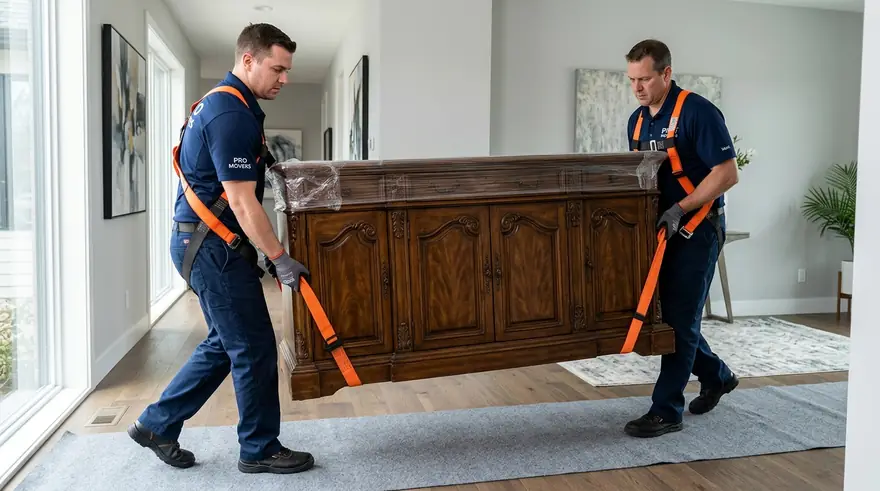
Stairs change every calculation of the move
With a lift a move is usually estimated by item count and truck size. Without one, the deciding factors are the floor, the number of steps, the width of the staircase and how it turns. A big wooden wardrobe may pass the flat door but not the stair turn, a heavy washing machine needs four hands to go up one floor, and a rigid-frame sofa may need tilting on its side at every landing. So we first ask about the floor and stair width before suggesting a crew size.
In Dammam mid-rise buildings with internal stairs are common in many districts, and many have narrow entrance corridors and banisters close to the wall. We therefore advise photographing the stairs and sending the pictures before the date, because one look can change the whole dismantling and preparation plan.
How heavy pieces are handled on stairs
Each piece has its own approach on stairs:
Fridge and washing machine
Emptied, internal parts secured and carried with lifting straps by several workers, taken up slowly with short rests.
Large wardrobes
Emptied, doors and drawers removed and wrapped; if the frame can be dismantled it is taken apart.
Sofas and sectionals
Units are separated, legs removed and pieces tilted at turns according to the stair measurements.
Beds and mattresses
Beds are dismantled and mattresses wrapped and carried flat, never folded sharply.
Marble and glass
Carried vertically by enough workers with edge protection, and the stairs are not used without a plan if too narrow.
Boxes and small items
Packed in medium boxes that are easy to carry on stairs instead of huge heavy boxes.
Floor, crew size and time: general indicators
There is no fixed figure, but this table shows the general direction:
| Floor | Effect on the move | What changes |
|---|---|---|
| Ground | Least effort | Depends on distance from door to truck |
| First and second | Moderate effort | Faster move but care at turns |
| Third and fourth | High effort | Larger crew, longer time and rests between floors |
| Fifth and above | Very high effort | Heavy pieces may be lifted differently depending on the case |
We decide after reviewing photos, and if anything special is needed we discuss it before the date.
Steps for a move in a building without a lift
This is the order we follow:
Collect details and photos
We ask about the floor, number of steps, stair width and turns, and request photos of the stairs, flat door and large pieces.
Make a dismantling plan
We decide what is dismantled to pass the stairs, what moves whole and whether extra wrapping is needed.
Set the crew size
The number depends on the heaviest pieces, not the number of rooms, because carrying a fridge up stairs takes more than two workers.
Protect the building
Floors, wall corners and banisters are covered where needed and obstacles are removed from the stairs.
Carry and unload
Pieces are carried in order with short rests and coordination at turns, and the truck is loaded in a suitable order.
Assemble and review
At the new place dismantled pieces are assembled and rooms are checked to confirm the pieces and walls are in good condition.
Measuring the stairs and turns before the day
Our first advice to anyone living without a lift is to measure three things: the stair width between wall and banister, ceiling height at the turns and the width of the flat door. Then compare that with the dimensions of the largest piece. In many cases it becomes clear that a piece will not pass without dismantling, so the wardrobe or sofa is taken apart before moving day instead of discovering the problem halfway up.
Photographing the stairs from below, from the turn and from the door helps us estimate remotely. If you have a rare or very heavy piece, mention it so we can plan specially.
- Measure stair width between wall and banister
- Measure the height at the turn
- Measure the flat door and room doors
- Photograph the stairs from several angles
Safety while carrying on stairs
Carrying on stairs is the riskiest part of a move for both workers and pieces. So we follow clear rules: no worker carries a heavy piece alone, pieces are lifted with coordination and voice signals between those above and below, the stair route is kept clear and lifting straps are used for heavy pieces and appliances. We also allow for wet or dusty floors that can be slippery.
It is important that nobody stands under a piece while it is carried and that children and elderly people stay away from the stairs during the move. Rest points are planned so workers on upper floors are not exhausted.
Protecting walls, floors and banisters
The building is part of the move, and your standing with neighbours and the landlord matters:
Wall corners
Covered with cardboard or foam at turns where big pieces rub.
Floors
Covers are laid on marble or ceramic floors to avoid scratches from feet and wheels.
Banisters and doors
Edges are protected and doors are opened fully and held so they do not close during carrying.
Building entrance
Kept clear of obstacles and cleaned when finished.
Bells and lights
We avoid touching them and protect wall-mounted fittings in the corridor.
What if a piece will not go up the stairs?
You may meet a large piece that cannot pass the stairs and cannot be dismantled, such as a solid cabinet or a very large marble item. In those cases the options are discussed honestly: can it be dismantled in a way that preserves it? Can it be lowered from the balcony or window if the building allows and suitable equipment is available under safe conditions? Or is replacement wiser? We do not risk the piece or the workers without a clear plan, and if no safe solution exists we tell you in advance.
That is why we stress sending photos and measurements early; a problem found a day before is much easier than one found on the stairs.
What is different about no-lift moves in Dammam buildings
Buildings in Dammam vary: some were built with wide stairs and good lighting, others have narrow stairs and close corridors. Some also have limited front parking, so the truck stands far from the entrance and the carrying distance grows. In summer the heat in closed stairwells with no ventilation increases, so we plan rest breaks and water for the crew.
See our page on moving to upper floors for upper floors with lifts, and our apartment moving page for general apartment steps.
Factors that affect the cost of a no-lift move
We do not publish fixed prices, but these factors shape the quote:
| Factor | How it matters |
|---|---|
| Floor number | The higher it is, the more effort and time |
| Number of heavy pieces | Fridge, washing machine and wardrobes need more hands |
| Stair width and turns | Narrow stairs increase carrying time and the need to dismantle |
| Dismantling and reassembly | Each dismantled piece needs time |
| Truck position | Distance from the entrance increases carrying |
| Protection materials | Covering walls and floors |
Ask for a quote with details, and see moving cost factors in Dammam.
Mistakes that repeat in no-lift moves
One of the most common mistakes is using too few workers to save cost, so two people carry what needs four, raising the risk of falls and scratches. Another is ignoring stair measurement, so carrying stops halfway. Others are packing heavy items in huge boxes that are hard to carry, or not protecting the walls, so the landlord asks for compensation.
All of this can be avoided with planning: photos and measurements, prior dismantling, enough workers, medium boxes and building protection.
- Do not cut crew size at the expense of safety
- Do not load huge heavy boxes onto stairs
- Do not neglect protecting walls and floors
- Do not leave measuring the stairs for moving day
What you can lighten before the move to make the stairs easier
Every kilo you reduce before the move is less effort on the stairs. Start by getting rid of what you do not need: old furniture you will not use, piled-up boxes and broken appliances. Then empty wardrobes, cabinets and drawers completely, since an empty wardrobe is far lighter and less likely to warp. If you have bookshelves, move books into small boxes; books are among the heaviest things to carry up stairs.
If you are moving to a home with a lift the next move is easier, but this one needs the lightening. Tell us what you will discard so we do not include it in the quote.
What to prepare before the crew arrives
Simple preparation speeds up the move:
Clear the stairs
Remove shoes, bicycles and any items from the stairs and corridor, and ask neighbours to do the same.
Tell the neighbours
Let them know the date and that the stairs will be busy with carrying for several hours.
Open the doors
Agree that the building door and flat door are open and the lights work.
Prepare boxes
Medium, light boxes rather than huge ones, marked with the room name.
Truck parking
Reserving a spot near the entrance shortens the carrying distance.
Frequently asked questions about moving without a lift in Dammam
Short answers:
Do you move from a fourth floor without a lift?
How many workers will I need?
Does the crew carry the fridge on the stairs?
What if the wardrobe will not pass the stairs?
Do you protect the stair walls?
Should I photograph the stairs?
Does a no-lift move take longer?
Do you move to other cities from a building without a lift?
Related moving pages in Dammam
Nearby services in the same city:
Movers in Dammam
The main service page
High-floor moving in Dammam
Upper floors and lifts
Apartment moving in Dammam
Flats and towers
Sofa & majlis moving in Dammam
Measuring and dismantling
Bedroom moving in Dammam
Disassembly and reassembly
Furniture assembly in Dammam
Reassembly after the move
Moving workers in Dammam
The crew and roles
Moving cost factors in Dammam
What shapes the quote
Send the floor, photos of the stairs and the large pieces
Tell us the floor at both places, whether either has a lift, photos of the stairs and flat door, and a list of large items and appliances.