Furniture Dismantling and Assembly in Dhahran: How Pieces Are Taken Apart, Numbered, and Rebuilt Precisely
Questions about furniture assembly in Dhahran usually come after a surprise: a wardrobe that will not fit through the door, or a bed that arrived with missing screws. Dismantling and assembly is not a side detail of a move. It separates furniture that is usable the same day from furniture that stays in pieces in a corner for weeks. This page explains what can and cannot be taken apart, how parts and screws are numbered, what bedrooms, kitchens, and offices need, the common mistakes, and how to check quality before the technician leaves.
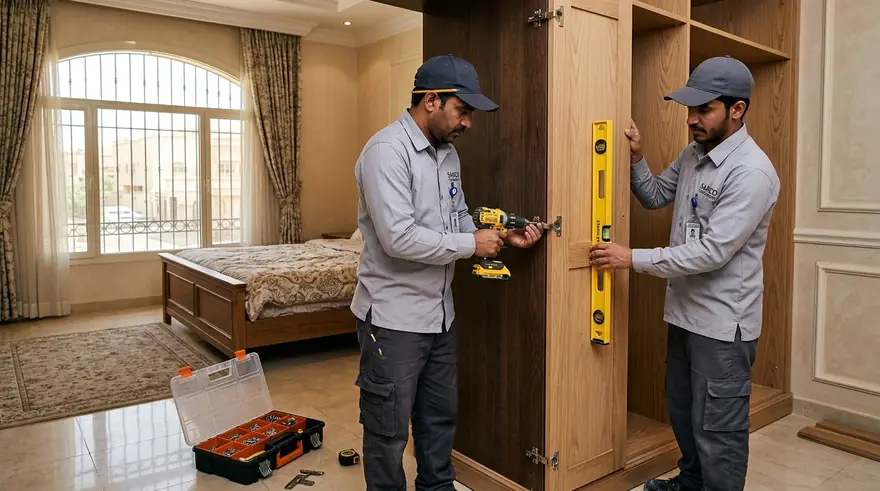
Good assembly starts with good dismantling
The difference between an experienced technician and a hurried worker shows at reassembly, not at dismantling. A good technician takes things apart while thinking about putting them back: photographing joints, numbering panels, placing screws in named bags for each piece, and keeping tools organised. The piece returns to its original shape with no gaps, no extra holes, and no reversed panels.
Assembly as part of a full move is covered in moving with assembly in Dhahran. Here we go deeper into the craft itself: furniture types, tools, problems, and quality standards.
Pieces that can be dismantled and pieces that should not be
Panel-built furniture is normally dismantled and rebuilt: beds, large wardrobes, desks, bookcases, dressing tables, and most children’s room furniture. Items that are glued, welded, or built solid from a single piece should not be taken apart, since dismantling weakens their structure. Some imported flat-pack furniture is designed to be assembled once, and repeated dismantling may weaken its joints.
So the technician assesses first: can the piece tolerate dismantling? Are screws and joints sound? Is there an alternative in carrying it whole after measuring doors? An honest answer is sometimes not to take it apart at all.
Furniture types and what dismantling involves
A rough guide that varies by maker and condition.
| Item | Usually taken apart | Main precaution |
|---|---|---|
| Wooden bed frame | Frame, headboard, and base | Keep long bolts and support slats |
| Large wardrobe | Doors, shelves, and sometimes the body | Avoid breaking edges and hinges |
| Fitted kitchen | Doors, shelves, and legs | Number each unit and its position |
| Desk and bookcase | Shelves, drawers, and legs | Secure and protect glass |
| Dressing table with mirror | Mirror and drawers | Remove the mirror and protect it with boards |
| Flat-pack furniture | Parts according to the manual | Avoid repeated dismantling |
If your piece is not listed, send photos and we will advise before touching it.
Technician tools that make a difference
Varied screwdrivers
Screw heads differ between makers, and the right tip avoids damage.
Spanner and hex keys
For bed joints, table legs, and kitchen units.
Drill and screws
To refix when original holes have worn out.
Tape measure and spirit level
To set shelves and wall units correctly.
Bags and labels
To separate screws and name panels and their positions.
Rubber mallet and protective pads
To fit panels without breaking edges.
How a bed or wardrobe is taken apart in order
A general sequence that varies by type.
Photograph and measure
The piece is photographed from several angles and its dimensions and joints are noted.
Empty it
Removable drawers, shelves, and contents are taken out.
Take apart
Doors come off first, then sides, then bases, in the reverse order of assembly.
Number and label
Each panel gets a number and screws go in a bag with the piece’s name.
Protect
Panels are wrapped and bundled together so nothing is lost and surfaces do not rub.
Hand over for loading
The dismantled parts are listed and checked again at unloading.
Dismantling and assembling bedrooms
A bedroom is among the most dismantled spaces because it holds a bed, wardrobe, dressing table, and side units, many of them large. It is best to rebuild the bed and wardrobe first in the new home so the room can be slept in the same day, and the other pieces follow. Mattresses go onto level bases to avoid sagging, and bed legs deserve a careful check because they suffer most from repeated dismantling. If a wardrobe has mirrors or glass doors, they are removed and wrapped separately.
Fitted kitchens and wall units
Taking down a kitchen demands more precision because units connect to floor, wall, and services. Units are numbered by position on a plan, water and electrical connections are disconnected by qualified people, and doors and shelves are removed and wrapped on their own. In the new home, check dimensions against the new space first, since units may not match the new kitchen layout, and it is better to propose changes before carrying than after. Marble and heavy worktops need special care and enough workers.
Office furniture and showrooms
Offices have meeting tables, chairs, filing cabinets, and partitions, many built as modules. Modules are numbered by department, electrical and network connections are photographed, and responsibility for disconnecting devices is assigned. To protect confidentiality, cabinets are emptied under your supervisor or locked and sealed. Rebuild the modules in the new office according to a layout plan prepared in advance, which saves days of work.
What is specific to Dhahran: buildings and working space
Many flats and compounds in Dhahran restrict noise and the hours of works. Dismantling and assembly make drill and mallet noise, so ask about permitted hours and avoid rest times. You usually need ample working space inside the home to lay out panels, so prepare an empty room or part of the lounge. Protect floors with pads or blankets so they are not marked by dragged panels and dropped tools.
How to check the quality of assembly
When the technician has finished, inspect the piece yourself: do doors close without rubbing? Do drawers slide easily? Is the bed firm and silent when you sit on it? Are shelves level? Are there spare or missing screws, or new scratches? Ask for corrections before the technician leaves and note what you agreed. It is best to open and close doors and drawers while the technician is still there.
Frequent problems and how they are solved
Worn screw holes are repaired with wooden plugs or slightly larger screws. Panels swollen by humidity may not return to shape and need replacement. Bent hinges are adjusted or replaced. Missing parts may be ordered from the maker or made as substitutes. The more organised the dismantling, the fewer of these problems arise, which is why we focus on numbering and screw bags.
What to prepare before the technician arrives
To let the technician start quickly, empty wardrobes and drawers, move small items into boxes, and clear space around pieces so the sides are reachable. If you have the original assembly manual or photos of the earlier assembly, hand them over; they save time and prevent errors. Mention any piece that has been dismantled before, since some furniture weakens with repeated dismantling and its joints need gentler handling.
Make sure lighting is good and that an electrical socket is nearby if a power drill will be used.
Protecting floors and walls while working
Working with large panels means dragging, dropped tools, and furniture feet, all of which threaten flooring. Blankets or cardboard are laid in the work area and nearby walls are padded to avoid scratches when panels lean on them. In apartments with marble or parquet floors an extra layer is advisable, since scratches there are hard to repair. Pieces are lifted slightly or placed on a trolley rather than dragged.
Fixing tall units to walls for child safety
Tall wardrobes and heavy bookcases can tip over if not fixed to the wall, a real hazard in homes with children. After assembly, fix them with suitable screws or wall brackets for the wall type, and check that upper shelves do not carry excessive loads. The technician may need to know the wall type, concrete, plasterboard, or block, in order to choose the right fixing. This is part of good assembly that nobody sees but that protects the household.
When pieces do not match the new space
You may find at assembly that a wardrobe is too tall for a lower ceiling or that a bed does not fit a narrower room. It is better to measure the new rooms before moving day and compare them with your furniture, deciding in advance what is installed and what is stored or sold. If a modification is unavoidable, such as cutting a panel or rearranging shelves, agree its limits with the technician beforehand, as some alterations cannot be undone.
Safety during dismantling and assembly
The technician needs gloves, protective eyewear when drilling, stable footwear, and an organised work area so screws and tools do not scatter on the floor. Heavy beds and wardrobes need at least two people to lift large panels, and no panel is left leaning against a wall unsecured. Where children live, sharp tools and screws are kept out of reach and collected before the technician leaves, and the area is cleared of sawdust and debris.
How long dismantling and assembly takes
Time depends on the number of pieces, their complexity, the technician’s skill, and how well the space is prepared. An ordinary bedroom may take part of a day, while a whole home with a kitchen and offices may need a day or more. We do not commit to fixed figures before seeing the pieces because an old or complex item can take twice as long. Send photos and we will estimate the time with you.
Simple care after reassembly
Tighten screws slightly a week after reassembly, because rebuilt furniture can loosen in the first weeks while joints settle. Check hinges and drawers, add a drop of light oil where needed, and do not load shelves beyond their capacity. A squeak in a bed usually comes from one loose bolt and takes a minute to fix. This small care extends the life of a piece after a move.
Common dismantling and assembly mistakes
Typical errors include leaving dismantling to an untrained worker, not photographing joints, mixing screws between pieces, using force that breaks panels, leaving doors open during carrying so they warp, and assembling a piece upside down because the top side was not marked. You avoid them by assigning the work to someone skilled and following a short checklist.
Summary
Dismantling and assembly is a skill, not just a number of screws. Choose someone who numbers, photographs, and keeps the screws, and leave dismantling to a person who knows when not to dismantle. Check quality before the technician leaves. To add it to a full move see moving with assembly, or request an estimate on the quote page with photos of your furniture.
Furniture assembly in Dhahran: common questions
Answers before you book.
Can all furniture be dismantled?
How do you make sure a piece returns as it was?
Does it include kitchen installation?
How long does a bedroom take?
Do I need special space?
What if a screw is lost?
Does dismantling make noise?
How do I request furniture assembly in Dhahran?
Related pages about assembly
More material to complete the picture.
Movers in Dhahran
The main city service page.
Moving with assembly in Dhahran
Assembly inside a full move.
Furniture packing in Dhahran
Protecting panels after dismantling.
Moving crew in Dhahran
Preparing your home for the crew.
Furniture assembly across the Eastern Province
The service across the region.
Request a quote
Describe your home and get an estimate.
Want your furniture dismantled and rebuilt with care?
Send photos of your pieces and we will assess what can be taken apart and suggest the technician and time needed.