Compound Moving in Dammam: Coordinating With Management and Moving Without Disruption
Living in a residential compound has real advantages, but it adds an administrative layer to moving: gates and security staff, a management office that may want advance notice, shared corridors and lifts, and sometimes fixed hours for trucks. This page explains how to coordinate with your compound's management, what to prepare, and how we organise moves in and out of residential compounds in Dammam with as little disruption as possible to you and your neighbours. Rules differ from one compound to another, so please check with your own management first.
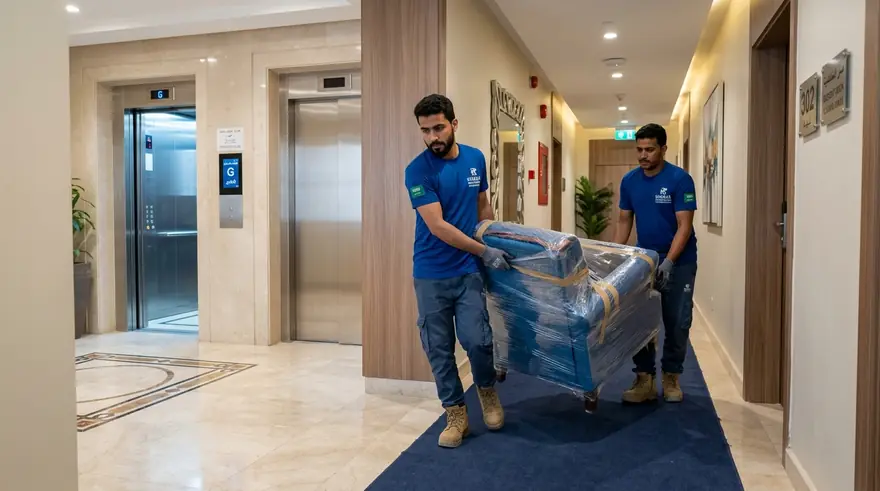
How moving from a compound differs from moving from a standalone home
In a standalone house you deal with the street and your neighbours directly. In a compound there is a third party: the management. It may ask for notice, restrict the days and hours, require a deposit, or want the lift reserved in advance.
The moving truck travels on shared internal roads, and workers pass through corridors everyone uses, so protecting floors and walls and keeping noise and mess down matters even more.
We do not know your compound's rules and we do not assume them, because they vary. Our part is to ask you about them and build the plan on what your management tells you.
What to ask management before choosing a date
Start by asking the management office or security desk: is a permit or advance notice required, which days and hours are allowed, is there a service lift for furniture, and where may the truck stand and for how long?
Ask also about any fee or refundable deposit, and whether workers must be registered or show identification at the gate. These questions take minutes but can prevent a stop at the gate on the day.
Once you have the answers, send them to us. We will build arrival time, crew size and loading order around them.
Unit types inside compounds and how the plan changes
A practical summary of common cases. The final crew is confirmed once we know your details and management's conditions.
| Unit type | Main planning concern | What we ask | What changes in execution |
|---|---|---|---|
| Villa inside a compound | Internal gate and truck position | Management approval and parking | Medium crew, detailed wrapping |
| Flat in a tower with lifts | Lift booking and hours | Lift size and usage rules | Crew sized to the load, tight schedule |
| Flat in a building without a lift | Stairs and distance | Number of floors and stair width | Extra workers, longer time |
| Ground-floor unit | Distance to the truck | Permitted standing place | Faster loading, smaller crew |
| Furnished unit | Moving personal items only | What belongs to you and what stays | Small vehicle, short job |
| Partial move between two units | Selecting specific pieces | Item list and sizes | Short time, coordination at both gates |
Compounds can look alike from outside, but the move itself depends on the unit type and management's rules, so we plan each case separately.
Practical points that recur in residential compounds
Things worth coordinating early so the truck is not held up at the gate.
Gate and security
The guard may ask for workers' names, vehicle details or management approval. Tell us what is needed before the date.
The furniture lift
If there is a service lift, book it. If not, confirm that using the ordinary lift is allowed and with what protection.
Truck parking
Agree on the nearest permitted place. Every extra metre adds effort and time.
Corridor protection
Covering floors, lift interiors and wall corners protects the building and spares you any claims.
Quiet and clean
Keep to permitted hours and clear packing waste as you go so nothing is left in shared areas.
Shared facilities
Do not use visitor parking or shared corridors to store items, and wait for management's approval before any exception.
The order of a compound move from coordination to handover
A general plan that we adapt to your compound's conditions.
Coordinate with management
Obtain approvals, permitted times and the lift booking, and send them to us.
Share the load details
Send the unit type, floor, number of rooms and photos of large pieces so we can suggest crew and vehicle.
Prepare the unit
Empty drawers and set aside papers and valuables you will carry yourself.
Arrival and registration
The crew arrives on time, registers at the gate if required, and covers the corridors and lift.
Wrapping and loading
We wrap and load in an order that protects heavy items and eases unloading, within the permitted period.
Unloading and handover
At the new unit we respect that compound's approvals too, then place furniture, reassemble what was taken apart and review with you.
Scheduling when the old and new compounds have different rules
It is common to move between two compounds with different rules. One may allow moves only in the morning, the other only in the afternoon. You then need a schedule that respects both without leaving the truck stranded in between.
We suggest speaking to both managements before fixing a date and then building the schedule on the shared window. If there is no shared window, the answer may be to split the move into two stages or change the day.
We advise against confirming a final date before both approvals are in place, since changing a date after crews and vehicles are booked is harder than waiting a day or two to book.
Protecting floors, lifts and walls
Covering the corridor floor and lift interior and padding wall corners and door frames prevents marks that could become claims from management or neighbours.
It helps to take photos of the lift, corridor and entrance before you start, as a record of their condition. If an accidental mark occurs, it is better to tell management at once than days later.
We ask workers not to lean on walls or carry furniture in a way that scrapes them, and to follow the carrying route management has set.
Appliances and air conditioners in shared buildings
A refrigerator and washing machine must be emptied and secured before moving, and in shared buildings no water should leak into the corridor. Make sure both are drained the day before.
Air conditioning may be governed by management or a specific maintenance company, so ask before removing or refitting units.
Our offer states what we handle and what needs a specialist, so that reconnecting appliances at the new unit is not delayed.
Example: a family moving from a compound villa to a tower flat in another compound
A family leaves a villa inside one compound for an upper-floor flat in another. At the villa we need management approval and a truck position; at the tower we need a lift booking and usage hours. So the plan splits in two: loading in the morning, unloading in the window the new building allows.
The family also sorts furniture beforehand because the flat is smaller, and leaves behind what will not fit. Sorting reduces the number of trips and the time needed.
This is an illustration of our thinking, not a record of a particular job, and the real plan is shaped by your details.
Mistakes that repeat in compound moves
The commonest is arriving with the truck without telling management, so it is stopped at the gate. Next is booking the lift for less time than needed, then not measuring the lift and doors of the new unit, then leaving packing waste in the corridor.
Another is assuming the old compound's rules apply to the new one. Ask each management separately and keep their approvals in writing.
A quick checklist before contacting us
Send the compound or district, unit type, floor, lift details, number of rooms, the largest pieces, appliances and any fragile items. Add what management told you: permitted hours, permit and lift booking.
Give your preferred date and how flexible it is. With this we propose a crew, vehicle and time, and the written offer states what is included and what could change on the day.
How we handle moving from residential compounds
We start from your details and your management's conditions rather than from a template, then suggest crew, vehicle and timing. We do not publish fixed prices here because cost varies with load, floor, access and the time window allowed inside the compound.
To understand what shapes the cost, read our Dammam moving prices guide and then send your details for a written offer. To begin, message us on WhatsApp or call 0566300558.
Small arrangements that make a long day easier
Have drinking water and a place to rest ready for the crew on a long move, mark important boxes clearly, and keep the keys to the old and new units with you. Tell neighbours if the move will occupy the lift or corridor for hours.
After loading, walk through the old unit once more: cupboards, balcony, storage and drawers. Small items are often left behind because they were never counted in the load.
Common questions about moving from residential compounds in Dammam
General answers; rules differ between compounds, so check with your management and send us what you learn.
Do you move furniture in and out of residential compounds?
Do I need a permit from management to move?
How do I book the lift?
What if the new compound allows moves at a different time?
Do you protect floors and lifts?
Can you move villas inside compounds?
Are there fixed prices?
What if management will not allow loading at my preferred time?
What should I send first?
Pages related to moving in Dammam
Services and guides that complete your planning.
Movers in Dammam
Main page for moving services in Dammam
Villa movers in Dammam
Details for moving villas
High-floor moving in Dammam
Stairs, lifts and upper floors
Moving inside Dammam
Planning a move between districts
Moving prices in Dammam
What shapes the cost of a move
Kitchen and appliance moving
Preparing fridges, washers and cookers
Packing system
How we wrap and protect furniture
Request a quote
Send your details for an offer
Coordinate your compound move with us
Send the unit type, floor, lift details, any rules your management gave you and photos of large furniture, and we will suggest a suitable time and crew.