Moving Marble Tables, Glass and Antiques in Dammam: How Heavy, Fragile Pieces Arrive Unbroken
There are pieces in a home where no mistake is allowed: a marble table that cannot easily be replaced, a large mirror in a gilded frame, a glass cabinet holding the guest sets, a family heirloom. These pieces combine two contradictions: very heavy and very fragile. Carrying them takes strength and protecting them takes gentleness. This page explains how such pieces are wrapped, carried and moved in Dammam in a way that cuts the risk of breakage, and what to ask any crew before handing over your valued pieces.
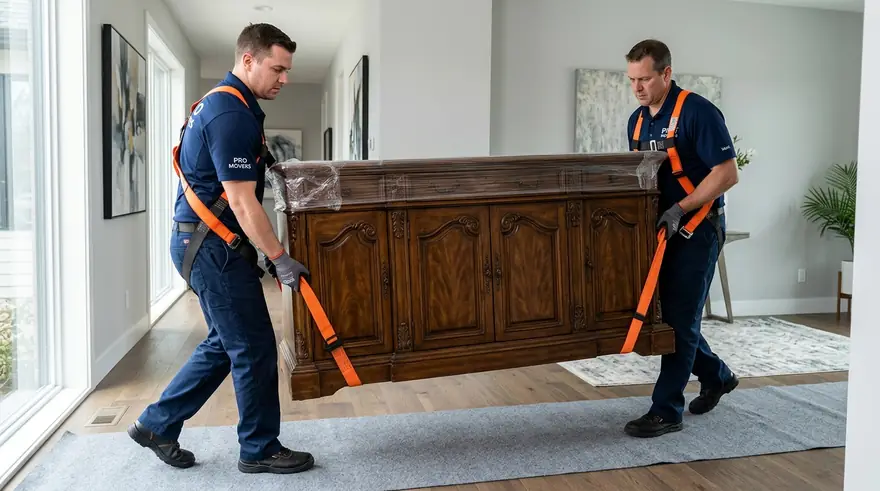
Marble and glass: visible strength and hidden weakness
Many people think marble is so hard it will not break, but the truth is that it is strong against pressure from above and weak against bending and side knocks. A marble tabletop cracks if it is carried from its middle or set down on a single point, and a corner can chip at the smallest knock. Glass looks obviously fragile, but what people do not see is that hairline flaws can turn into a full break under vibration.
So the commonest mistake is not too much force but carelessness: carrying a piece by its edge, leaning it on a wall with no padding, or laying it flat in the truck where it bears the weight of what is above. Understanding the nature of the material is the first step to protecting it.
How each piece is protected and moved
These are general guidelines, and the crew fixes the final method from the piece's size and condition.
| Piece | What threatens it most | Wrapping | Transport position |
|---|---|---|---|
| Marble tabletop | Bending and knocks on the edges | Separate from base, corner guards, foam or thick card and an outer cover | Upright on a padded edge and secured |
| Table base | Scratches and falling | Cover, bubble wrap and leg protection | By its shape, strapped |
| Large mirror | Breaking from vibration | Protective layers and rigid card with corner guards | Upright on its long side |
| Glass cabinet or sideboard | Glass breakage and frame cracking | Empty it, separate the glass if possible, wrap each part | Upright with doors secured |
| Paintings and frames | Surface scratches and frame distortion | Soft paper, bubble wrap and rigid card | Upright, not stacked flat |
| Antiques and fine ornaments | Chipped edges | Individual wrapping in paper and bubble wrap, padded boxes | In small boxes with gaps filled |
No single wrapping suits every piece, and the more valuable or older a piece is, the more careful an inspection it needs before loading.
How a marble table is wrapped in the right layers
This method is an example of the general principle: graded layers from soft to rigid.
Separate the top from the base
If possible the top is detached from the base and each moves separately, since carrying them together raises the risk of bending and falling.
A soft layer against the surface
Cover the top in soft paper, cloth or thin foam to prevent scratching, paying attention to polished edges.
Protect corners and edges
Corners break first, so they are fitted with guards of thick card or foam, secured without pressure that harms the edge.
Rigid boards on both faces
A thick card board or similar goes on both faces and is tied firmly to spread pressure and stop bending.
Outer cover and straps
Wrap the piece in a plastic or fabric cover then secure it with straps that do not press harmfully on the edges.
Label the piece clearly
Write the piece name, the word fragile and the upright direction so that everyone who handles it knows how to carry it.
Carrying rules never broken with heavy, fragile pieces
These rules protect the piece and the workers at once.
Carry from below and the sides
Marble and glass tops are not carried by the upper edge or the middle but supported from underneath and held at the sides by two or more workers in coordination.
Move on a single signal
The crew agrees on a signal to start and stop moving, so nobody moves before the others or lets go of their end.
A clear, checked route
The route is checked before lifting: doors open and held, floor dry, no obstacles and the turns calculated.
Avoid steep tilting
Tilting on the stairs or in a lift puts stress on the piece, so it is planned to happen within the narrowest possible range.
How fragile pieces are placed in the vehicle so they arrive sound
The arrangement inside the vehicle is an essential part of protection. Large flat pieces such as marble tops and mirrors travel upright on their long edge after the bottom edge is padded, leaning against the truck wall with a soft separator and strapped so they are held without pressure. Nothing is ever placed on top of them, and they are surrounded by soft furniture such as mattresses and pillows to absorb vibration.
Small fragile pieces travel in padded cartons fixed firmly in a place that does not move. Loads are distributed so heavy pieces stay low and near the front of the truck and do not shift under braking. Fragile pieces are best loaded last and unloaded first, so they are not exposed to the movement of other furniture.
When the route to your piece is a staircase or a narrow lift
Stairs and lifts are the two riskiest stages. On stairs a marble top tilts and the loads on the corners grow, which demands more workers, slow movement and coordination. A lift has limited dimensions and may take a large table only standing on its edge, or may not take it at all, sending it back to the stairs.
So it is wise to measure the piece and the route before moving day and send us the sizes and photos, so we can assess whether the piece will pass and how. If the piece is very large and cannot be taken apart, to confirm the special options available and their conditions for your request, contact us well before the day.
Why you photograph your pieces before the move and what you agree on
Valuable pieces deserve documentation before they are handed over. Photograph them from every side and show any old scratch or crack so the condition is recorded before loading. On delivery, review the piece with the crew before they leave and note any remark at once. This does not mean you expect damage; it means you know your rights and protect them.
Agree with the crew a clear procedure for what happens if damage occurs and how it is recorded and followed up. A written agreement in advance is better than improvising after a problem, and a serious crew welcomes it.
An example: moving a reception room with a marble table, a mirror and a glass cabinet
A family moves a reception room containing a large marble table with a metal base, a mirror in an ornate frame nearly as tall as the wall, and a glass cabinet full of guest sets. Planning starts by measuring the pieces and the route and photographing them, then agreeing to separate the top from the base, empty the cabinet and wrap each set separately in padded cartons.
On the day the top is wrapped in layers and carried upright with edge protection, the mirror and fragile items are loaded last and unloaded first, and the ornaments are unpacked in the new home after the cabinet is placed. All the pieces arrive sound because prior detail removed the surprises.
- Measure and photograph before agreeing
- Separate the top and empty the cabinet
- Wrap in layers and protect corners
- Load last and unload first
How to prepare your new home to receive a marble table or a heavy piece
Before the heavy pieces arrive, prepare the place where they will rest. Measure the door, the corridor and the turns the piece will pass to be sure it will go in, and decide its final place exactly so it is not moved twice. If the floor is marble or fragile ceramic, use a protective mat or rug along the carrying route to reduce the risk of scratching and breakage when the piece is set down.
Make sure the floor is level where the table will stand, because a marble table on an uneven floor bears uneven pressure that may crack it over time. If the spot has carpet or a wooden floor, protect it with felt pads under the base. Finally arrange for someone to direct the crew who knows the right place, so the job is done the first time without moving a heavy piece again.
- Measure doors and corridors before arrival
- Decide the exact final place
- Protective mat on the carrying route
- Check the floor is level under marble
How to look after marble and glass after the move
After arrival, inspect the piece carefully before setting it in place and make sure there are no new cracks or scratches. Set a marble table on a level, balanced base, since an uneven surface exposes it to stress and cracking over time. Clean marble with a gentle cleaner suited to its type and avoid strong acidic products that affect its shine.
For mirrors and glass, check the hanging or standing is firm after installation and avoid placing them near strong heat or humidity. If you notice a hairline crack, do not press on it; consult a repair specialist.
Mistakes that happen with fragile pieces and cost a lot
The commonest mistake is carrying a marble top by its upper edge or with one person. The second is moving it flat with something placed on it. The third is wrapping glass with a single thin cover. The fourth is skipping the separation of top from base. The fifth is leaving small ornaments without individual wrapping inside the same box so they rub against each other.
The sixth is not telling the crew about fragile pieces from the start, so nothing is prepared for them. Tell us in your first message about anything valuable, fragile or old.
How we handle heavy, fragile pieces
We are Al Bayt Al Hadith for furniture moving in the Eastern Province, moving homes, apartments, villas and offices with multi-layer packing, dismantling and reassembly and heavy furniture handling. We build the plan for fragile pieces on photos, measurements and the carrying method that suits each piece.
Call or message us on WhatsApp at 0566300558 and send photos of the pieces, their sizes and the floor, and we will explain the method and the lines in a written offer.
Common questions about moving marble, glass and antiques in Dammam
General answers to help you plan; send your details and we will confirm what applies.
Do you move marble tables?
Why is marble not carried from the middle?
How do you move big mirrors?
Can a glass cabinet be moved full?
What if a piece breaks?
Do you move antiques and fine ornaments?
What about very large pieces that will not fit?
Does cost rise with fragile pieces?
How do I request an offer?
Pages related to moving heavy and fragile pieces
Services and guides that complete the planning.
Movers in Dammam
Main page for moving services in Dammam
Heavy furniture moving
Handling large pieces
Furniture packing in Dammam
Multi-layer protection
Packing system
Multi-layer wrapping method
Protection guarantee
How we protect furniture
Villa movers in Dammam
Details of moving villas
High-floor moving in Dammam
Stairs and lifts
Request a quote
Send details and get an offer
Send photos and measurements of your fragile pieces
We will read the photos and sizes and suggest the right wrapping and carrying method, and the written offer will state what it includes and what may change.